
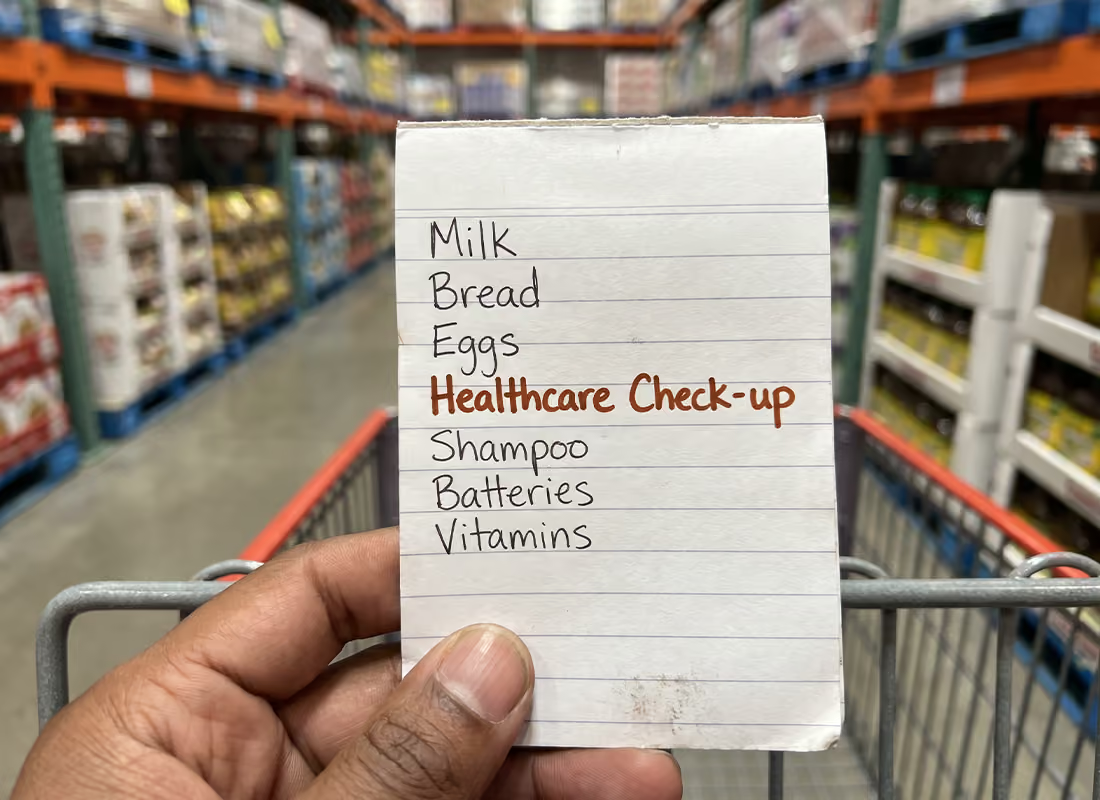
Retailers have spent decades competing on price, selection, and convenience. The ones pulling ahead now are competing on something entirely different: health.
Across America, the most successful retailers are no longer competing on price alone. They're competing on relevance—and nothing is more relevant to a customer's daily life than their health. The retail industry trends in 2026 show that convergence of healthcare and retail isn't a trend. It's a structural shift, and the retailers who understand it will own a loyalty advantage that no discount strategy can replicate.
Consumer behavior has already shifted. In 2022, 45% of consumers sought care at retail health clinics—up 18 percentage points from 2018 alone.1 And according to a J.D. Power survey, 83% say they're interested in receiving health and wellness services at their pharmacy.2
The retail foot traffic demand is there. The question is whether the infrastructure is.
For most retailers, the answer has been a patchwork—a pharmacy counter here, a blood pressure cuff station there, perhaps an optical center or a hearing aid kiosk in the back. These are valuable. But they are transactional. They don't connect. They don't close the loop. And they don't capture the full economic opportunity sitting right inside the store.
That's exactly where the OnMed CareStation™ changes the equation.
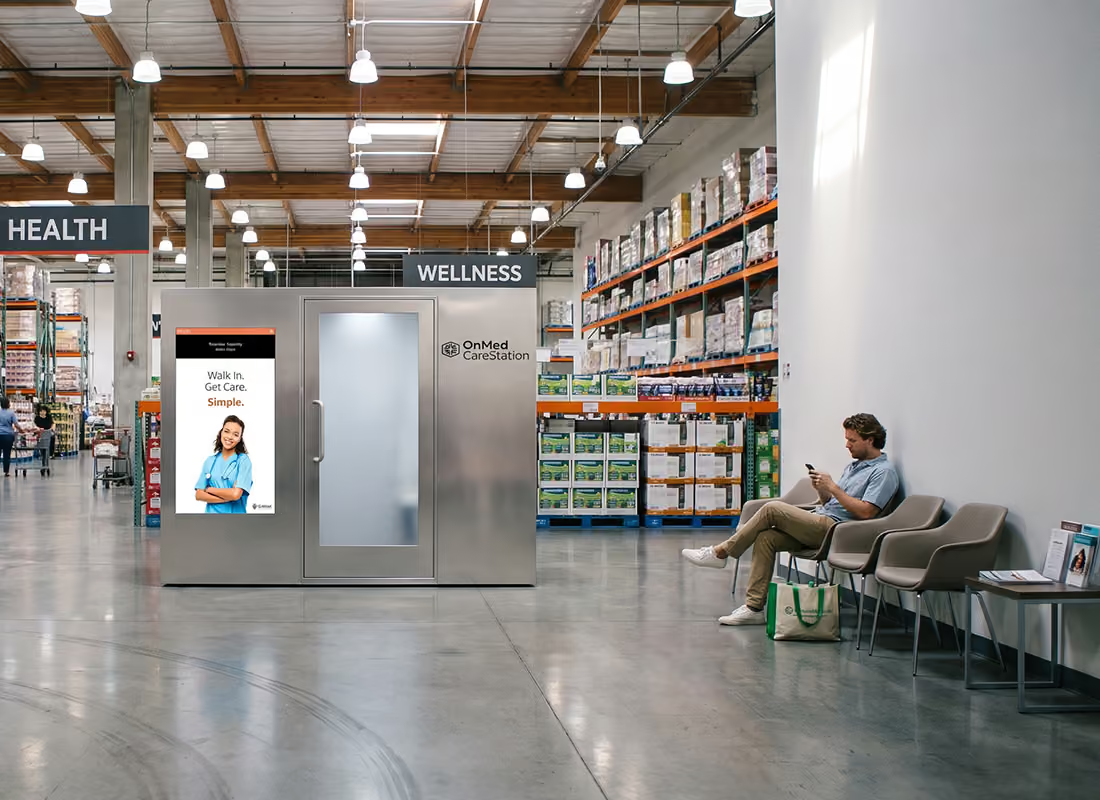
The CareStation is an 8×10-foot, clinic-grade "Clinic-in-a-Box"—bringing licensed clinicians and advanced diagnostic tools directly into retail stores. It transforms healthcare access into a seamless, in-store experience, where vitals, exams, consultation, and next steps are all completed in a single visit—no waiting rooms, no referrals, and no friction.
Purpose-built for retail, the CareStation requires no construction, no additional staffing, and only an electrical outlet, with deployment in as little as 45 days. Its compact footprint allows retailers to activate underutilized space and convert it into a high-value service destination that drives both traffic and engagement.
Within each visit, live clinicians, on a 55-inch screen, capture core vitals such as blood pressure, heart rate, temperature, oxygen levels, and weight, while leveraging integrated diagnostic tools to assess a wide range of conditions—from respiratory concerns to skin issues, eye and ear conditions, and minor acute needs. The result is a fully connected care experience that not only improves health access, but creates a natural pathway to relevant in-store products—linking clinical insights directly to retail spend.
In a world where nearly anything can be purchased online, physical retail must offer something fundamentally different: an experience worth showing up for. Industry leaders increasingly point to experiential retail as the key differentiator, transforming stores from transactional spaces into destinations that engage, educate, and serve customers in meaningful ways.
The CareStation plays directly into this evolution, turning healthcare access into a high-impact, in-store experience that cannot be replicated digitally. It gives customers a compelling reason to visit, extends dwell time, and reinforces the store's role as a hub for health and wellness—ultimately driving both foot traffic and deeper customer engagement.
The business case for bringing healthcare access into retail is not abstract. It shows up in three places: retail foot traffic, basket size, and return visits.
Research is consistent on one point: the longer a customer stays in your store, the more they spend. A landmark study by Pathintelligence found that a 1% increase in dwell time produces a 1.3% increase in sales.3 The Wall Street Journal has reported retailers can see sales increases of up to 40% from strategies designed to keep shoppers lingering longer, resulting in an increase in retail customer loyalty.4
A CareStation isn't a waiting room—it's a destination. When a customer comes in for a blood pressure check, a rash, or to address a nagging cough, they are already inside your store. They walk in with purpose and they leave with a shopping cart. That visit, without any prompting, creates a natural path through health and wellness aisles: supplements, OTC medications, nutrition products, healthy food, personal care.
The health and wellness category was already growing—up 6.4% in U.S. dollar sales year over year through Q1 2024.5 The fastest-growing segments include performance nutrition, gut health products, and probiotics. When a patient walks out of a CareStation with guidance on managing blood pressure, blood sugar, or weight, they don't leave empty-handed. They pass exactly the products that address their diagnosis.
That's not incidental. That's the playbook.
The CareStation's health encounter generates something no traditional retail health fixture can: a documented, guided health conversation. And that conversation is a direct lever for wellness product revenue—when the retail environment is designed to respond to it.
Consider a patient who presents with elevated blood pressure. The OnMed medical professional, practicing at the top of their license, conducts a full exam, reviews vitals, and recommends lifestyle modifications. That recommendation creates an immediate, relevant retail moment. Targeted signage, a companion wellness section, and staff-enabled handoffs can guide that patient directly to heart-healthy food options, sodium-conscious meal products, and blood pressure support supplements, all within the same visit.
The same logic applies across conditions. A patient flagged for pre-diabetes walks past low-glycemic foods with new context. A patient treated for a rash walks out with a recommended OTC cream and a clear path to the skincare aisle. A patient managing weight who may be on or considering GLP-1 therapy represents a proven incremental spend opportunity: research shows semaglutide users spend 36% more on groceries than the average consumer.6
This is the CareStation as a hub—not a standalone service, but the connective tissue of a wellness ecosystem already living inside your store and the retail store experience. Pharmacy. Optical. Hearing. Nutrition. The CareStation doesn't compete with any of these. It amplifies all of them.
Customer loyalty in retail is increasingly driven by trust. And nothing builds trust faster than health.
The retailer that helps a customer manage their hypertension, catch a UTI early, or understand their cholesterol numbers is no longer just a store. It becomes a health partner. That relationship is stickier than any loyalty points program, and it brings customers back on a cadence no promotional calendar can manufacture.
Consider: 37% of OnMed CareStation users are repeat visitors. 78% say the CareStation is their medical home. These are not passive shoppers. They are engaged, returning, health-motivated customers—precisely the demographic that over-indexes on wellness product spending.
Retailers offering health services also attract a higher-income patron mix. Research consistently shows that health-conscious consumers have higher average household incomes and higher basket values.7 When your store becomes a health destination, you don't just serve your existing customers better—you attract new ones.
Gen Z is already a major force in retail, with rapidly growing spending power and a strong preference for brands that support holistic well-being, convenience, and digital-first access to services. As highlighted by NielsenIQ, this generation prioritizes health, personalization, and immediacy—expectations that traditional retail formats often struggle to meet.
The CareStation is purpose-built for this shift, delivering on-demand, tech-enabled, human-delivered care in a format that aligns with how Gen Z wants to engage: seamlessly, efficiently, and on their terms. By integrating healthcare access directly into the store environment, retailers can meet this high-value demographic where they are—and build early loyalty with consumers whose lifetime value is only just beginning.

For retailers with membership models, on-site healthcare access isn't just a service—it's a strategic asset that redefines the value of belonging.
Membership retail has always been built on a simple promise: pay to join, get more in return. But as the membership landscape grows more competitive, the question every retailer faces is what "more" actually means. Discounts, free shipping, and cash-back have become table stakes. Health is the next frontier.
A CareStation integrated into a membership model creates immediate, tangible value that members feel on every visit. Access to on-site care, for themselves and their families, is a benefit that transcends category. It's not seasonal. It's not a coupon. It's something members use when they need it most, and it builds the kind of emotional connection to a brand that no pricing strategy can replicate.
The implications for membership participation are significant. When health access is part of the value proposition, the calculus for a prospective member changes. It's no longer a question of whether they shop frequently enough to justify the fee—it's a question of whether they can afford not to have it. That's a fundamentally different conversation, and it drives enrollment.
For retailers with tiered membership structures, the CareStation opens a compelling pathway to premium tier differentiation. Unlimited no-cost healthcare visits could anchor a higher-tier offering—giving members a concrete, health-centered reason to upgrade. The retailers who crack this model won't just grow membership revenue. They'll build a subscriber base that is healthier, more engaged, and deeply loyal to the brand that took care of them.
The membership model has always been about perceived value. On-site healthcare access may be the highest-perceived-value benefit a retailer has ever been able to offer.
The opportunity inside a retail environment isn't only about the patron walking in the front door. It's also about the thousands of employees who report to work every day.
Retail employs some of the largest hourly workforces in the country, and those workforces carry healthcare costs that are rising faster than any other line item. According to KFF, the average employer-sponsored family health insurance premium in 2025 reached $26,993 annually.8 That's up 6% year over year, and employers are absorbing the majority of it. According to Mercer's National Survey of Employer-Sponsored Health Plans, 2025 marks the third consecutive year of health benefit cost increases above 5%.9
For large retail employers, the math is brutal. A workforce of 5,000 employees with family coverage represents over $135 million in annual premium exposure—before accounting for the cost of lost productivity.
And that cost is significant. When absenteeism and presenteeism are combined, the productivity cost to U.S. employers exceeds $575 billion annually.10 The Bureau of Labor Statistics recorded a national absence rate of 3.2% in 2024, and unplanned absences alone drive an average 36% loss in productivity.11
Retail is a shift-based industry. A single unplanned absence cascades into overtime, into rescheduling, into service gaps, into customer experience failures. The cost is not just dollars. It's operational stability.
A CareStation deployed on or adjacent to a retail location gives employees something most of them don't have: a medical home. 78% of OnMed users have no primary care physician. That means they defer care until conditions worsen, and then they call out sick. On-site access changes the trajectory. Minor issues get addressed immediately. Chronic conditions get monitored before they become crises. The employee who might have missed three days for an untreated infection gets seen on their lunch break and stays on the floor.
For self-insured retail employers, the value compounds further. When employees use the CareStation, 86% are fully diagnosed and addressed without a specialist referral. 58% of cases that might have otherwise landed in an emergency room are diverted. Lower-acuity, earlier-intervention care is materially cheaper than the alternative—and for a self-insured plan, that savings flows directly back to the employer.
This is a healthcare benefit for your retail employees that doesn't require a benefits negotiation. It deploys in 45 days. It operates wherever there's an electrical outlet. And it delivers value to both the business and the workforce from day one.
The CareStation is 8 feet by 10 feet clinic-in-a-box. It fits in a footprint smaller than most store displays. But what it does to the asset value of a retail location is outsized.
Retail real estate is navigating significant headwinds. The brands that are winning are the ones converting square footage into services and experiences that cannot be replicated online. A tech-enabled, AI-powered, always human-delivered CareStation is exactly that. It is a reason to come in. A reason to stay. And a reason to return.
The global wellness market is projected to reach $7 trillion.12 The U.S. retail wellness industry is already valued at $450 billion.13 The retailers who position themselves as the physical access point to that market—not just a shelf for products, but a destination for health—will capture a loyalty dividend that compounds over years.
The convergence has arrived. The only question is whether your store is ready to lead it.
OnMed is showing up. Don't miss this opportunity.
The OnMed CareStation™ is a patented, hybrid-care model—tech-enabled, AI-powered, and always human-delivered—deployable in 45 days, with no construction required. To learn how OnMed is partnering with retail environments to build the healthcare ecosystems of tomorrow, contact us today.
What is the next major competitive advantage in retail for 2026?
The retailers pulling ahead in 2026 are competing on health. Consumer behavior has already shifted—45% of consumers sought care at retail health clinics in 2022, up 18 percentage points from 2018. And according to J.D. Power, 83% of pharmacy customers say they are interested in receiving health and wellness services at their pharmacy. The convergence of healthcare and retail signals a structural shift, and the retailers who position themselves as the physical front door to health will build a loyalty advantage that no discount strategy can replicate.
How does on-site healthcare access affect retail foot traffic and sales?
The business case is direct and measurable. Research by Pathintelligence found that a 1% increase in dwell time produces a 1.3% increase in sales. A patient who comes in for a blood pressure check, a rash, or an urgent care need is already inside the store. They arrive for a health visit and can leave with a full shopping cart based on their visit summary, or because they found something along the way to their clinic-in-a-box appointment.
How does a store-within-a-store healthcare model build customer loyalty?
Customer loyalty in retail is increasingly driven by trust, and nothing builds trust faster than health. The retailer that helps a customer manage their health becomes a health partner—and that relationship is stickier than any loyalty points program. The data supports it: 37% of OnMed CareStation users are repeat visitors, and 78% say the CareStation is their medical home. These are engaged, returning, health-motivated customers who over-index on wellness product spending and bring a higher average household income than the general shopper population.
Follow along as we continue to redefine the healthcare landscape and bring the OnMed CareStation to communities across the U.S.

.avif)