
Resident assistant (RA) training, delivered in a multi-day pre-semester block, covers community-building, policy enforcement, conflict resolution, and, per ACUHO-I's own standard curriculum, strategies for responding to emergency situations. That's a deliberate scope: RA training teaches recognition and protocol—assess the situation, call for help, follow the chain of notification—not diagnosis or treatment. What it does not cover, because it isn't reasonable to expect it to, is clinical judgment: whether a student's chest pain is anxiety or something more serious.
The role has been expanding for decades faster than that training scope has. In ACUHO-I's own Campus Housing Index survey data, most of the nearly 200 responding institutions agreed the RA role has accumulated too many responsibilities over time and needs to be restructured—not simply retrained. Institutions are increasingly treating access to real clinical backup, not additional training modules, as the more durable fix.
On-site, licensed clinical access removes the judgment call from the RA's hands entirely: instead of guessing whether a symptom needs an ambulance, a health center that's closed for the night, or nothing at all, an RA can connect a student directly to the OnMed CareStation® and a real clinician makes that call.
Institutions are increasingly finding that giving RAs access to real clinical backup addresses the underlying gap more directly than adding training modules that still leave an untrained student making the final judgment call. Standard RA training covers conflict resolution, policy enforcement, and often basic first aid or CPR, but it is not designed to prepare a student staff member to judge the severity of a medical or mental health symptom.
It usually falls to the Executive Director of Housing and Residential Communities, who holds budget authority over housing operations and staffing but not always over the campus health center itself. RAs report to a Residence Hall Director or Area Coordinator, but the Executive Director of Housing and Residential Communities ultimately owns the liability and staffing strategy when an after-hours incident occurs. When an RHD or RA without clinical training has to judge whether a symptom is an emergency, institutional liability, staff burnout, and parent communication land on the housing department.
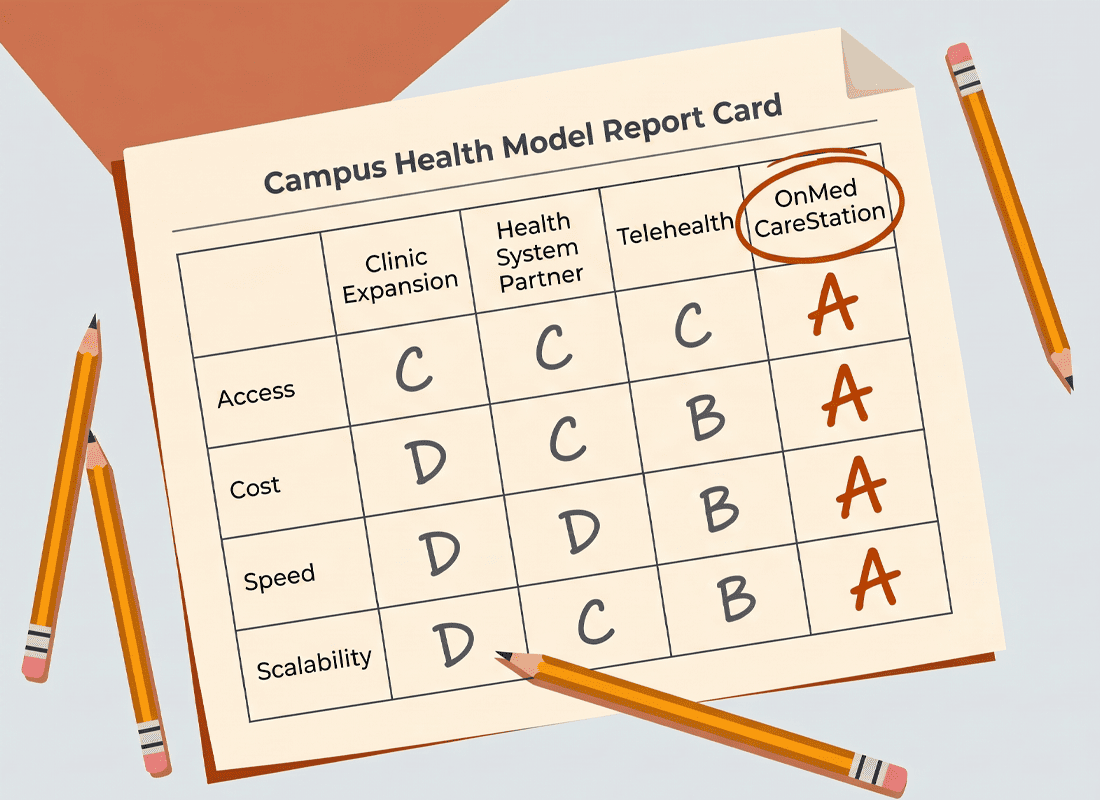
Every term here points to the same gap in healthcare access. See how the CareStation closes it.
Talk to Our Team