
.png)
Marcus runs a shift of 40 people at a distribution center outside Columbus. Last quarter, Brian, one of his best forklift operators, worked through three days of worsening back pain rather than taking time off to see a doctor, because the nearest urgent care was 25 minutes away, and the earliest opening was Thursday. On day four, he couldn't stand up straight. What started as a muscle strain that a same-day visit could have caught became a workers' comp claim, a missed week of work, and a gap on the line that took two weeks to backfill.
Nothing about that decision was careless. Brian did exactly what most employees do when getting care costs more time than the problem seems worth. The plan didn't fail him. Access to a doctor, in the abstract, exists. What didn't exist was a way to find out early, inexpensively, and without disrupting his shift, whether the pain was something to worry about.
This is the trap most employer healthcare strategies are stuck in: they keep buying more benefits, while the thing that actually drives cost is whether care gets resolved before it escalates. Employer healthcare premiums are projected to rise roughly 9% again in 2026, on top of years of similar increases, and most of that growth isn't happening because employees have too little insurance. It's happening because conditions that could have been caught early aren't being caught early—they're surfacing later, in more expensive settings, as bigger claims.
The clearest place to see this is the emergency department. Estimates of exactly what share of ED visits are truly avoidable vary widely depending on methodology, but the dollar impact doesn't: the U.S. spends roughly $168 billion a year on emergency department visits that didn't need to happen in the ED at all, and care delivered there costs roughly 12 times more than the same condition treated in an alternative setting. Every one of those visits started the same way Brian's back pain did—as something that felt manageable to wait out, until it wasn't.
Absenteeism tells the same story from a different angle. Health-related absenteeism and presenteeism cost U.S. employers $575 billion annually. That number isn't driven primarily by catastrophic illness. It's driven by the accumulation of ordinary, treatable conditions—a lingering cough, an infection, unmanaged blood pressure—that go unaddressed long enough to turn into missed shifts, and then into claims. Telehealth was supposed to close this gap, and for scheduling friction, it has. But a screen still can't listen to lungs, examine a wound, or look into an ear or throat. It can triage. It can't resolve.
So the visit that started as a video call frequently ends the same place it would have anyway: a referral out, another appointment, another day away from the line.

Workers' comp exposure compounds the same underlying problem for physically demanding workforces. The average combined cost of a workers' compensation claim is now north of $47,000, and that figure climbs sharply for anything involving a vehicle, a fall, or a burn. Earlier triage doesn't eliminate injury risk—but it changes how many minor issues turn into claims at all, and how fast the ones that do get reported and treated.
This is the specific gap the OnMed CareStation® is built to close—not by adding another point of access, but by resolving more of what walks through the door. A CareStation visit takes about 20 minutes and pairs a real, licensed clinician with integrated diagnostic tools—HD exam cameras, a digital stethoscope, vital sign capture—the equipment a screen-only visit simply doesn't have. It sits inside the workplace, so getting checked doesn't cost someone the calculation Brian made: is this worth leaving his shift to find out.
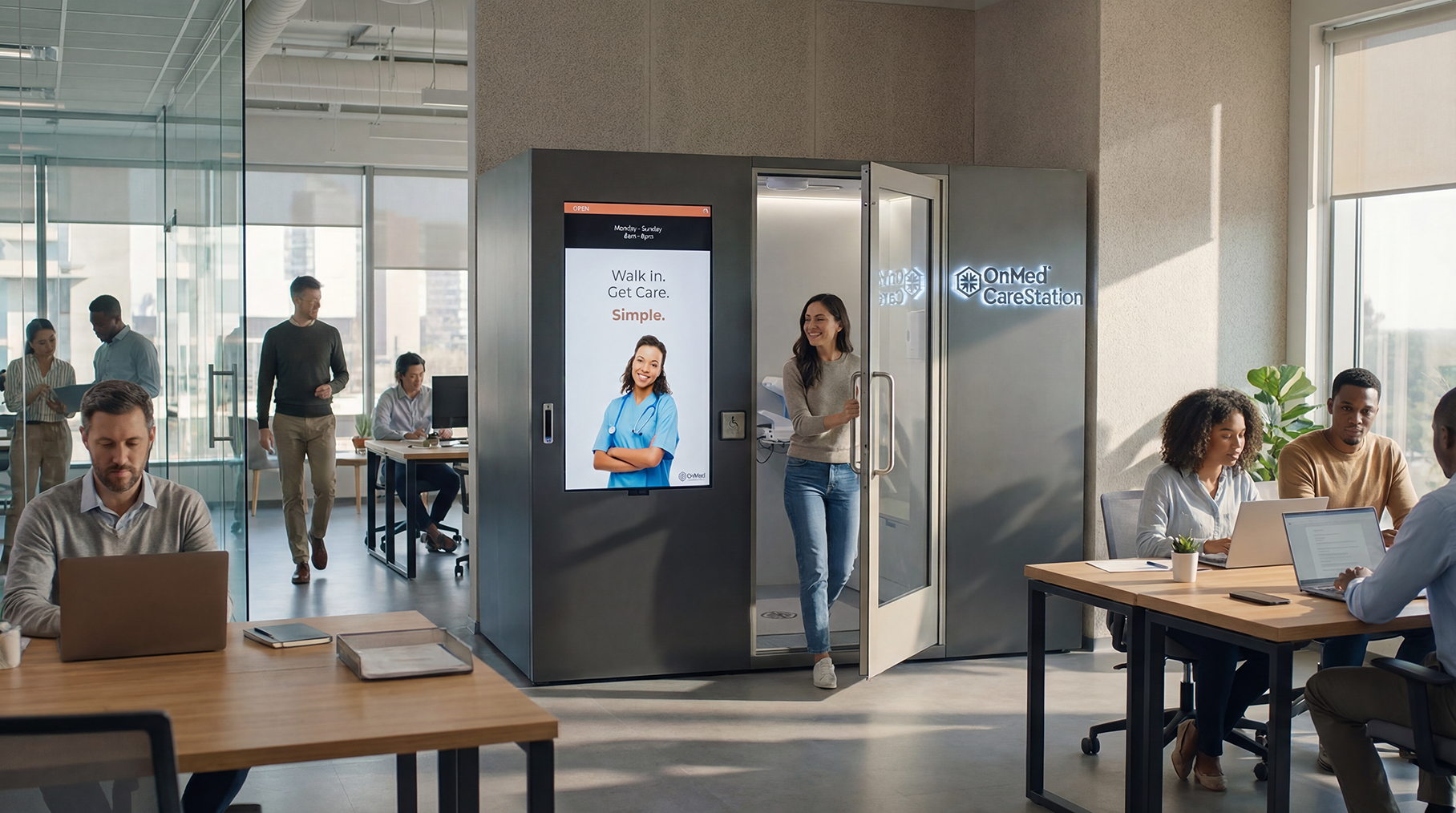
The results track the thesis. Across CareStation deployments, 86% of visits are resolved on-site without a referral out. 58% of users say they would otherwise have gone to the emergency department or urgent care for the same issue—meaning the diversion is happening at exactly the point where cost would otherwise escalate. Employer deployments see a 42% chronic condition presentation rate, frequently catching conditions before they turn into six-figure claims rather than after. Employers see an average of $1,400 in annual savings per CareStation user, and patient satisfaction across deployments runs 4.96 out of 5—none of which required building a clinic or hiring new staff.
None of this asks an employer to abandon their existing plan design or rebuild their benefits strategy from scratch. It asks a narrower, more answerable question: for the conditions that are currently escalating into claims, absenteeism, and comp cases, how much sooner could they have been caught—and what would that be worth? On-site, human-delivered care with real diagnostic tools is built to be operational in about 45 days, without construction or added headcount.
For a full breakdown of what counts as healthcare cost containment and how employers measure it, see our glossary definition.
Talk to our team to see how the CareStation can help you reduce claims, restore productivity, and improve employee experience—alongside the benefits plan you already have.
Follow along as we continue to redefine the healthcare landscape and bring the OnMed CareStation to communities across the U.S.

.png)