
.jpg)
Access to care remains one of the most persistent challenges in healthcare today—but the real issue extends beyond affordability. Across individuals, employers, and communities, delayed or deferred care is fueling a cycle of rising costs, avoidable utilization, and worsening health outcomes. What appears to be a short-term cost-saving decision often becomes a long-term financial and operational burden.
In the article below, originally published on LinkedIn, OnMed COO Ashley Christy explores the true cost of inaction in healthcare and the systemic impact of gaps in care access and care delivery. Drawing on data and frontline experience, she highlights how missed appointments, skipped medications, and delayed preventive care contribute to increased emergency utilization, unmanaged chronic conditions, and avoidable healthcare spend.
For leaders in employer-sponsored healthcare, population health, digital health, and hybrid care delivery models, this perspective reframes a critical decision point. The question is no longer just what care costs today—it’s what it costs when care is inaccessible, underutilized, or postponed. From workforce productivity and absenteeism to community-wide health outcomes, the ripple effects are significant and measurable.
This piece challenges organizations to rethink how they evaluate healthcare investment, access strategy, and care models—shifting from reactive cost management to proactive healthcare solutions. Because in healthcare, inaction isn’t neutral. It’s a decision that compounds, often at the highest cost.
Read the original article below:
There's a debate most of us have more often than we realize: do we pay for healthcare, or do we skip it?
A copay shows up. A premium increases. A deductible resets. And almost instantly, the mental math begins—is it worth it? We weigh the dollar amount in front of us against the vague, uncertain cost of whatever might happen if we don't act. More often than not, we convince ourselves to skip the appointment, delay the prescription, tell ourselves we feel fine enough. We can live with it.
Until we can't.
A recent KFF poll found that 36% of adults skipped or postponed needed healthcare in the past 12 months. Nearly half—43%—haven't taken medication as prescribed because of cost. These are not outliers. This is the norm. People are making impossible tradeoffs every day: do I go to the doctor, or do I keep the lights on?
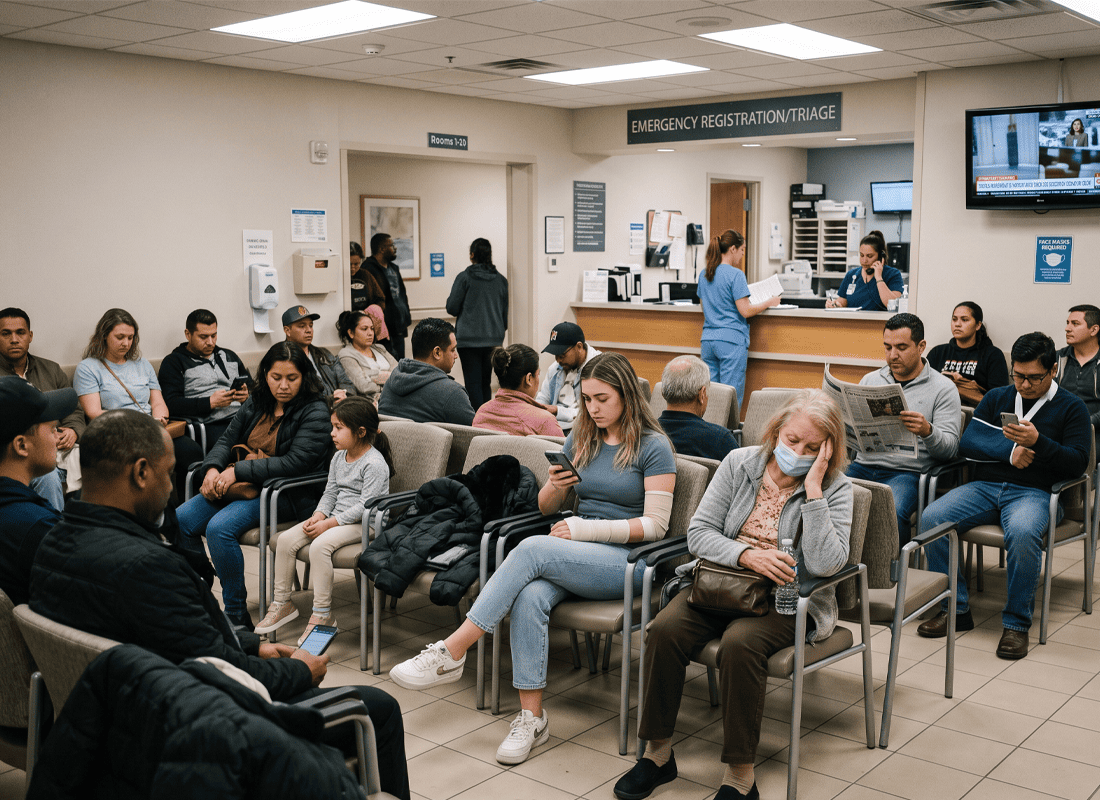
But what makes this problem even larger is that it doesn't stop at the individual. Organizations—schools, towns, employer groups - are making the same kinds of calculations. And they're rarely accounting for what those decisions cost the communities around them. When people can't access care, that burden doesn't disappear. It shifts. More pressure on already strained infrastructure: lost productivity, overwhelmed ERs, paramedics and fire departments absorbing what primary care should have caught, and provider burnout accelerating across the board.
The CDC reports that 90% of the nation's $4.9 trillion in annual healthcare expenditures go toward people with chronic and mental health conditions. Nine out of every ten dollars—spent on conditions that, in many cases, could have been caught earlier, managed better, or prevented altogether. At the community level, counties lose an average of $230 million per year to inaction alone, spanning avoidable ER visits, unmanaged chronic disease, lost productivity, and the slow erosion of shared resources. Factor in lower academic achievement, reduced workforce participation, and diminished economic output, and the picture gets harder to ignore.
This isn't an affordability problem dressed up as a healthcare problem. It's a decision problem. And the decisions we keep making are extraordinarily expensive.
So how do we change this?
The first shift has to be in how we frame the decision.
For too long, healthcare has been treated as a line item—something to manage, reduce, or defer when budgets get tight. But that framing is costing us more than we're saving. Every deferred appointment, every skipped prescription, every person who waits until a condition becomes a crisis represents downstream costs that far exceed the original bill. We're not saving money. We're borrowing against the future.
The better question isn't what does this cost today? It's what does it cost us if we don't act?
That reframe matters at every level. For individuals, it means recognizing that avoiding care is itself a financial decision—and often a more expensive one. For employers, it means looking beyond premium spend and factoring in absenteeism, presenteeism, and the quiet drag of a workforce that isn't well. For schools, it means connecting the dots between student and staff health and what shows up in the classroom. For municipalities and health systems, it means not just what is being spent, but what is being lost in productivity, in emergency systems pushed past their limits, and in the long-term health of the communities they serve.
None of this means cost doesn't matter. It does. But when we only look at what something costs to fund, we make ourselves blind to what it costs to ignore. Shifting from budget management to impact accounting isn't just a smarter financial strategy—it's the only honest way to look at this problem.
What would change in your organization if the cost of inaction was on the same slide as the cost of the program?
To learn more about an alternative healthcare access solution, visit our OnMed CareStation™ page.
Follow along as we continue to redefine the healthcare landscape and bring the OnMed CareStation to communities across the U.S.

.png)