Healthcare has an access problem.
Not a technology problem. Not a knowledge problem. An access problem—made worse by a shortage of more than 200,000 physicians nationwide.
The treatments exist. The expertise exists. What often doesn't exist is a practical way to connect people to that care when and where they need it.
For decades, healthcare has been built around a simple assumption: patients will come to it. They'll schedule the appointment, travel to the clinic, navigate the wait, and fit care into already busy lives.
But that's not how people live anymore.
Healthcare can't scale through hospitals alone. It can't scale through clinics alone. And it can't scale through technology alone.
It scales through partnerships.
That's why partnerships aren't an extension of our strategy at OnMed. They are the strategy.
This isn't about replacing traditional clinics or telehealth—it's about filling the gap between them. Many communities lack reliable broadband for video visits, while virtual care alone can't provide diagnostics or vitals monitoring, and traditional facilities face scalability limits and workforce constraints of their own.
We're building the missing platform that allows healthcare access at scale.
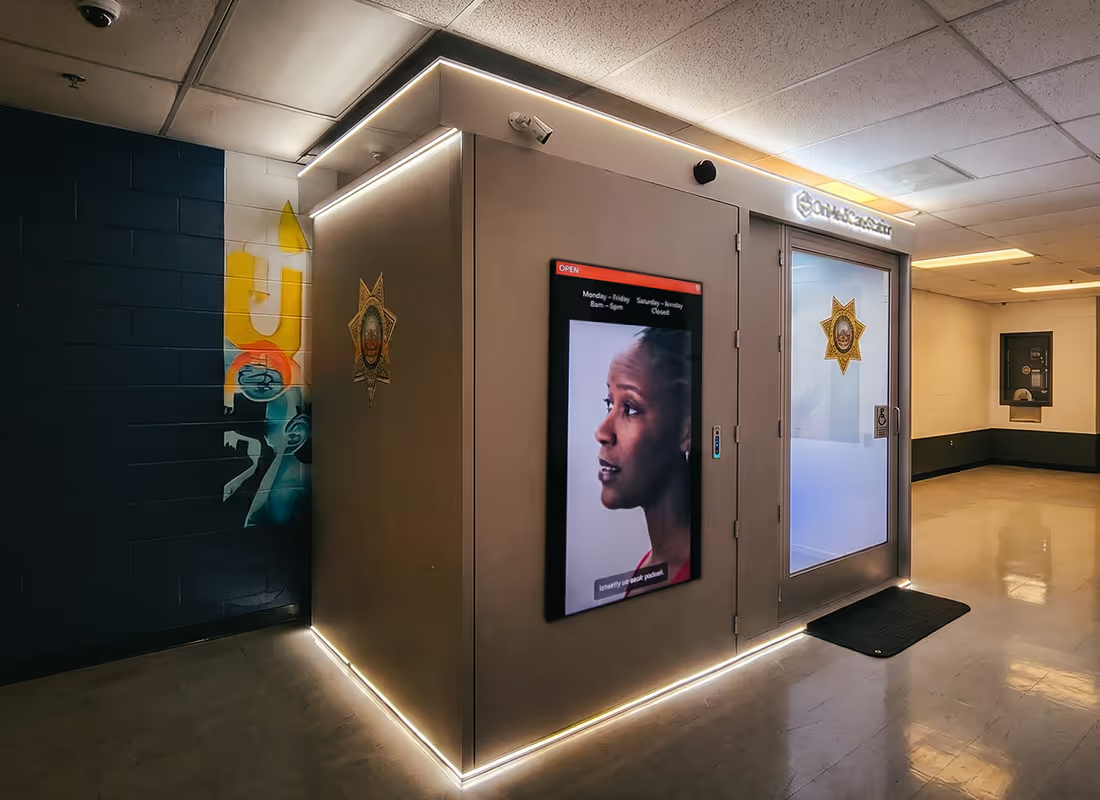
Meet the OnMed CareStation®: the perfect blend of traditional "brick and mortar" and virtual care, in a patented, 8×10-foot "Clinic-in-a-Box" that places that platform directly inside the environments where people already work, learn, shop, and live. It's tech-enabled, AI-powered, and human-delivered, blending the comprehensiveness of traditional in-person care with the rapid scalability of telemedicine—and it's why 86% of CareStation visits resolve on-site, without a referral or a second trip.
Each CareStation is a local access point within a scalable, connected grid—which is why every partnership below starts the same way: put that platform exactly where people already are.
Health is shaped long before someone walks into a clinic.
It shows up in the workplace when an employee postpones care because they can't afford to lose half a day. It shows up in schools when a student misses class because a minor illness goes untreated. It shows up in rural communities where the nearest provider may be hours away. It shows up in hospitals when patients seek emergency care for conditions that could have been addressed earlier.
Solving that requires more than any single healthcare organization. It requires partners who can put a CareStation directly inside the environments where people already live, work, learn, and gather—and bring that same blend of depth and reach to those environments.
OnMed's on-site care gives employers the healthcare access their workforce actually needs.
For many adults, work is the single most consistent environment in their lives. It's also where healthcare access often becomes most difficult—and the cost shows up on the balance sheet: employer healthcare costs have risen 50% over the last decade, and health-related absenteeism drains $575B from U.S. employers annually.
A routine doctor's appointment can mean hours away from work, transportation challenges, lost productivity, and missed wages. People delay care until a manageable issue becomes a costly one.
Employer partners place the CareStation where their workforce already is—on a warehouse floor in a logistics hub, on an automotive assembly line, inside a food & beverage production facility, or across a distributed multi-site footprint and centralized corporate campus. Wherever hourly employees can't easily step away for care, the CareStation meets them at work instead. The result: earlier intervention, fewer avoidable claims, an average of $1,400 in savings per user, and more than two hours of productivity returned per visit.
"The City of Atlanta is committed to supporting the health, wellness, and overall quality of life of our employees. Our partnership with OnMed represents an innovative step forward in providing convenient, accessible healthcare solutions for our workforce. By bringing healthcare access directly to employees, we're helping to remove barriers to care and ensuring our team members have the resources they need to stay healthy, informed, and supported."
— Calvin Blackburn III, Department of Human Resources Commissioner, City of Atlanta
In retail environments, the CareStation does double duty—supporting both the workforce behind the counter and the shopper in front of it. 45% of consumers already sought care at a retail health clinic in 2022, up 18 points since 2018, and 83% say they want health and wellness services where they already shop. For retailers, that demand shows up on the register too: every 1% increase in in-store dwell time drives a 1.3% increase in sales, and CareStation visitors return at a 37% rate.
This isn't a wellness perk. It's a cost-reduction strategy that happens to make care easier to reach—for the employee behind the counter and the customer in front of it.
Learn more about Employers →
OnMed expands your catchment area, reduces uncompensated care, and keeps the patient journey inside your network.
Health systems compete for catchment area every day. Patients who can't get timely access go somewhere else—or nowhere at all, showing up later with a condition that's harder and more expensive to treat. 63% of ED clinicians report burnout at the highest levels ever recorded. Outside their organizations, uninsured patients are 2-3x more likely to turn to the ED for primary care, contributing to $50B spent annually on uncompensated care industry-wide.
We partner with providers because the goal isn't fewer visits—it's capturing more of the patient journey inside your own network. By extending the CareStation into the community, health systems expand their catchment area into places they couldn't otherwise reach, meet patients earlier, and route them back into the system at the site of care that makes sense clinically and financially. Every patient referred beyond the CareStation stays within the partnering health system's own network.
This isn't about replacing traditional care delivery. It's about extending your reach and keeping the patient journey where it belongs—inside your system.
"We don't see them as competition, we see them as supplementing additional care...Our partnership with OnMed is helping us achieve that every day."
— Debra Hayes, Chief Integration Officer, Hartford HealthCare
Learn more about Providers & Health Systems →
The CareStation extends healthcare access for schools and universities, reducing strain on existing staff and elevating outcomes.

Education and healthcare are deeply connected. 70% of students factor healthcare access into their college choice, and 68% say health challenges directly impact their academic performance.
Schools and universities are already trusted institutions at the center of their communities—which makes them one of the most effective places to put a CareStation. On campuses, 92% of visits resolve on-campus without escalation, 40% of students return, and patient satisfaction runs 4.96 out of 5—evidence that the model earns trust rather than just proximity.
The CareStation isn't a replacement for the health center or its staff. It's a force multiplier—extending the hours and diagnostic reach your team already has, without adding headcount.
"Students will actually be students, and it's hard to get them to focus on health at an early age. But they will come and visit the OnMed CareStation® if they have something going on immediately at that moment. Our students that come in for the OnMed CareStation not only come here for their health, but they're also advocates in the community for us, or on campus with their peers. They go home and tell their family members. They tell other students when they're sick. They say, 'Did you go to the OnMed CareStation?' It's no cost, it's accessible, and you don't have to worry about anyone knowing—your information is confidential."
— Dr. Audrey McCrary-Quarles, Co-Director, Health Education Research & Training Center, South Carolina State University
OnMed helps maximize the impact of government funding, like the Rural Health Transformation Program (RHTP), across tribal nations, veterans, and correctional facilities.
Some of the greatest healthcare access challenges exist in rural and underserved communities. 80% of U.S. counties already qualify as healthcare deserts, where provider shortages, hospital closures, and transportation barriers have made access not just difficult, but often unavailable.
These communities don't need promises of future access—they need infrastructure that deploys now. A CareStation is satellite-enabled and operational within 45 days, with no construction and no new buildings required. In counties where CareStations have deployed, provider gaps have closed by 61%, and every visit restores an estimated $500 in local economic vitality.
In correctional facilities, the CareStation eliminates costly off-site transports and helps meet constitutional care standards, with 86% of visits resolved without escalation.
"By bringing care stations directly to our facilities, we anticipate decreased overtime costs, fewer emergency medical transports, and faster treatment for our offender population. This is an innovative solution that strengthens care delivery while improving operational efficiency."
— Joe Lombardo, Governor, State of Nevada
For Tribal Nations, every partnership is sovereignty-first: health data generated in the community stays with tribal leadership, and deployment happens on the nation's own terms.
Because that kind of access shouldn't depend on a ZIP code.
Learn more about Government & Rural Communities →
Lower claims, close network adequacy gaps, and qualify as QIA-eligible MLR spend with the CareStation.
For payors, many of the biggest cost drivers in healthcare come from what happens when care arrives too late: half of unmanaged chronic conditions escalate into emergencies, and chronic-condition patients without a PCP cost 60% more to cover.
By placing CareStations closer to where members live and work, payor partners intercept low-acuity cases before they ever reach the ED—58% of users say they would otherwise have gone to the ED or urgent care—and redirect that volume to the optimal site of care. 75% of CareStation-related spend qualifies as QIA-eligible MLR spend, per an independent HMA report.
That's what actually bends the cost curve: not just closer access, but access built to resolve care in a single visit.
"With the addition of the OnMed CareStation, we aim to reduce barriers to care, decrease wait times and improve overall health outcomes."
— Dr. Minh Nguyen, Market Chief Medical Officer, CareSource Georgia
OnMed extends population access infrastructure to patients biopharma companies can't reach through traditional channels.
Innovation only creates impact when patients can access it. Yet 94% of pivotal clinical trials fail to achieve diverse enrollment, and delays of a month or more cost the industry an average of $600K per day—symptoms of a broader population access problem: 120 million Americans are effectively invisible in every medical data set, never seen, never diagnosed, never enrolled.
Because 80% of CareStation users have no primary care provider, and 73% are minorities, the CareStation functions as population access infrastructure: a way to reach patients who exist outside traditional clinical and commercial channels, in the communities where they already are.
In practice, that means helping biopharma partners identify and engage patients who don't appear in any existing data set and generate real-world evidence from the underserved populations most research simply never reaches. It's population access infrastructure, not a sponsorship or advertising channel—CareStation data is never sold or shared commercially.
Learn more about BioPharma →
Every partnership we build serves a different population and solves a different problem.
Some improve workforce health. Some reduce pressure on health systems. Some support students and educators. Some expand access across rural communities. Some help payors bend the cost curve. Some connect biopharma to populations they couldn't otherwise reach.
Individually, each partnership brings that same platform to one group. Collectively, they build a distributed, connected grid of CareStations delivering that access wherever people actually live their lives.
"Over 98% walk out and say their needs were met. OnMed has been hands down the best partner that I've ever worked with. This OnMed CareStation is literally saving lives."
— Hollie C. Cost, PhD, Assistant Vice President of University Outreach & Public Service, Auburn University
Healthcare has traditionally been defined by places: hospitals, clinics, medical offices. The future will be defined by access—delivered closer, faster, and before problems escalate, without waiting for new buildings or entirely new systems to be built.
The care people need already exists. The challenge is putting it within reach. That's why every OnMed partnership begins with the same goal: bringing healthcare closer to where life actually happens.
The OnMed CareStation is distributed through trusted public-private partnerships with employers, providers, payors, governments, and educational institutions—redefining healthcare access, closing critical gaps, restoring trust, and strengthening the health and economic resilience of communities everywhere.
In order to truly change how the world accesses healthcare, and bring care to the underserved at scale, we need partners ready to join us on this mission. The gap isn't closing on its own.
Connect with our team to see how the CareStation is being deployed across employers, health systems, universities, and communities.
OnMed is transforming how the world accesses healthcare. With its patented OnMed CareStation®, an 8×10-foot "Clinic-in-a-Box," OnMed delivers comprehensive, immediate care wherever people live, work, and learn. The CareStation is a tech-enabled, AI-powered, and human-delivered platform that blends the comprehensiveness of traditional in-person care with the rapid scalability of telemedicine. Each CareStation serves as a local access point within a scalable, connected grid that delivers everyday healthcare at scale.
Powered by public-private partnerships across insurers, healthcare providers, governments, employers, and educational institutions, OnMed is redefining healthcare access, closing critical gaps, restoring trust, and strengthening the health and economic resilience of communities everywhere.
Learn more at www.onmed.com.
OnMed partners with Employers (including retail, logistics, automotive, and food & beverage operations), Providers and Health Systems, Education, Government and Rural Communities (including Corrections and Tribal Nations), Payors, and BioPharma.
Because OnMed built the missing platform that makes healthcare access work at scale. The CareStation blends the comprehensiveness of traditional in-person care with the rapid scalability of telemedicine, fully treating 86% of patients inside the CareStation without redirection to a specialist, urgent care, or emergency department, which is why employers, health systems, schools, governments, payors, and biopharma organizations partner with OnMed to bring that access directly into their own environments.
80% of CareStation users have no primary care provider. For many, the CareStation is the first time they have experienced care they can count on. The CareStation operates on dual broadband and satellite connectivity, reaching communities that traditional telehealth cannot serve. It requires no construction, no permanent staffing, and deploys in 45 days (about 60 days for Tribal communities), making it viable for rural counties, tribal lands, correctional facilities, urban underserved neighborhoods, and any community where the infrastructure to deliver care has been absent for decades. The CareStation's 4.96 out of 5 patient satisfaction score reflects what happens when people who have been systematically excluded from the healthcare system finally have a front door. It can be placed in workplaces, educational institutions, government facilities, and community settings.
Organizations using the CareStation have seen improvements in care access, patient engagement, referral retention, and diversion from higher-cost care settings. OnMed data shows: • 80% of patients have no primary care provider and use the CareStation as their medical home • 58% would have otherwise visited the emergency department or urgent care • 45% of patients have at least one chronic condition and are now receiving care • 100% of referrals remain within the provider network
CareStations are placed in trusted community locations that people already visit regularly. These include libraries, community and senior centers, employer sites, schools and government facilities. The platform is currently deployed across Alabama, Connecticut, Florida, Georgia, Texas, Nevada, South Carolina and Puerto Rico, with expansion underway. Access challenges extend beyond rural geography: approximately 80% of U.S. counties experience some form of healthcare access gap, including urban and suburban areas where long wait times, clinician shortages, high costs or cultural barriers limit access, so locations beyond rural areas are also a strong fit.
Follow along as we continue to redefine the healthcare landscape and bring the OnMed CareStation to communities across the U.S.