

For years, employers have searched for the next lever to pull—something to meaningfully reduce costs, boost productivity, and strengthen retention without adding operational burden. Yet, the answer has been hiding in plain sight: employee health.
The stakes are rising fast—and with insurance premiums rising by nearly 20% for many employers in 2026, the urgency is clear: traditional benefits strategies are no longer enough. Employers need solutions that address cost, access, and experience simultaneously.
Among today’s benefit investments, on-site healthcare remains one of the clearest and most underutilized paths to ROI—one that the OnMed CareStation® is uniquely positioned to unlock.
Health-related productivity loss costs U.S. employers more than $500 billion each year. According to the CDC and the Integrated Benefits Institute, absenteeism and presenteeism tied to employee health alone account for $530–$575 billion annually, with chronic conditions driving nearly 90% of total healthcare spending, impacting both budgets and bottom lines.
Employees miss an average of 6–9 workdays per year due to illness—many of which are preventable or manageable with early access to care. Yet for most workers, accessing healthcare still means taking time away from work, navigating transportation challenges, and paying higher out-of-pocket costs. These barriers keep employees from getting care when they need it most, leaving productivity—and employers’ ROI—on the table.
The average primary care visit costs employers two to four hours of lost productivity once travel time, waiting, and recovery are factored in. By contrast, an OnMed CareStation® visit takes just 20 minutes.
That difference compounds quickly across a workforce. When healthcare is available on-site, employees seek care earlier, minor issues are resolved before becoming major claims, managers recover productive hours, employees return to work feeling supported instead of penalized, and the organization benefits from measurable cost savings and improved operational efficiency.
Wellness programs only deliver value when employees actually use them. Research from ACOEM, Mercer, and RAND consistently shows that on-site healthcare access drives two to three times higher engagement compared to off-site or reimbursement-based wellness programs.
Access removes friction. No long scheduling delays. No transportation barriers. No uncertainty about cost. No stigma around taking time off from work.
When healthcare is convenient and visible, utilization follows—and utilization is what ultimately drives better health outcomes and lower downstream costs.
While many employers recognize the value of on-site care, they are often deterred by perceived complexity and cost. Traditional clinics require licensing, staffing, regulatory compliance, and significant capital investment. Advisory Board and Kaufman Hall estimate that a fully staffed on-site clinic can cost $2–$3 million annually to build and operate.
The OnMed CareStation® eliminates those barriers entirely. It requires no permanent staffing, no clinic build-out, and can be rapidly deployed with predictable monthly costs. Employers gain comprehensive everyday care without the overhead, risk, or rigidity of brick-and-mortar healthcare.
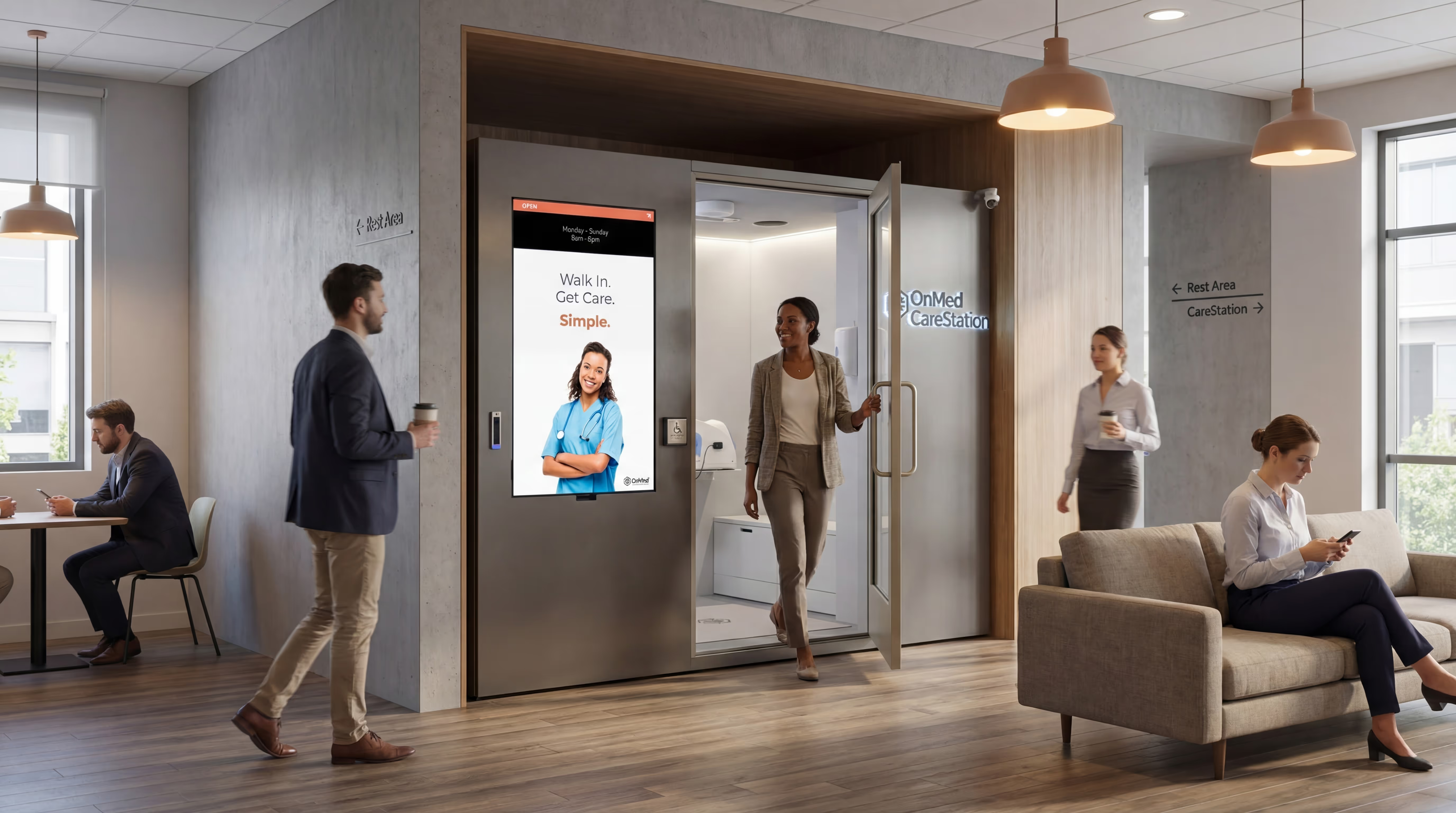
Nearly 30% of emergency department visits are considered avoidable, according to AHRQ. The average ER visit costs five to ten times more than primary care or on-site care, as reported by UnitedHealth Group.
When employees have immediate, on-site access to healthcare, they are far less likely to default to urgent care or the emergency department for common, non-emergent conditions like colds, flu, UTIs, skin issues, GI concerns, or routine prescription refills. This care redirection alone can meaningfully reduce employer claims and unnecessary spend over time.
Health-related absenteeism and presenteeism cost U.S. employers $575 billion annually. Many absences stem from common, manageable conditions that escalate only because care is delayed, inconvenient, or inaccessible.
On-site healthcare fundamentally changes that equation by enabling earlier intervention, reducing recovery time, preventing downstream complications, and minimizing missed shifts. The result is measurable improvements in attendance, workforce continuity, and overall operational stability.
Healthcare access is no longer just a benefit—it is a powerful retention lever. SHRM reports that 92% of employees say benefits directly impact whether they stay with an employer, and Gallup consistently ranks healthcare access among the top three most valued workplace benefits.
Employers offering on-site healthcare see higher employee satisfaction, improved retention, and stronger employer brand perception. Employees notice when an employer invests not just in insurance coverage, but in real, everyday access to care.
As premiums continue to rise, more employers are shifting toward high-deductible health plans (HDHPs), which afford employers lower costs. While effective at controlling premium growth, HDHPs often discourage care-seeking due to higher out-of-pocket costs.
On-site healthcare bridges this gap by covering most everyday health needs and prescriptions at no additional cost to employees, making HDHPs far more usable and attractive for employees, while simultaneously reducing total healthcare spend for employers.
Employers who prioritize healthcare access are perceived as more modern, more employee-centric, and more trustworthy. This perception shows up consistently in engagement surveys, Glassdoor reviews, candidate and recruitment conversations, and overall leadership credibility.
That brand lift is difficult to quantify—but increasingly impossible to ignore.
The most powerful benefit of on-site healthcare is not just what it saves, but what it restores: time, energy, and trust.
The OnMed CareStation® delivers measurable economic ROI through reduced healthcare claims, decreased absenteeism, and minimized productivity loss, alongside meaningful human ROI through better care experiences, healthier employees, and a workplace culture that visibly values people.
Healthcare access is foundational infrastructure. OnMed is poised to become the de facto employee healthcare access solution—not by replacing insurance, but by making existing benefits work better for everyone.
When healthcare is easy, immediate, and reliable to access, employers recover lost productivity, employees receive care when and where they need it, and organizations build healthier, more resilient workforces.
Make healthcare access part of your infrastructure—not just your benefits package.
Contact us to see how the OnMed CareStation® can help you reduce claims, restore productivity, and improve employee experience.
Follow along as we continue to redefine the healthcare landscape and bring the OnMed CareStation to communities across the U.S.

.png)