See how one structural challenge impacts healthcare costs, outcomes, and workforce stability.


Healthcare is the foundation of thriving communities, yet for millions of Americans, access remains just out of reach. Rural towns, farming communities, and underserved regions aren’t asking for miracles—they’re asking for the basics: reliable, affordable care close to home. Now, for the first time in a generation, we have both the mandate and the means to deliver it.
Rural America needs transformation now. And the Rural Health Transformation Plan (RHTP) is calling for exactly that—bold, sustainable, innovative solutions that can reimagine how care reaches communities too often left behind.
The challenge is clear: build infrastructure that not only addresses today’s inequities but ensures long-term resilience for rural populations. The opportunity is just as clear: we can meet people where they are, with out brick-and-mortar delays, without broadband limitations, and without waiting years for access to improve. This isn’t tomorrow’s idea—it’s today’s reality.
For states to succeed in securing federal funding, RHTP applications must align to five core priorities:
States that can convincingly check every box will win. And OnMed is uniquely positioned to help them do it.
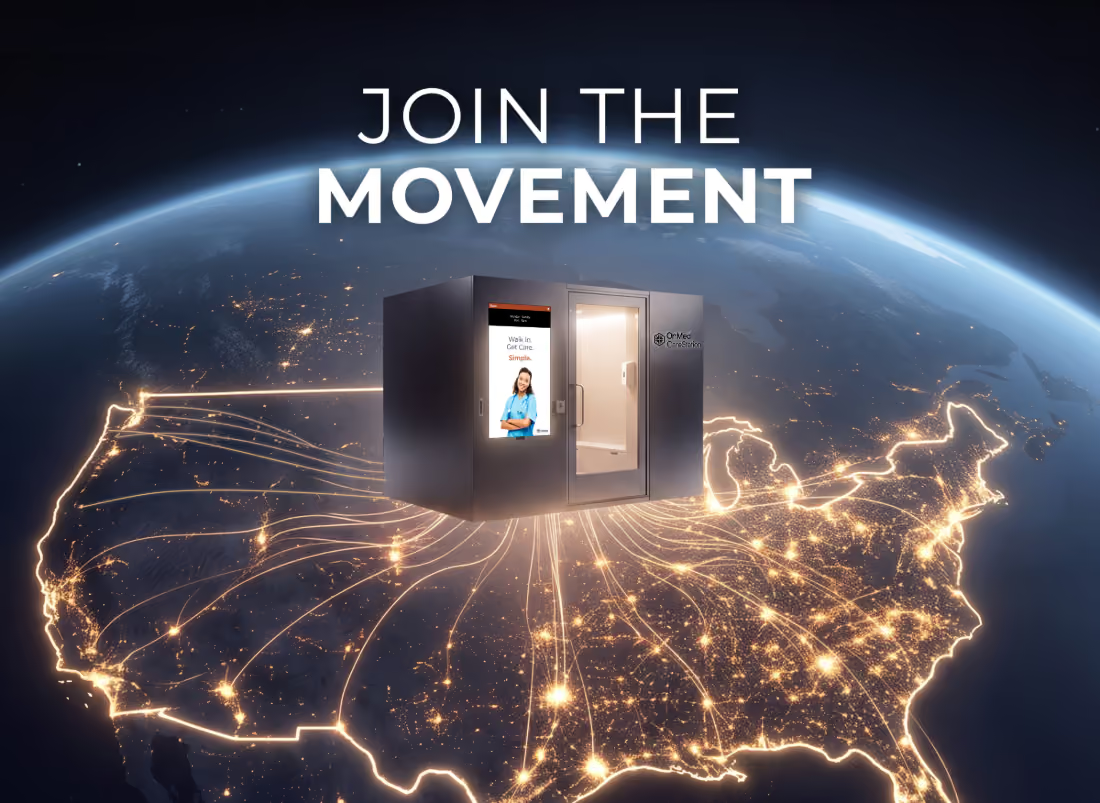
OnMed isn’t a promise for the future—we are healthcare now. Our CareStations are already deployed in seven states and Puerto Rico, with additional states on the horizon. These 8'x10’ “Clinics-in-a-Box” require nothing more than an electrical outlet. No costly construction. No multi-year buildout. From contract to deployment, a CareStation can be fully operational in just 30 days.
Inside, patients step into a private, soundproof environment where advanced diagnostics are a part of the device ecosystem and a clinician greets them on a 65” screen as though standing right there. Unlike traditional telehealth, this is comprehensive, physical and digital, empowering patients while enabling clinicians to diagnose, triage, and treat with precision.
Every requirement of the Rural Health Transformation Plan is already embedded in OnMed’s model.
Partnering with OnMed means states can submit proposals that are not just visionary, but operational today:
The Rural Health Transformation Plan isn’t about short-term funding. It’s about building lasting healthcare infrastructure for millions of Americans who deserve better. States that seize this moment will not only successfully secure CMS funding, but will also reshape rural healthcare for generations to come.
OnMed is already doing it. We are the only solution with immediacy, scalability, longevity, and proven impact to make the RHTP a reality.
OnMed is the rural health solution America has been waiting for.
Learn more or contact us to learn how OnMed is bridging the gap to healthcare access in rural communities.
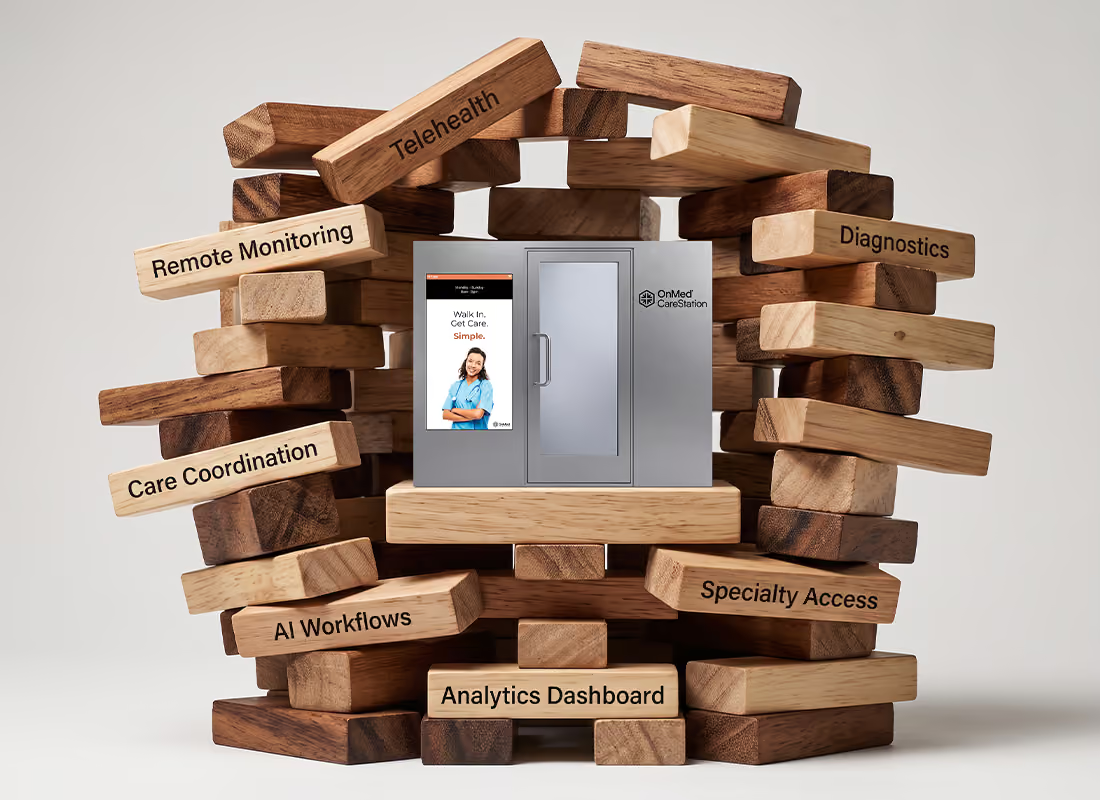
The OnMed CareStation® is an 8-by-10-foot "Clinic-in-a-Box" that connects patients in real time with licensed clinicians and integrated diagnostic tools through a fully integrated device and human platform. Patients can walk in and receive a diagnosis, treatment plan, and e-prescription, often without an appointment or waiting room. Unlike traditional telehealth, the CareStation combines virtual care with diagnostic tools, real-time scans, and vital sign monitoring to support comprehensive clinical evaluations where care is needed most. See how a CareStation visit works.
The Rural Health Transformation Program (RHTP) is a CMS initiative investing $50 billion over five years to expand healthcare access, strengthen healthcare infrastructure, address workforce shortages, and improve health outcomes in rural communities. It is one of the most significant federal investments in rural healthcare in a generation. The program is structured around five priorities: preventive care and chronic disease management, sustainable access infrastructure, workforce development, innovative care models, and technology-enabled diagnostics. CMS cited the OnMed CareStation® in the RHTP Notice of Funding Opportunity (NOFO) as a Rural Health Regional Excellence Initiative example demonstrating how innovation can expand access to care. Read how to turn RHTP funding into rural healthcare access.
Many state and local governments used ARPA/SLFRF dollars to seed public-health staffing, broadband expansion, and telehealth-adjacent infrastructure that now face a funding cliff—roughly 69% of city leaders expect a negative budget impact once ARPA funding ends, per the National League of Cities.
Over three years, the CareStation logged 3,877 visits, reached 76% of the town's population, achieved a 4.97/5 patient satisfaction score, and delivered a 67% emergency room and urgent care diversion rate in 2025. The CareStation was deployed through the Auburn Rural Health Initiative, which CMS later cited in the Rural Health Transformation Program (RHTP) Notice of Funding Opportunity as an example of sustainable access innovation. The LaFayette deployment also showed a 39% repeat visit rate.
The CareStation is operational in as little as 45 days from contract signing, requiring only a power outlet and broadband or satellite connectivity—no construction or permits.
Follow along as we continue to redefine the healthcare landscape and bring the OnMed CareStation to communities across the U.S.