For the full definition and program specifics, see our RHTP glossary entry.
Over the next five years, $50 billion will flow into rural healthcare systems across the United States, creating one of the most significant investments in access, infrastructure, and care delivery in a generation. The mandate is clear. Rural communities need reliable, consistent healthcare access, and for the first time in decades, the resources exist to deliver it.
Every rural health leader understands what this means.
The challenge now is something different. Not whether the opportunity exists. But how to act on it—fast enough, clearly enough, and without adding operational strain to systems that are already stretched.
To secure RHTP funding, applications must demonstrate alignment to five core priorities:
States that can convincingly check every box will win. The question is not whether this opportunity exists. The question is who executes first.
Rural healthcare has never lacked commitment. It has lacked infrastructure.
Across the country, most rural counties face persistent access gaps. Patients delay care not because they don't need it, but because healthcare access is too far away, too inconsistent, or too difficult to navigate. As a result, preventable conditions escalate, emergency departments carry avoidable burden volume, and systems operate under constant pressure.
This is not a temporary problem. It is structural.
As our CEO Karthik Ganesh wrote in his open letter to rural hospital CEOs, the challenge rural leaders cannot solve from inside their four walls is proximity. The patients who need care most are not always showing up—not because trust is missing, but because access is. Distance, time, and complexity create barriers that traditional systems cannot overcome on their own.
That reality is what RHTP is meant to change.
But funding alone does not change proximity. Execution does.

RHTP creates a rare alignment of federal will and financial investment. It is designed to expand preventive care, strengthen chronic disease management, support behavioral health, and improve access across underserved populations. The expectations are comprehensive, and the priorities are clear.
At the same time, the demands of execution are high.
Systems are being asked to move quickly, to demonstrate measurable progress, and to build solutions that are sustainable beyond the funding window. This is not a multi-year planning exercise. It is an execution cycle with compressed timelines and immediate expectations.
And this is where many organizations hesitate. Not because they do not understand the need. But because translating funding into infrastructure, deployment, and operational care delivery within these timelines is genuinely complex.
Traditional approaches cannot keep pace. Building new facilities requires capital and time. Expanding workforce capacity depends on recruitment pipelines that are already constrained. Digital-only solutions rely on connectivity and environments that are not consistent across rural communities.
The path forward must be different.
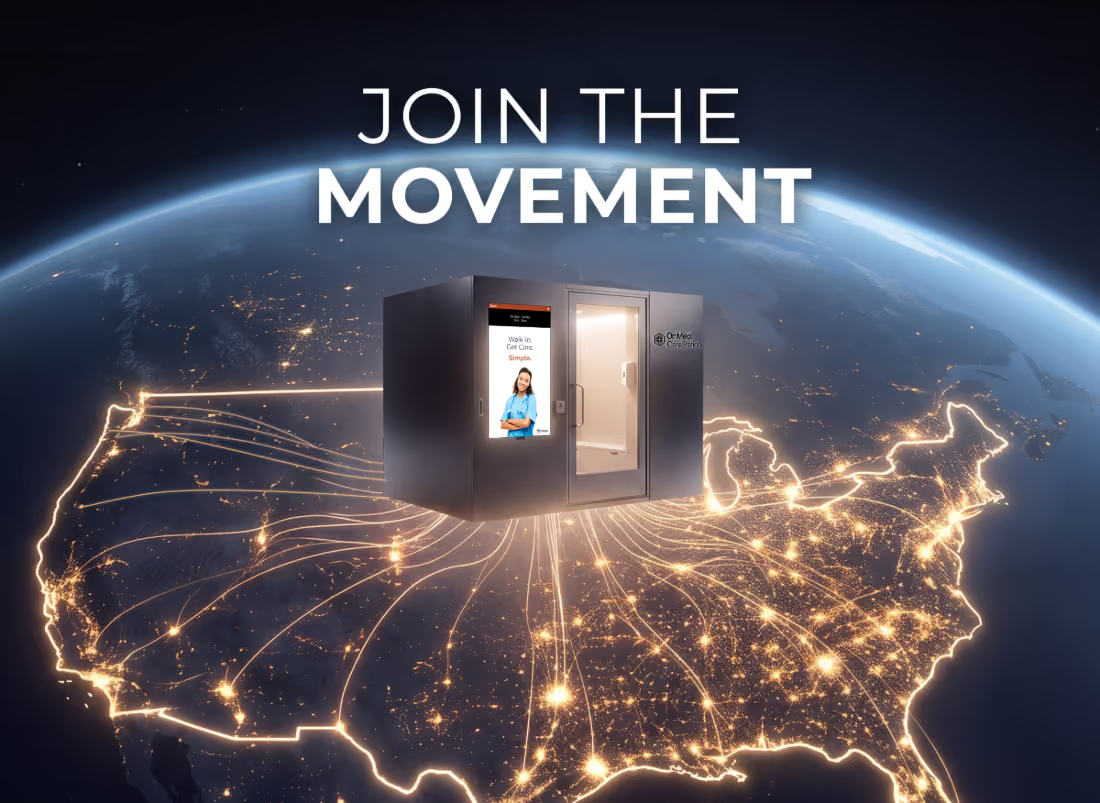
OnMed is not a promise for the future. OnMed is healthcare, delivered now. CMS formally cited OnMed in the RHTP Notice of Funding Opportunity (NOFO) as a "Rural Health Regional Excellence Initiative" example, demonstrating how innovation can increase and expand access to healthcare. The OnMed CareStation® is currently deployed across seven states and Puerto Rico, in rural counties, community centers, pharmacies, schools, shelters, and health system sites. It's ready-to-deploy infrastructure.
Rural transformation is not about adding more layers to the existing system. It is about extending the system itself.
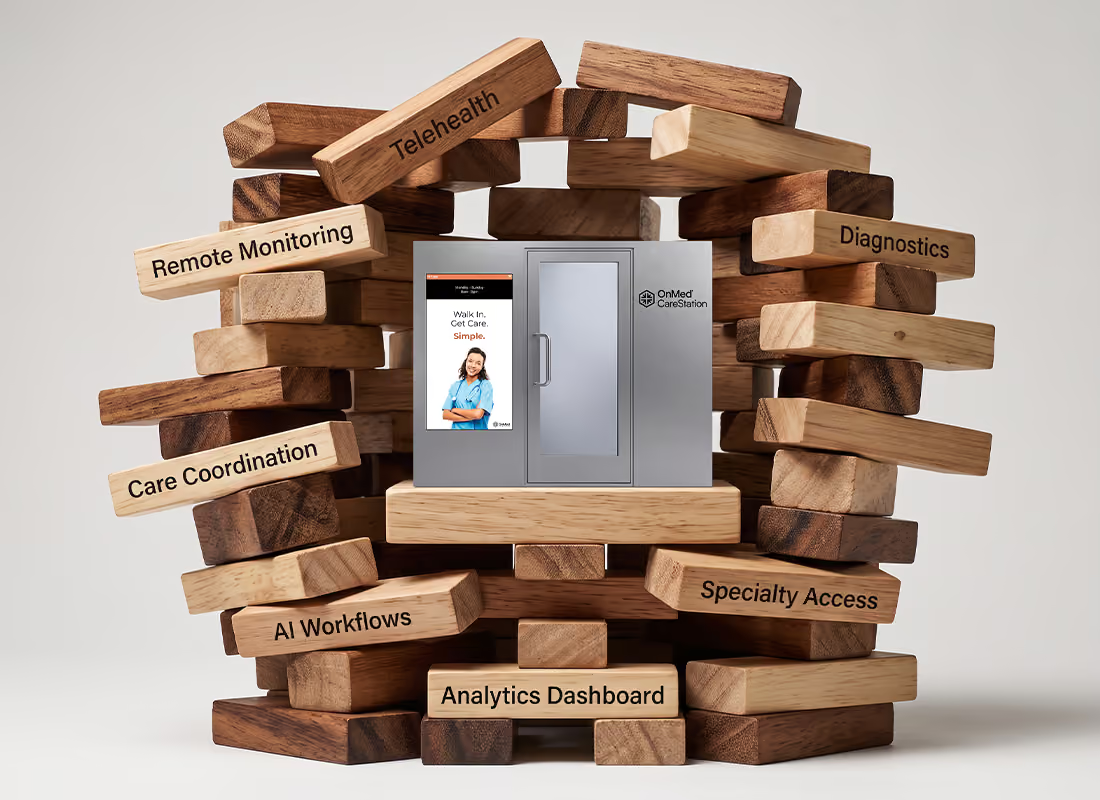
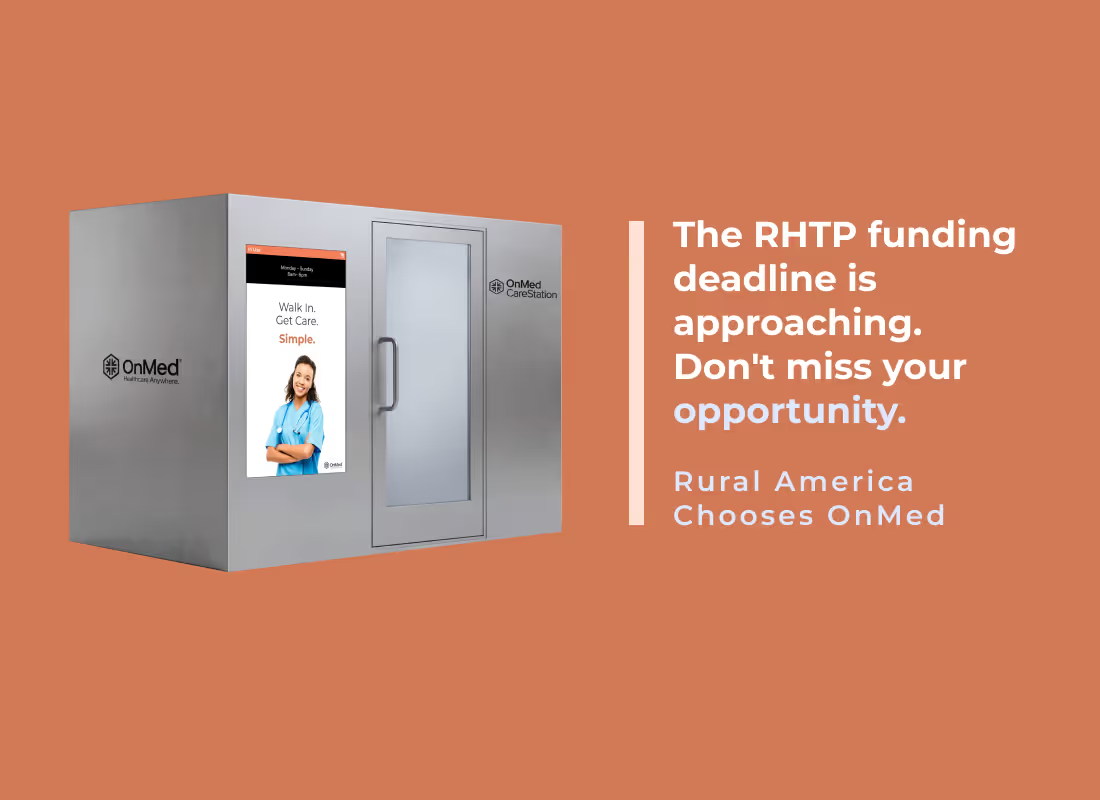
The CareStation was built around this idea. It is a self-contained, clinic-grade access point—an 8×10-foot "Clinic-in-a-Box"—that can be placed directly inside the communities you serve. It requires no construction, no new hires, and can be deployed in as little as 45 days. Inside, patients enter a private, ADA-compliant, self-sanitizing environment where they are connected in real time with a licensed clinician and supported by seven integrated diagnostic tools—blood pressure, pulse oximetry, digital stethoscope, otoscope, high-definition camera, thermal imaging, and weight scale—that enable a full clinical evaluation.
This is care as infrastructure.
The CareStation operates as a branded extension of your local health systems. Every visit is documented within your workflows. Every referral flows back into your network. Lower-acuity conditions are resolved locally, while higher-acuity patients are identified earlier and guided to your facility. For the first time, proximity shifts in your favor.
Standard telehealth offerings function primarily as communication tools. They connect patients to providers but often lack the integrated diagnostic capability to fully assess a condition. Many encounters end in deferred care. At-home monitoring shifts clinical responsibility into uncontrolled environments where device calibration, ambient lighting, and user technique all introduce uncertainty that clinicians cannot account for.
The CareStation is a different category entirely. It is purpose-built clinical infrastructure—a standardized, controlled environment with medical-grade, FDA-approved diagnostic tools that delivers a measurably higher standard of care:
In addition, most telehealth solutions depend entirely on reliable broadband connectivity—a resource that nearly 1 in 5 Americans lacks, and that rural communities are disproportionately left without. The CareStation was built for that reality. Equipped with both broadband and satellite connectivity, it operates anywhere there is power, which means it reaches the communities that need it most, not just the ones with the infrastructure to support it.
Read more about why rural communities need more than connectivity →
The difference is not theoretical. It shows up in how care is delivered and how systems perform.
Care happens earlier. Conditions are managed before they escalate. Systems regain control of how patients move through their network. The impact extends beyond access. It strengthens the entire operating model of rural healthcare delivery.
RHTP is not designed to create temporary access. It is intended to establish a foundation that lasts.
The CareStation model reflects that goal. From the moment it is operational, it supports billable encounters through Medicaid and commercial payors. It introduces new patients into the system who previously had limited access. It reduces uncompensated care by addressing conditions earlier in the care journey. The funding initiates the expansion. The model sustains it.

For many rural health leaders, the barrier is not the vision. It is the path from funding to implementation. OnMed was built to simplify that path.
RHTP will not be defined by how much funding is allocated. It will be defined by what gets built, where it gets placed, and how quickly it begins delivering care.
You have spent years holding together a system under pressure, working to serve communities that depend on you in ways that extend far beyond clinical care. This moment offers something different. Not another plan. Not another incremental change. A way to extend your reach into every corner of the communities you serve—without building new facilities, without taking on additional staffing risk, and without waiting years for results.
The funding is here. The question is how quickly it becomes care.
Get your pre-filled application started today—a member of our team will contact you to prepare your application and make sure you are positioned to meet your state's submission deadline.
Get Your Pre-Filled Application →
The OnMed CareStation® is an 8-by-10-foot "Clinic-in-a-Box" that connects patients in real time with licensed clinicians and integrated diagnostic tools through a fully integrated device and human platform. Patients can walk in and receive a diagnosis, treatment plan, and e-prescription, often without an appointment or waiting room. Unlike traditional telehealth, the CareStation combines virtual care with diagnostic tools, real-time scans, and vital sign monitoring to support comprehensive clinical evaluations where care is needed most. See how a CareStation visit works.
The Rural Health Transformation Program (RHTP) is a CMS initiative investing $50 billion over five years to expand healthcare access, strengthen healthcare infrastructure, address workforce shortages, and improve health outcomes in rural communities. It is one of the most significant federal investments in rural healthcare in a generation. The program is structured around five priorities: preventive care and chronic disease management, sustainable access infrastructure, workforce development, innovative care models, and technology-enabled diagnostics. CMS cited the OnMed CareStation® in the RHTP Notice of Funding Opportunity (NOFO) as a Rural Health Regional Excellence Initiative example demonstrating how innovation can expand access to care. Read how to turn RHTP funding into rural healthcare access.
Telehealth connects a patient to a clinician without a physical exam, so conditions that need a hands-on assessment often still require an in-person follow-up—one study found this happens after 6.2% of video visits, compared to 1.3% of in-person visits.
Yes. CMS cited OnMed’s Alabama deployment through the Auburn Rural Health Initiative as a model in the RHTP NOFO, under the “Rural health regional excellence initiative” example within the “Sustainable access” goal. Read how states are deploying RHTP funding with the CareStation.
Rural health organizations cannot apply directly for Rural Health Transformation Program (RHTP) funding. CMS awards RHTP funds to states, and organizations typically access those funds through state subawards, contracts, grants, and requests for proposals. The first step is identifying the state's lead RHTP agency and monitoring funding opportunities. RHTP investments are focused on healthcare access, workforce development, sustainable healthcare infrastructure, innovative care models, and technology-enabled diagnostics. Get your pre-filled RHTP application.
Follow along as we continue to redefine the healthcare landscape and bring the OnMed CareStation to communities across the U.S.