See how one structural challenge impacts healthcare costs, outcomes, and workforce stability.


July 29, 2025
You probably didn’t even notice it at first. Maybe it was when you waited on hold for 30 minutes just to be told the doctor wasn’t taking any new patients. Or when you learned that the first available appointment was 6 months out for a symptom you were stressing to resolve. Or when you ended up waiting 8 hours in the ER for something minor because there wasn’t a clinic open or within reach. Maybe it was when a consultation felt so rushed that you couldn’t think of the questions to ask until you were back at home. Or when you suddenly felt like part of a process rather than a person in need, seeking care.
Healthcare has been unraveling slowly, and in plain sight. A thousand small friction points adding up to something that doesn’t quite work anymore. For too many of us, the system that’s supposed to protect our well-being now feels indifferent at best. At worst, it feels like it’s pushing us away.
We’ve normalized delays, confusion, and disconnection: systems that are hard to navigate and cold interactions. In the U.S., the average wait time to see a provider has ballooned to 30 days. That’s 43% longer than it was just two decades ago. That’s nearly a month to address a health concern that may not wait. Meanwhile, you can get groceries delivered in 30 minutes and your packages arrive overnight.
So why does healthcare feel so out of step with the rest of your life?
For millions of people, the situation has gone beyond inconvenient to impossible. They face real, systemic barriers that keep them from accessing care altogether. Clinics are too far away or costs are too high. Today, approximately 100 million Americans are without access to healthcare. And for millions more, the access they do have is limited and frustrating at best. Services aren’t available in the formats that work for them or during the few windows of time they’re free. The healthcare system wasn’t designed around real lives—especially not the lives of those in marginalized or rural communities. It didn’t account for the scalability required to support 10,000 Americans aging into Medicare every single day, or the 3.6 million babies being born every year. There aren’t enough doctors to serve our country. Medical school enrollment won’t cover the need and a large number of the existing providers are at retirement age. Telehealth was a hope for the answer, but let’s face it, the inability to diagnose is incredibly limiting. And that’s without the realities of 42 million Americans without access to broadband and more than 70 million who face cost or connection issues that make a simple video call unreliable.
When access is missing, people aren’t just left waiting, they’re left vulnerable and in crisis. That’s not just inefficiency. It’s exclusion.
Access is more than an appointment, if you can even get one. It’s recognition, respect, and care that meets people where they are. It’s understanding their full reality, not just their symptoms.
That means care has to show up differently. It has to reach people not just geographically, but emotionally, financially, and culturally. It has to work within the details of real life. Care that doesn’t make you jump through hoops or question your worth. It’s care that fits into your life—not the other way around.
Between the overly automated and the painfully outdated. Between “I’m fine” and “I should probably talk to someone.” Between your day job and daycare pickup. Between today’s chaos and tomorrow’s peace of mind.
Because the reality is, we’ve been sold a false choice. The healthcare conversation has revolved around either/or: either you see a real person, or you use a digital tool. Either you wait months for a traditional appointment or you try your luck with symptom checkers and apps.
Technology without empathy feels cold and human care without scalability can’t keep up. We need both. OnMed is tech-enabled, human-led care, maximizing what works in both and neutralizing what doesn’t. This is hybrid healthcare.
Imagine walking into your workplace, your community center, or your school and being able to have a secure visit with a licensed medical provider—no waiting necessary. No endless hold music. No login portals or confusing apps. Just walk in, talk to someone, get assessed, and walk out with answers, a prescription, and the care plan you need.
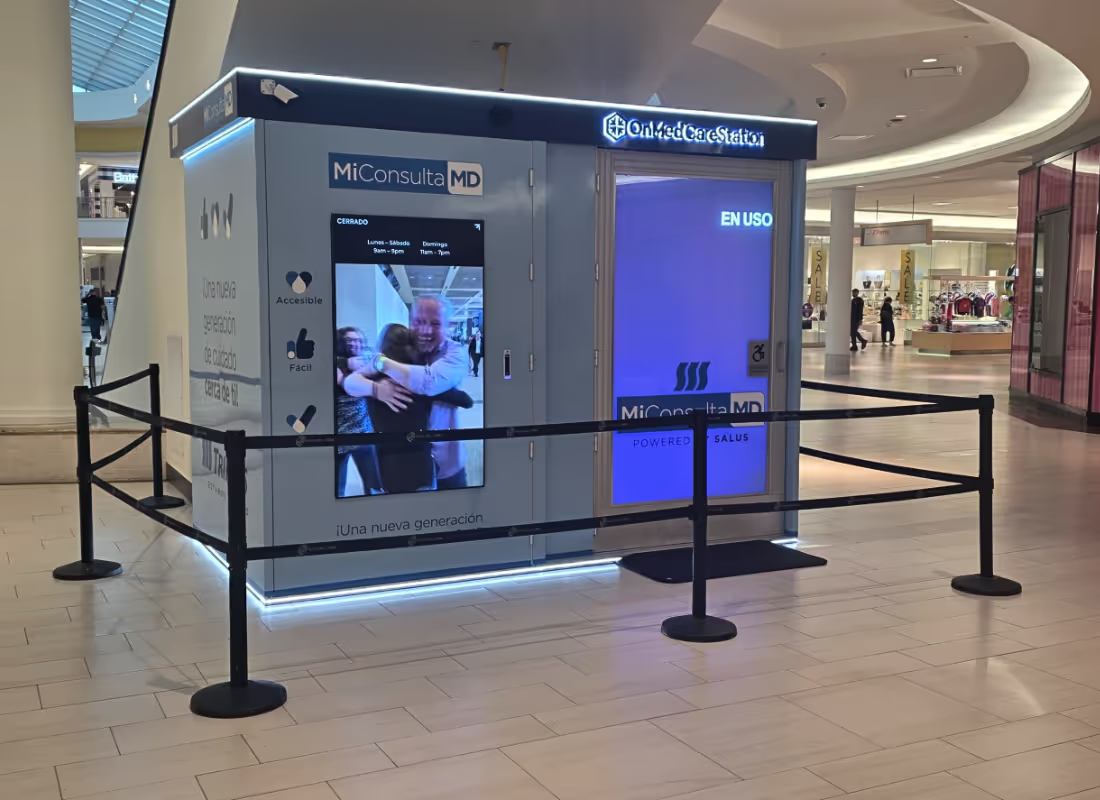
The OnMed CareStation is an 8’ x 11’ Clinic-in-a-Box that brings access to healthcare anywhere there’s an outlet to plug it in. You walk in and simply press ‘Start’. The door locks, the windows fog, and you are in a private, soundproof environment with a real life human clinician on a 65” screen that feels like they are right there with you. But this is better than telehealth, because in the CareStation, comprehensive diagnostic tools emerge and you are guided through a self-exam that can get you diagnosed with incredible accuracy. Blood pressure, pulse, HD camera for ears, eyes, nose, throat, and rash. Even thermal imaging for fever and congestion.
That’s what care should look like: Immediate. Human. Leveraging smart technology to close gaps—not widen them. And expanding access without losing the compassion that makes it meaningful. Like a patient with shortness of breath who registered dangerously low oxygen and was calmly guided to emergency treatment for pneumonia. Or someone with a painful rash who was quickly diagnosed with shingles using an HD camera and started on antivirals the same day.
We need to think bigger and innovate more to reimagine healthcare. Tech for tech’s sake isn’t going to work. We need to rethink what people need, and then the entire experience that follows. These are real people. Real outcomes. And real proof that when care shows up in the moments it matters most, everything changes.
Hybrid care that not only combines the best of both worlds, is better than both alone. This is healthcare reimagined with the intelligence of technology and the warmth and trust of compassionate healthcare teams. It’s not care that pushes you to your limits, it’s care that meets you where you are. Embedded in real spaces. Present in daily life. Active where and when people need it most. This is what it means to reimagine access.
Because where the traditional healthcare system stops, life keeps going. And that’s precisely where care needs to start showing up, for everyone, everywhere.
The OnMed CareStation® is an 8-by-10-foot "Clinic-in-a-Box" that connects patients in real time with licensed clinicians and integrated diagnostic tools through a fully integrated device and human platform. Patients can walk in and receive a diagnosis, treatment plan, and e-prescription, often without an appointment or waiting room. Unlike traditional telehealth, the CareStation combines virtual care with diagnostic tools, real-time scans, and vital sign monitoring to support comprehensive clinical evaluations where care is needed most. See how a CareStation visit works.
Access to healthcare in the United States is not a single problem with a single solution. For the 120 million Americans living without reliable access, the barriers are structural and compounding—distance from care, inability to afford coverage, gaps in insurance, and a fragmented system that demands significant navigation before anyone receives treatment. Solving this requires more than availability. It requires care that can be completed, not simply accessed. The result is delayed care, escalating chronic disease, $168 billion in avoidable emergency department costs annually, and $320 billion or more in preventable complications from unmanaged chronic conditions.
Many communities lack sufficient provider capacity, creating significant barriers to care. The OnMed CareStation® can be deployed directly within underserved communities, helping health plans expand network reach and improve access without the time and expense required to build traditional healthcare facilities. This broader access supports member engagement, preventive care initiatives, and long-term population health goals.
The OnMed CareStation® helps expand access to care, strengthen continuity of care, and connect patients to appropriate follow-up services. Across OnMed deployments:
When members delay care, health conditions often become more complex and costly to treat. By improving access to timely care, supporting earlier intervention, and helping redirect appropriate healthcare needs away from high-cost settings, the OnMed CareStation® can help health plans manage healthcare utilization more effectively across the continuum of care. Earlier access also lets clinicians identify emerging health concerns through consultations and integrated diagnostic tools, supporting earlier intervention, follow-up care, and appropriate referrals when needed.
Follow along as we continue to redefine the healthcare landscape and bring the OnMed CareStation to communities across the U.S.