Show: Healthcare Rap
Host: Jared Johnson and Zain Ismail
Guests: Karthik Ganesh, CEO of OnMed Alan Washington, President and CEO of 22Beacon, and Earl Martin Phalen, Founder and CEO of Phalen Leadership Academies
Published: January 13, 2026
Duration: ~33 minutes
Listen on Apple Podcast
Listen on Spotify
Watch on YouTube
Chronic absenteeism has gone from a background statistic to one of the most urgent numbers in American education, and this episode of Healthcare Rap makes the case that healthcare access is the lever nobody's pulling. Host Jared Johnson brings together three leaders working the problem from different angles: Karthik Ganesh, CEO of OnMed; Alan Washington, President and CEO of 22Beacon, a national nonprofit dedicated to removing barriers to quality education; and Earl Martin Phalen, founder and CEO of the Phalen Leadership Academy, a network of public charter schools serving thousands of students across five states.
The conversation moves from the hard data behind chronic absenteeism, to how healthcare access gaps compound across students, families, and school staff, to why the school building—not a new clinic, not a hospital wing—is the most powerful place to actually deliver that care. At the center of it is a new partnership between OnMed and 22Beacon to explore deploying the OnMed CareStation® across charter schools nationwide, with Phalen Leadership Academy among the schools under consideration. The throughline of the episode: school-based healthcare isn't an aspiration anymore. It's a measurable, scalable model with real deployment data behind it.
"Healthcare has never been a field of dreams. If you build it, they will not come. You have to bring healthcare where people are naturally congregating already. That's the only way you can truly create healthier communities that have a greater sense of well-being."
"Resilience is as much about what you find within and the strength you find within as it is about the support system that you have around you that can constantly help ensure you bend but don't break."
"78% of the people who come to the CareStation from a rural community tell us that we are their medical home. They have no place else to go. 58% tell us that if they hadn't come to the CareStation, they would have gone to the ED."
"Employers that have rolled this out are saving north of $1,100 per employee. As they start rolling out more wellness programs and a greater push around employee health and wellness, this has the ability to have a 15x return on investment."
"Most things in life at the end of the day converge around health and wealth. You can't have wealth without health. The school is the perfect integration point for that across students, caregivers, and staff."
The episode opens with a number that sets the tone for everything that follows before COVID. Roughly 13% of students were chronically absent. That figure has since climbed to nearly 23% nationally, with some cities reporting rates as high as 51%. The point Karthik and his co-guests return repeatedly is that chronic absenteeism isn't just a school problem—it's a life-outcomes problem, and healthcare access sits underneath most of it.
Karthik laid out the downstream consequences directly: chronic absenteeism is linked to a 700% higher dropout rate, a 350% higher incarceration rate, nine fewer years of life expectancy, and a 200% greater likelihood of living in poverty. His conclusion is equally direct—addressing absenteeism through healthcare access has the potential to break a cycle of generational poverty, not just improving attendance rates.
Alan Washington added that the problem extends beyond the students who miss school. Kids who show up hungry, unwell, or carrying the health burden of a chronically ill caregiver are affected just as much, even when they're sitting in their seats. Earl Martin Phalen grounded that point in specifics from his own network's schools in Indianapolis, Detroit, Alabama, and Ohio, where most families live in food deserts and rely on emergency rooms as their only source of care.
A central theme of the episode is that healthcare works best when it meets people where they already are—and for underserved communities, no institution qualifies quite like the school. Karthik has made a version of this argument before, but here, with a partner and a school leader in the room, it lands with specificity.
Other than a house of worship, the school is often the most central, trusted institution in a community. It's where children and adults spend the most time, and for families served by schools like the Phalen Leadership Academy, it may be the only institution they trust with something as personal as healthcare. Some of that trust comes down to a model of care often described as school-based health centers—bringing the clinical encounter into a building families already walk into every day, rather than asking them to find, trust, and travel to a new one.
Alan Washington made the practical case alongside the trust case: a traditional brick-and-mortar clinic takes millions of dollars and years to build. The CareStation deploys in weeks, scales efficiently across a network of schools, and starts showing impact almost immediately. That speed matters when the communities waiting for access have already been waiting too long.
Karthik shared OnMed's real-world data from rural CareStation deployments, and the numbers are the strongest evidence in the episode that this model works outside of a pilot. 78% of users in rural communities identify the CareStation as their only medical home. 47% have a chronic condition. 58% say that without the CareStation, they would have gone to the emergency department instead.
That last figure connects to a stat Karthik has cited elsewhere: roughly 70% of ED visits nationally are for non-emergent reasons. People don't show up at the ED because they need emergency care—they show up because they have nowhere else to go. The CareStation is built to change that equation before it ever reaches the ED.
On the employer side, schools that have deployed the CareStation are saving more than $1,100 per employee. Karthik projects that as wellness programs and engagement build out further, the return on investment could reach 15x. For schools and districts already operating under significant financial pressure, that's not a soft benefit sitting next to the mission case—it's a business case that stands on its own.
22Beacon is a national nonprofit whose core mission is removing the barriers that keep children from accessing quality education. For most of its history, that work centered on facilities. What came out of years of conversations with school leaders was that healthcare access is an equally critical barrier—and one without a good solution yet.
When Alan Washington and Karthik connected, the fit was immediate. 22Beacon was looking for something free to schools, genuinely innovative, and built to scale. OnMed was looking for mission-aligned partners who understood what underserved communities needed, not just what was easiest to deploy. The CareStation checked both boxes.
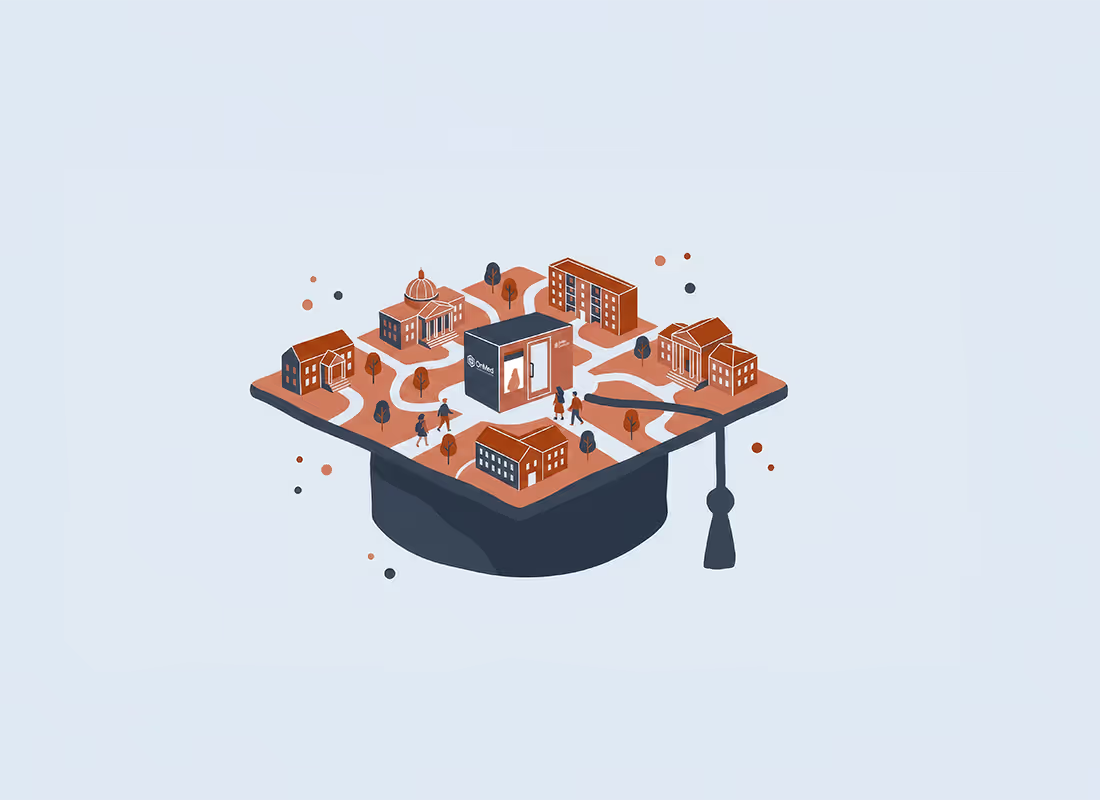
The partnership is built around placing CareStations in charter schools at no cost to the school, with the long-term goal of making it standard healthcare infrastructure for K-12 schools nationwide. Earl Martin Phalen's Phalen Leadership Academy—a network of public charter schools serving thousands of students, families, and staff across five states—is an early and prominent partner in that rollout.
The episode closes on a note of urgency rather than a victory lap. Karthik, Alan Washington, and Earl Martin Phalen all converge on the same point: the solution exists, the data supports it, and the partnerships are already forming. What's missing now is support from philanthropic, private, and government organizations willing to help it scale.
Karthik's closing framing is that the charter school system—built on a premise of innovation from the start—is exactly the right place to pilot this model before expanding it across under resourced K-12 schools more broadly. In his words, 2026 is the year healthcare in under resourced schools stops being a foreign concept.
OnMed is transforming how the world accesses healthcare. With its patented OnMed CareStation®, an 8×10 foot “Clinic-in-a-Box”, OnMed delivers comprehensive, immediate care wherever people live, work, and learn. The OnMed CareStation is a tech-enabled, AI-powered, and human-delivered platform that blends the comprehensiveness of traditional in-person care with the rapid scalability of telemedicine. Each CareStation serves as a local access point within a scalable, connected grid that delivers everyday healthcare at scale.
Powered by public-private partnerships across insurers, healthcare providers, governments, employers, and educational institutions, OnMed is redefining healthcare access, closing critical gaps, restoring trust, and strengthening the health and economic resilience of communities everywhere.
See how the OnMed CareStation is helping schools like the Phalen Leadership Academy and 22Beacon close healthcare access gaps and reduce chronic absenteeism. Connect with the OnMed team to talk about bringing a CareStation to your school or district.
Follow along as we continue to redefine the healthcare landscape and bring the OnMed CareStation to communities across the U.S.
.png)
.png)