Show: Outcomes Rocket
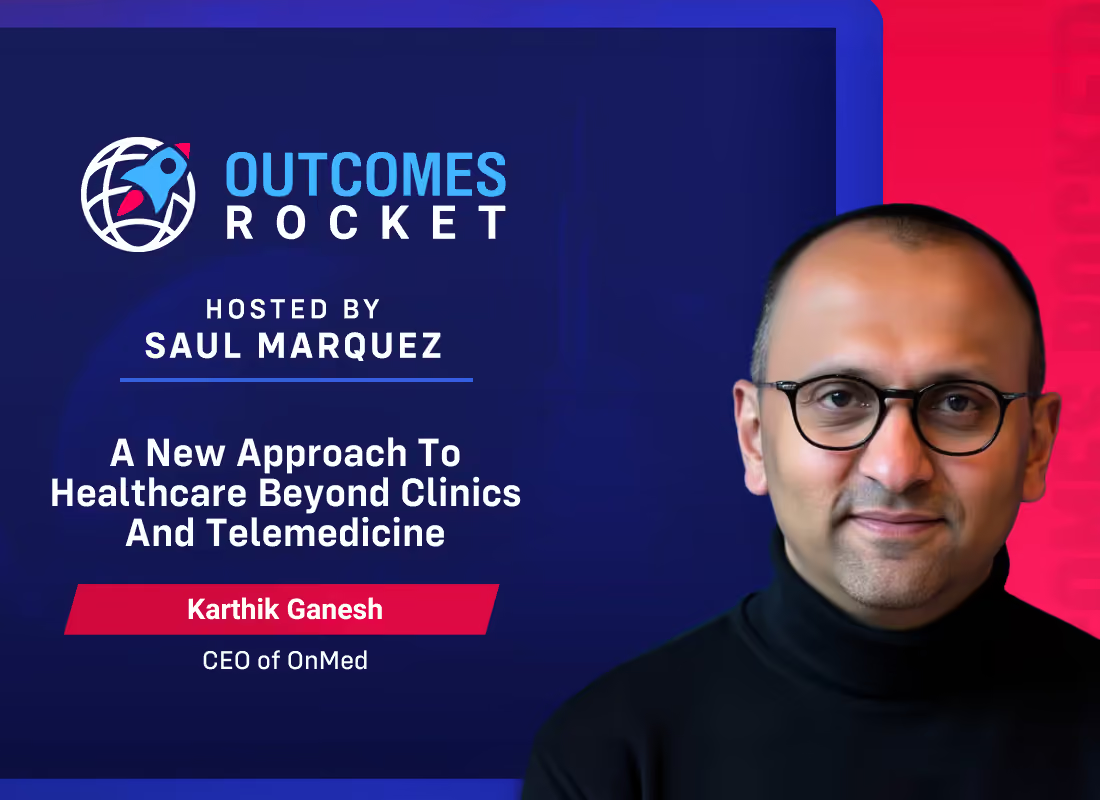
Host: Saul Marquez
Guest: Karthik Ganesh, CEO of OnMed
Published: April 16, 2025
Duration: ~17 minutes
Listen on Apple Podcasts
Listen on Spotify
Watch on YouTube
In this episode of Outcomes Rocket, host Saul Marquez sits down with OnMed CEO Karthik Ganesh for a direct conversation about what's broken in healthcare access, and why the two dominant models, traditional clinics and telemedicine, aren't enough to fix it on their own.
Karthik draws on 25 years of experience across nearly every corner of the healthcare ecosystem: payor, provider, PBM, value-based care, and consulting. That breadth shapes how he diagnoses the problem and why he argues the fix isn't a better version of either existing modality, but a genuinely new one. The conversation covers the access crisis by the numbers, the structural ceilings both clinics and telemedicine have hit, what the OnMed CareStation™ does differently, and how it's already being deployed across rural communities, homeless shelters, prisons, universities, and employer campuses.
"120 million Americans have no viable access to healthcare. 80% of U.S. counties have no viable access to healthcare. That's the here and now. We already have a huge access problem, and we've got a demand that continues to skyrocket on our watch."
"Telemedicine is great for a quick call. But it doesn't have vitals. It doesn't have scans. It doesn't have biometrics. It isn't a true comprehensive clinical experience. Those are the only two modalities of care we know, and from a supply standpoint, for a demand that is just exponentially growing, we are completely falling short."
"The next pandemic is not an if, it's a when. We need a better access mousetrap as part of our public health infrastructure. The two modalities in place right now aren't cutting it."
"The American consumer is liberated. The American patient is claustrophobic. They are burdened by a system that isn't working for them. It is time to stop treating the American patient as a patient and to start treating them as a consumer."
Karthik opens with a framing that anchors the entire conversation. Healthcare policy in the U.S. has spent 60 to 70 years focused on two things: cost and access. Cost, he notes, has proven nearly impossible to move in a sustained way—it's easy to target and hard to lower. Access is simpler to define: you either have it or you don't, and by that measure, the country is failing a lot of people.
The current reality is stark. 120 million Americans have no viable access to healthcare, and 80% of U.S. counties qualify as healthcare deserts. Layered on top of that access gap is a demand curve moving in only one direction: 11,000 people age into Medicare every day, three out of four Americans are overweight or clinically obese, and Medicaid enrollment has spiked 32% in the last three years. As a country, Karthik says plainly, we're getting older, heavier, and poorer, and the infrastructure meant to serve that population isn't keeping pace.
Karthik walks through the structural limitations of both existing models with the precision of someone who's spent decades watching them fail from the inside.
Traditional brick-and-mortar clinics are expensive to build (over $2 million) and expensive to run (more than $750,000 a year), and they depend on a physician workforce that doesn't exist in sufficient numbers. The country's physician shortage sits at 200,000 or more, even as roughly half of all practicing physicians are either approaching retirement or have said openly they're burned out coming out of COVID. The clinic model has already hit its ceiling, and there's no obvious way to lift it.
Telemedicine, which generated real enthusiasm during the pandemic, has its own hard limits. Millions of Americans lack adequate broadband, and connectivity is only part of the problem—even with a good connection, telemedicine cannot do what an in-person clinical visit can. It can't take vitals, run scans, or deliver a comprehensive care experience. It works for minor, straightforward cases. It falls short everywhere else.
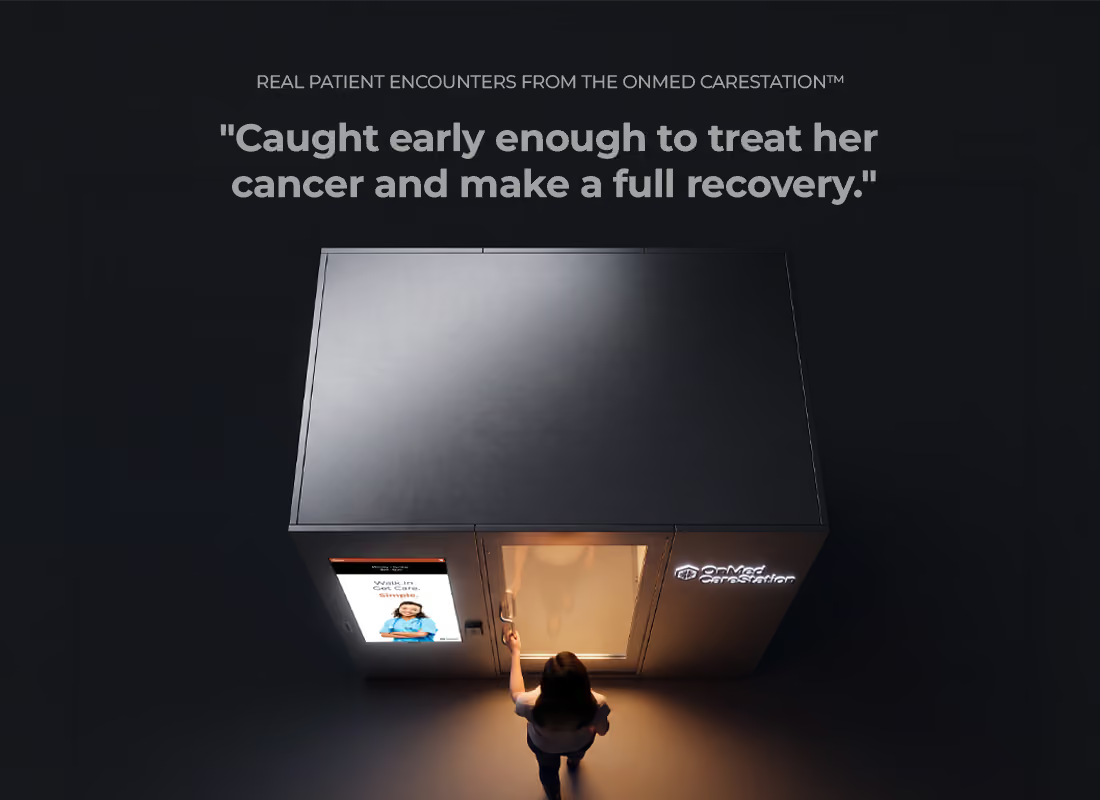
The OnMed CareStation™ is designed to occupy the space neither model can fill on its own. It's an 8×10 foot "Clinic-in-a-Box" that can be deployed almost anywhere with a power connection. The door closes, the glass fogs up, and the patient is connected to a live clinician on a 55-inch screen, carrying the diagnostic tools and biometric capabilities of a primary and urgent care setting.
About 80% of patients who walk into a CareStation don't need a referral elsewhere. That figure reflects the clinical depth of the experience, not just a triage function. OnMed describes the model as everyday care, covering primary, urgent, and post-acute needs in a single setting.
OnMed has already deployed the CareStation across rural West Alabama, homeless shelters, prisons, universities, employer campuses, and health system networks. In one notable example, placing a CareStation in Tampa's largest homeless shelter led to a 50% reduction in 911 calls within two months. In a prison deployment, it reduced costly and logistically complex off-site medical transport. In rural communities, it often serves as the only medical home available.
Karthik is deliberate about how broadly the CareStation applies. The customer is anyone trying to solve an access problem, and that problem shows up across sectors in different forms.
Health systems want to reduce non-emergent ER volume and extend their footprint into underserved communities without the cost of building new clinics. Payors need to improve access to support star ratings and member experience. Universities are looking for a more scalable alternative to expensive on-campus health centers. Local, state, and federal government entities are deploying CareStations in shelters, correctional facilities, and public spaces. Employers are using it to reduce absenteeism, lower healthcare costs, and improve workforce productivity. The CareStation offers an alternative: lower cost, faster to deploy, and better positioned to meet people where they already go.
One of the sharpest observations in the episode is Karthik's contrast between how Americans behave as consumers versus how they experience healthcare as patients. As consumers, people are comfortable doing nearly everything on their phones. As patients, they're burdened by a system that's opaque, inaccessible, and not designed around their needs.
The CareStation is built to close that gap. The goal isn't to make healthcare more clinical—it's to make it more accessible, more immediate, and more consistent with how people already expect to interact with the services that matter to them.
OnMed is transforming how the world accesses healthcare. With its patented OnMed CareStation™, an 8×10 foot “Clinic-in-a-Box”, OnMed delivers comprehensive, immediate care wherever people live, work, and learn. The OnMed CareStation is a tech-enabled, AI-powered, and human-delivered platform that blends the comprehensiveness of traditional in-person care with the rapid scalability of telemedicine. Each CareStation serves as a local access point within a scalable, connected grid that delivers everyday healthcare at scale.
Powered by public-private partnerships across insurers, healthcare providers, governments, employers, and educational institutions, OnMed is redefining healthcare access, closing critical gaps, restoring trust, and strengthening the health and economic resilience of communities everywhere.
See how the OnMed CareStation is closing the physician-shortage gap for health systems, payers, universities, employers, and communities across the country. Connect with the OnMed team to talk about deploying one in yours.
Follow along as we continue to redefine the healthcare landscape and bring the OnMed CareStation to communities across the U.S.