Show: The Empowered Patient Podcast
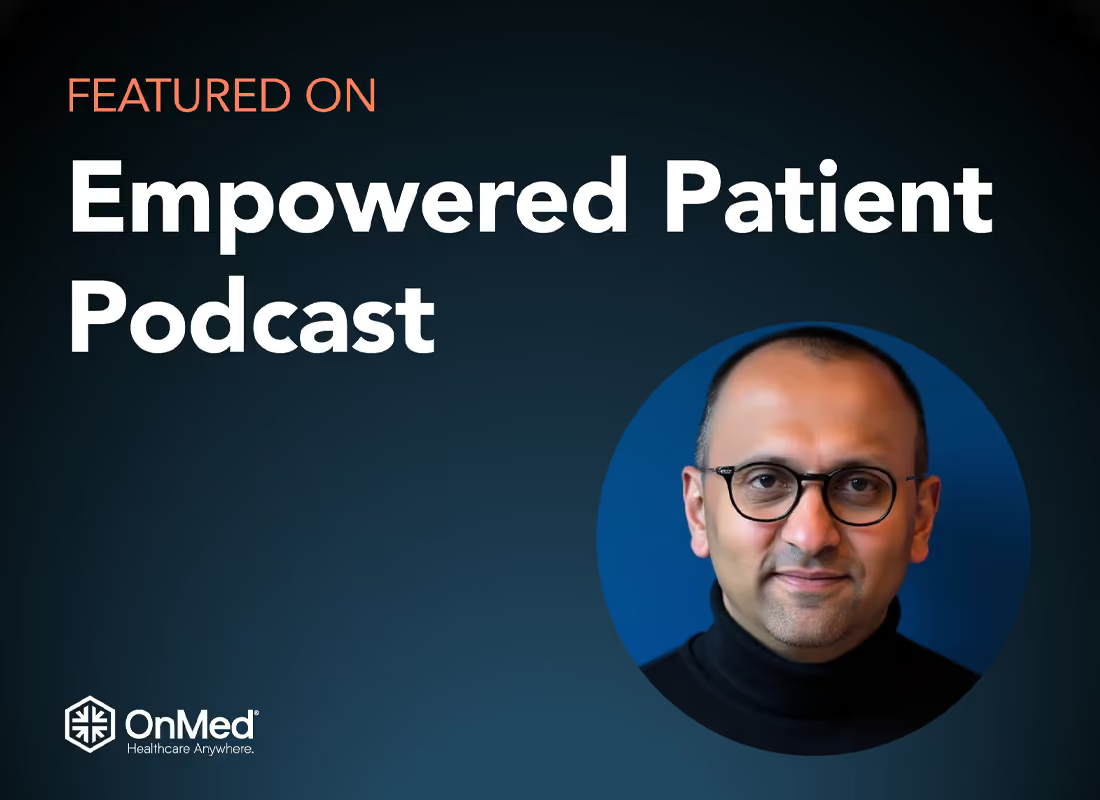
Host: Karen Jagoda
Guest: Karthik Ganesh, CEO of OnMed
Published: December 16, 2024
Listen on Apple Podcasts
Listen on Spotify
Karen Jagoda opens this episode of the Empowered Patient Podcast with a direct question: when people need quick primary care, they typically default to urgent care, the ER, or a doctor's office. So how is OnMed changing that? Karthik's answer reframes the entire conversation around two eras of healthcare access—pre-COVID and post-COVID—and argues that neither one has actually solved the problem.
Before COVID, the default was the clinic visit: comprehensive, but expensive to build and dependent on a shrinking supply of clinicians. After COVID, telemedicine looked like the fix, but it never carried the diagnostic weight of an in-person exam, and it assumes a level of broadband access a meaningful share of Americans still don't have. The OnMed CareStation® is built to close that gap: the clinical depth of a comprehensive visit, delivered with the reach and convenience of a screen.
From there, the conversation moves into how the CareStation actually works inside its private, fogged-glass room, how OnMed recruits and trains the clinicians on the other side of the screen, and where these units are already deployed—not just in rural communities, but inside a Texas prison, a Connecticut foster care center, and the Georgia state capitol. Karthik closes by tying the model back to Medicaid and Medicare, and by describing the mindset—"bend, but don't break"—those shapes how he thinks about both healthcare and resilience more broadly.
"Pre-COVID, you're exactly right. Most people would've thought of it as going into a clinic and seeing a doctor... There are two challenges with that: one is it's extremely expensive to set up a clinic. Two, we're running out of enough clinicians or doctors as a country. We need close to two hundred thousand in the next 10 years. We produce less than 18,000 a year."
"Everyone got excited about telemedicine being a game changer for us. Has it improved the game? It definitely has, but 42 million Americans, an extremely conservative number, don't have broadband... telemedicine has no vitals, biometrics, or scans. So, it isn't your optimal comprehensive clinical experience either."
"120 million plus Americans and over 80% of US counties lack access to viable everyday care. It's a staggering number."
"At this point, we have seen 48% of the community with a 35% return rate to the CareStation. So, this has essentially become the medical home for that community."
"It's one thing for [payors] to identify patients needing care. It's another thing for them to make sure the patients actually show up and can get the transportation needed to the site of care... deploying CareStations makes it incredibly easy for care to be delivered where these underserved communities already are."
"Resilience for me is two things. One, it's having a bend, but don't break mindset... I hope that the communities that this is deployed embrace it for access more so than anything they feel might be missing inside of it."
Karen Jagoda's opening question gets right to the point: when people need care quickly, they go to urgent care, the ER, or a doctor's office. Karthik's answer starts by splitting the problem into two. Pre-COVID, the default was a comprehensive clinic visit—but clinics are expensive to build, and the country is running out of the clinicians needed to staff them. The U.S. needs close to 200,000 more clinicians over the next decade and is producing far fewer each year, a shortfall made worse by retirements and burnout coming out of COVID-19.
Post-COVID, telemedicine looked like the answer. It improved convenience, but it never solved for diagnosis. A meaningful share of Americans still lack the broadband a clinical-quality video visit requires, and even with a strong connection, telemedicine has no vitals, no biometrics, and no scans. Two modalities, two different failure points—and neither one, on its own, gets a patient from "I don't feel well" to "this is resolved."
The OnMed CareStation® is built to take the best of both failed modalities and neutralize what doesn't work in each. It gives patients the psychological comfort and clinical confidence of a comprehensive in-person visit, paired with the rapid scalability and convenience of telemedicine. Karthik describes OnMed as a hybrid care company, and the CareStation as a tech-enabled, hybrid care vehicle that’s human delivered—not a replacement for either clinics or telehealth, but the thing that fills the gap they leave behind.
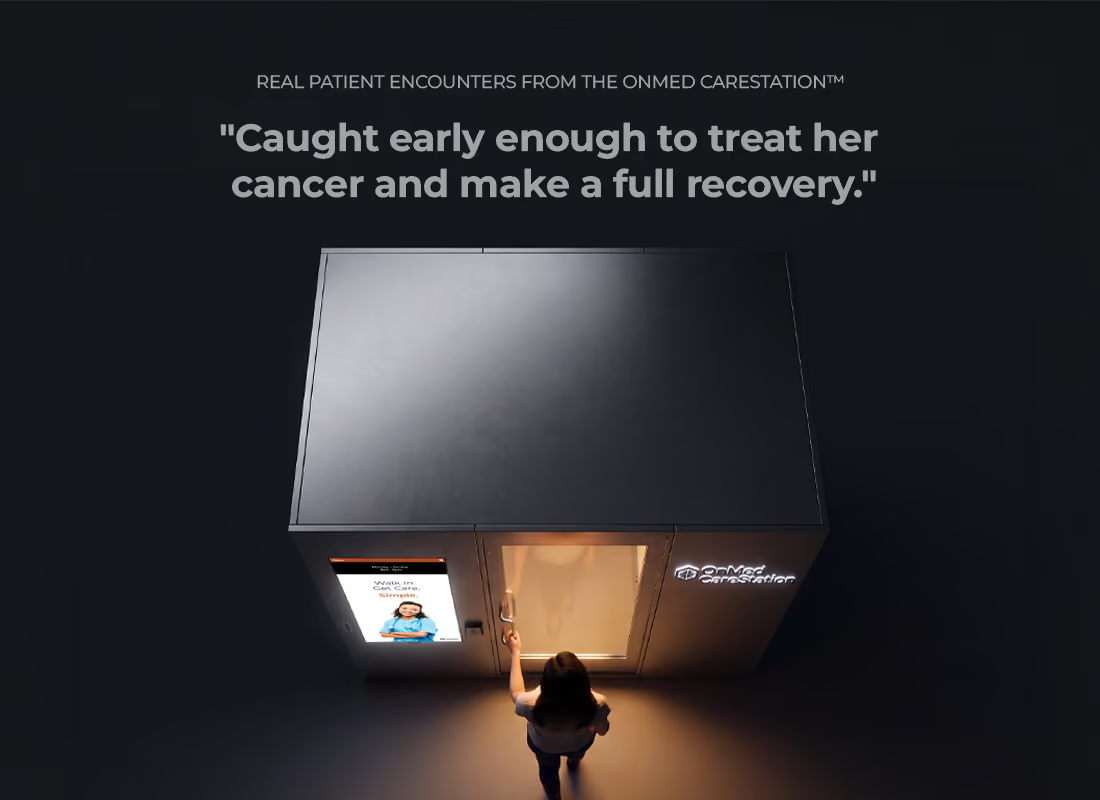
Physically, the CareStation is an 8×10 foot "Clinic-in-a-Box," self-sufficient enough to run anywhere with an electrical outlet. A patient walks in, the door closes, and the glass fogs for privacy. A weighing scale, blood pressure cuff, and pulse oximeter capture vitals immediately. Once the clinician takes over from a command center, they can lower a high-definition camera or a digital stethoscope from the ceiling to examine a rash, listen to a patient's chest in real time, or check for a sore throat—while thermal scans pick up on fever, congestion, or sinusitis. No tech literacy is assumed; the clinician guides the patient through it, the same way they would in any exam room. After every visit, UVC lighting sanitizes the space before the next patient enters.
Karthik is specific about how OnMed staffs the other side of the screen: experienced clinicians that are licensed and credentialed to practice in-state, who also score highly on a structured empathy assessment. That quality matters because many patients walking into a CareStation, particularly in underserved communities, are seeing a clinician for the first time in years. The clinician's first job, in Karthik's words, is to completely disarm the patient and make them feel comfortable before anything clinical happens. When care escalates—a dangerously high blood pressure reading, for example—the CareStation can connect directly to local EMS, and the clinician can e-prescribe to a nearby pharmacy or refer out to a specialist.
OnMed's deployments make a point Karthik returns to more than once: underserved communities "run the gamut" across America. The CareStation has been placed across roughly seven sites in rural Alabama, one inside a Miami community center, one inside a Texas prison, and two—with a third on the way—at Hartford Healthcare sites in Connecticut, including inside the state's largest foster care entity. Eighty-three million-plus Americans and over 80% of U.S. counties lack access to viable everyday care, in Karthik's telling—a reminder that the underserved aren't only in rural zip codes.
The same logic extends to where OnMed is exploring next: conversations are underway with large retail companies about deploying a CareStation inside warehouses, so employees can get care without leaving work, and employers get a convenient benefit tied directly to the worksite.
CareStations are typically sponsored by the deploying entity—an employer, a health system, a university, or a government agency. Karthik argues this structure is especially well suited to Medicaid and Medicare populations, where the harder problem often isn't identifying who needs care, but getting them to a site of care at all. By placing the CareStation where underserved communities already are, OnMed removes the transportation barrier that keeps many eligible patients from ever making it to an appointment.
Karthik says OnMed's near-term focus is straightforward: keep finding the right partners and grow a dominant install base across the country before turning to the access challenges he sees playing out globally, not just domestically. Asked to close on his personal interest in resilience, he describes it as a "bend, but don't break" mindset—one he hopes shows up in how communities experience the CareStation itself: as something that expands what's available to them, not something defined by what it doesn't yet do.
OnMed is transforming how the world accesses healthcare. With its patented OnMed CareStation®, an 8×10 foot “Clinic-in-a-Box”, OnMed delivers comprehensive, immediate care wherever people live, work, and learn. The OnMed CareStation is a tech-enabled, AI-powered, and human-delivered platform that blends the comprehensiveness of traditional in-person care with the rapid scalability of telemedicine. Each CareStation serves as a local access point within a scalable, connected grid that delivers everyday healthcare at scale.
Powered by public-private partnerships across insurers, healthcare providers, governments, employers, and educational institutions, OnMed is redefining healthcare access, closing critical gaps, restoring trust, and strengthening the health and economic resilience of communities everywhere.
See how the OnMed CareStation is closing healthcare access gaps for employers, health systems, universities, government agencies, and communities across the country. Connect with the OnMed team to talk about deploying one in yours.
Follow along as we continue to redefine the healthcare landscape and bring the OnMed CareStation to communities across the U.S.