See how one rural Alabama community got same-day care without building a clinic.

Show: HIMSS TV (Healthcare IT News / HIMSS Media)
Host: Andrea Fox, Senior Editor, Healthcare IT News
Guest: Karthik Ganesh, CEO of OnMed
Published: November 4, 2026
Twenty-five states are now using federal Rural Health Transformation Program funding to rebuild how rural communities get care, and OnMed CEO Karthik Ganesh joined HIMSS TV's Andrea Fox to explain what that money can and can't buy. The conversation covers why a telemedicine-only approach doesn't qualify as a win under RHTP, why new brick-and-mortar construction doesn't either, and what kind of model actually extends a rural hospital's reach instead of competing with it.
"A win is not a telemedicine pure play. A win can't be a brick-and-mortar pure play. It has to be something different that really extends the rural hospital's reach."
"What these hospitals are doing is they're going to be wrapping their brand around the care station, so this really becomes their unit, deployed into the community setting."
"We have a 37% return rate to the care station unsolicited, which is a higher level of stickiness than virtually anything, any other provider-patient relationship in the American healthcare system today."
Rural hospitals are closing at a rapid pace, with 80% of U.S. counties containing healthcare deserts and 120 million Americans are living with suboptimal care. Hospitals under that kind of strain can't close the gap alone, so the real question is how states can use five years of RHTP funding to bring clinical capacity to the people who need it.
That's why the program rules out both a telemedicine-only approach and new brick-and-mortar construction. The rural hospital still matters. It's as much a community anchor as a center of care, but it can't stretch itself into every town it serves, and patients can't be expected to travel to it. Mobile clinics and other point solutions run into a version of the same problem: care that arrives on a schedule instead of being there when someone needs it. OnMed positions itself as the different answer the program is asking states to find. Anything requiring hospitalization or higher-acuity care goes back to the hospital, and everything else gets handled on the spot.
More brick-and-mortar facilities are too expensive for rural hospitals to build, and the country doesn't have enough physicians to staff them. Telemedicine alone hasn't closed the gap either. The design follows from a simple observation: 80% of primary and urgent care visits come down to a vitals check or a diagnostic.
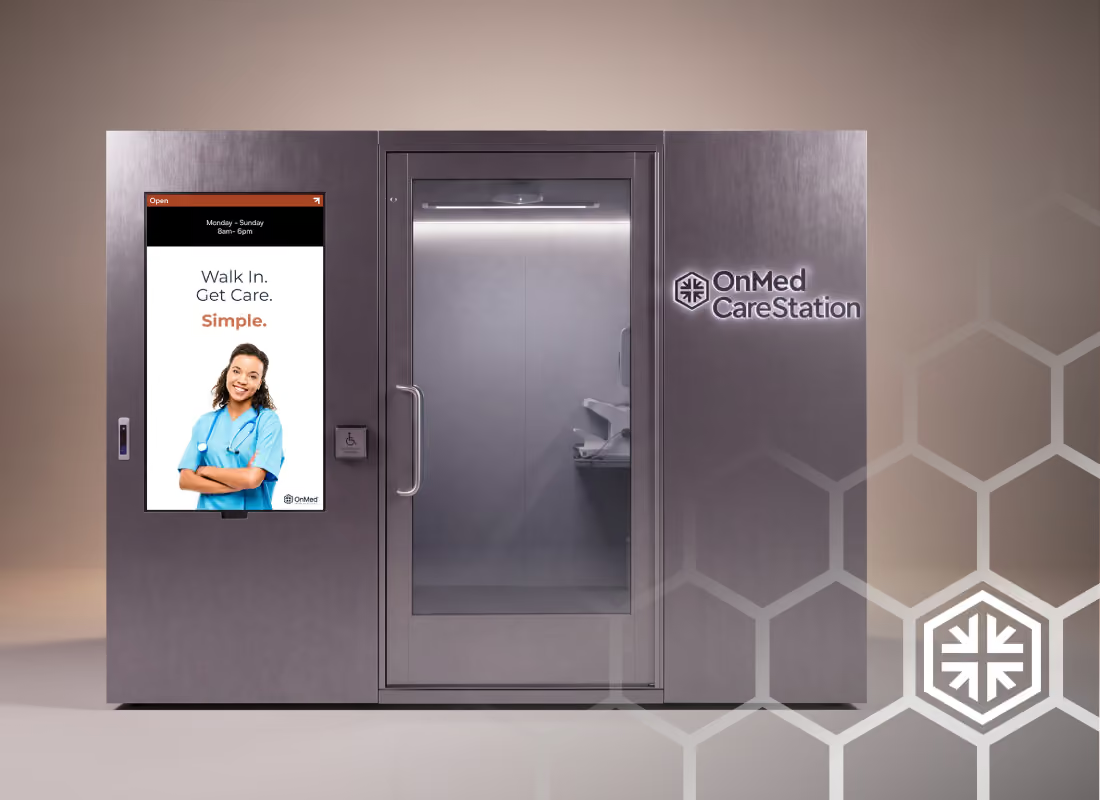
Inside, the 8×10-foot CareStation is equipped with real-time scanning, a blood pressure cuff, an otoscope, and a high-definition camera, all connected to a live clinician on a 55-inch screen. When the door closes, the glass fogs for privacy, so the visit stays private and secure. 85% of conditions are resolved on-site without a specialist referral. The rest are routed to a specialist at the rural hospital.
This model is built around the hospital, not around OnMed. Patients see the hospital's name on the unit, which keeps the hospital at the center of the relationship even as the point of care moves into the community.
West Alabama offers evidence that this already works. In OnMed's non-RHTP deployments there, about 78% of patients say the CareStation has become their medical home, and Karthik says they keep coming back on their own. He says that level of engagement outpaces nearly every other provider-patient relationship in American healthcare. He credits much of it to simplicity: OnMed has been deliberate about keeping the technology from overwhelming patients. The diagnostic capability is there, but the experience stays approachable.
For states and rural hospital associations deciding how to spend RHTP dollars, Karthik's message is consistent: the funding wasn't meant to rebuild the old system with new money. It was meant to pay for a scalable front door to care that rural hospitals can brand, deploy, and depend on.
OnMed is transforming how the world accesses healthcare. With its patented OnMed CareStation®, an 8×10-foot "Clinic-in-a-Box," OnMed delivers comprehensive, immediate care wherever people live, work, and learn.
The OnMed CareStation® is a tech-enabled, AI-powered, and human-delivered platform that blends the comprehensiveness of traditional in-person care with the rapid scalability of telemedicine. Each CareStation serves as a local access point within a scalable, connected grid that delivers everyday healthcare at scale.
Powered by public-private partnerships across insurers, healthcare providers, governments, employers, and educational institutions, OnMed is redefining healthcare access, closing critical gaps, restoring trust, and strengthening the health and economic resilience of communities everywhere.
See how the OnMed CareStation is helping states put Rural Health Transformation Program funding to work for hospitals, health systems, and the communities they serve. Connect with the OnMed team to talk about deploying one in yours.
The Rural Health Transformation Program (RHTP) is a CMS initiative investing $50 billion over five years to expand healthcare access, strengthen healthcare infrastructure, address workforce shortages, and improve health outcomes in rural communities. It is one of the most significant federal investments in rural healthcare in a generation. The program is structured around five priorities: preventive care and chronic disease management, sustainable access infrastructure, workforce development, innovative care models, and technology-enabled diagnostics. CMS cited the OnMed CareStation® in the RHTP Notice of Funding Opportunity (NOFO) as a Rural Health Regional Excellence Initiative example demonstrating how innovation can expand access to care. Read how to turn RHTP funding into rural healthcare access.
Telehealth connects a patient to a clinician without a physical exam, so conditions that need a hands-on assessment often still require an in-person follow-up—one study found this happens after 6.2% of video visits, compared to 1.3% of in-person visits.
It triages every walk-in, fully treats 86% of patients inside the CareStation without redirection to a specialist, urgent care, or emergency department, and routes the rest to exactly the right destination—the local clinic, a specialist, or the emergency department when it's truly warranted. Just as important, 78% of CareStation users arrive with no primary care provider, meaning it reaches people the local system had no way to find, then refers their care back into that same local network. Rural Health Transformation Program funding is meant to strengthen rural health systems, not route around them—an always-on front door that feeds the local system and coordinates where care goes next does exactly that.
Yes. CMS cited OnMed’s Alabama deployment through the Auburn Rural Health Initiative as a model in the RHTP NOFO, under the “Rural health regional excellence initiative” example within the “Sustainable access” goal. Read how states are deploying RHTP funding with the CareStation.
Rural health organizations cannot apply directly for Rural Health Transformation Program (RHTP) funding. CMS awards RHTP funds to states, and organizations typically access those funds through state subawards, contracts, grants, and requests for proposals. The first step is identifying the state's lead RHTP agency and monitoring funding opportunities. RHTP investments are focused on healthcare access, workforce development, sustainable healthcare infrastructure, innovative care models, and technology-enabled diagnostics. Get your pre-filled RHTP application.
Follow along as we continue to redefine the healthcare landscape and bring the OnMed CareStation to communities across the U.S.