See how one rural Alabama community got same-day care without building a clinic.


Sickness doesn't wait until the second Tuesday of the month.
Somewhere in rural America this week, a mobile clinic will roll into town. It will park in a familiar lot, open its doors for a few hours, and do real good—a blood pressure checked, a screening caught, an assessment that might save a life. Then it will pack up and drive to the next stop on the route. It won't be back for weeks.
Illness doesn't keep an appointment. The chest pain arrives on a Friday night. A child's fever spikes on a Sunday. The prescription runs out in the third week of the month, not the first. Rural communities don't need care that visits. They need care that stays.
The Rural Health Transformation Program put $50 billion on the table, $10 billion a year from 2026 through 2030, to rebuild how care reaches rural America. States moved fast, and mobile health moved with them: 42 states wrote mobile clinics into their RHTP plans across eight different service models, from primary care and dental to mammography and behavioral health.
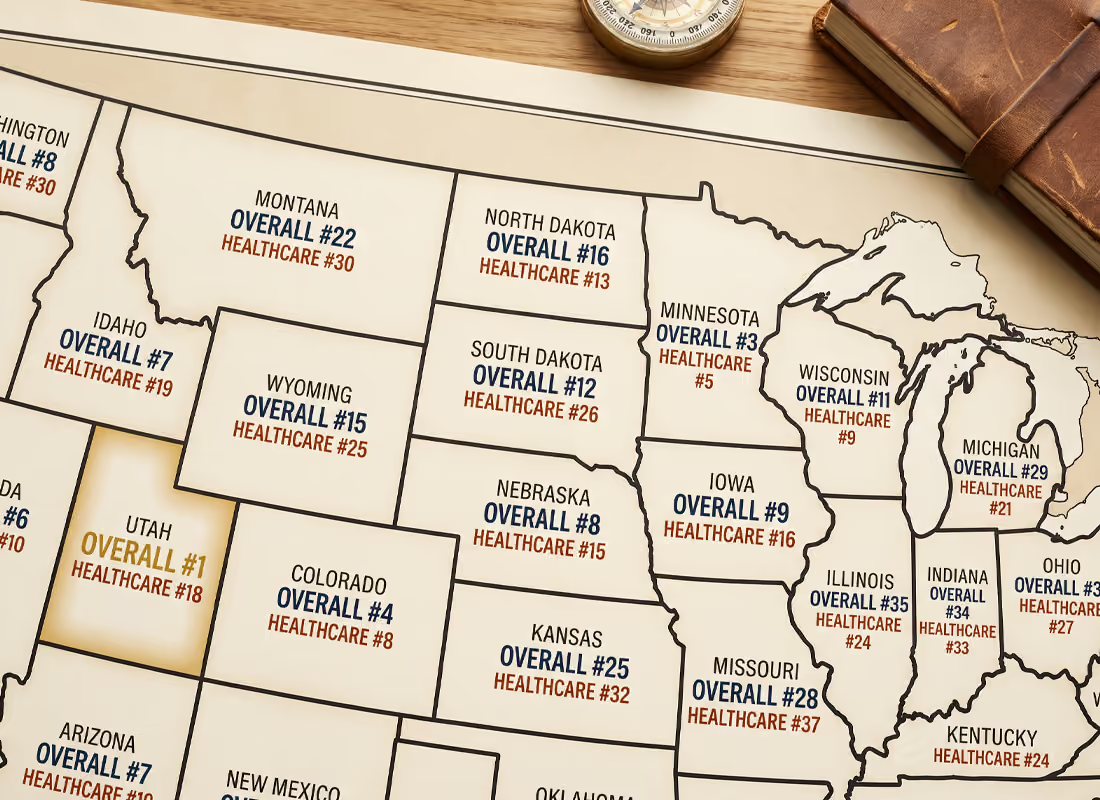
The enthusiasm is understandable, because the gap is real and it is widening. Chartis reports that 46% of rural hospitals now run negative operating margins and 432 are vulnerable to closure. Entire communities have already lost care, and the losses cluster hard: since 2010, Texas, Tennessee, Georgia, Kansas, Mississippi, Missouri, and Oklahoma have each seen care disappear from town after town.
Mobile clinics are good at the reach problem. For episodic, single-service needs—a screening day, a vaccination drive, a maternal-health outreach event—they are one of the most practical tools rural health has. But RHTP is not funding one good day of care. It is funding transformation. That raises the question every rural community should be asking before it commits a dime: when the ribbon-cutting is over, is the care actually there?
A mobile clinic's limits aren't failures of effort. They are the physics of a model that has to move, and those physics show up long before the sustainability question does.
Start with the sky. A route lives at the mercy of the calendar and the weather. A winter storm, a heat advisory, a flooded county road—any one of them cancels a town's only scheduled visit, and the next one may be weeks out. Illness, meanwhile, has seasons of its own. Flu and respiratory surges arrive on their own timeline, almost never the van's, which means the model is thinnest exactly when demand is highest.
Then there's the workforce math, and it doesn't favor a route. A mobile clinic runs on a dedicated team—typically two to five people, built around the same physicians, nurse practitioners, and nurses who are already scarce across rural America, plus a driver who often needs a commercial license. That team is committed to the vehicle for the full run, so hours that could be spent seeing patients are spent getting to and between sites. Programs that can't field their own team lean on local staff instead, drawing from a rural workforce that is already thin and stretched. Either way, the route consumes the exact resource RHTP is trying to build—which is why research on mobile clinics has found that roughly a third report trouble recruiting and retaining staff, with some struggling just to keep a licensed driver behind the wheel.
Even the instruments feel it. Diagnostics are precise, and precision doesn't love a bumpy road. Sensitive equipment jostled over rural miles drifts out of calibration and needs constant re-checking. Care delivered from a fixed, climate-controlled space keeps its tools stable and consistent—the same reliable reading, every visit.
And underneath all of it runs a meter that never stops. Fuel, maintenance, a driver, per-stop staffing—these are variable costs exposed to prices no one controls, and they make margins thin and unpredictable. A vehicle in the shop is a clinic with zero patient days. This is the fragility RHTP is warning about, and it is why mobile health's own strongest advocates say the same thing. Researchers at Harvard's Mobile Health Map have noted that across state RHTP plans, few actually specify how mobile services will be funded, integrated, or sustained beyond short-term pilots. Georgetown's Center on Health Insurance Reforms found that most states described their mobile programs in generalities, without the operational and financial detail sustainability requires. When the people making the case for mobile clinics are the ones flagging the gap, that is not a talking point. It is a warning label.
Here is what a rotation structurally cannot deliver: continuity. And continuity is not a nicety in rural health. It is a must.
Chronic disease—one of RHTP's central priorities—doesn't get managed in a single visit that comes around once a month. Diabetes, hypertension, and heart disease are managed in the spaces between visits: the follow-up, the medication adjustment, the "come back Thursday and we'll recheck." That requires the same access point, a record that builds over time, and a clinician who can pick up the thread. A model that leaves town can't hold that thread. An always-on point of care can, and it is the difference between screening someone once and actually keeping them well.
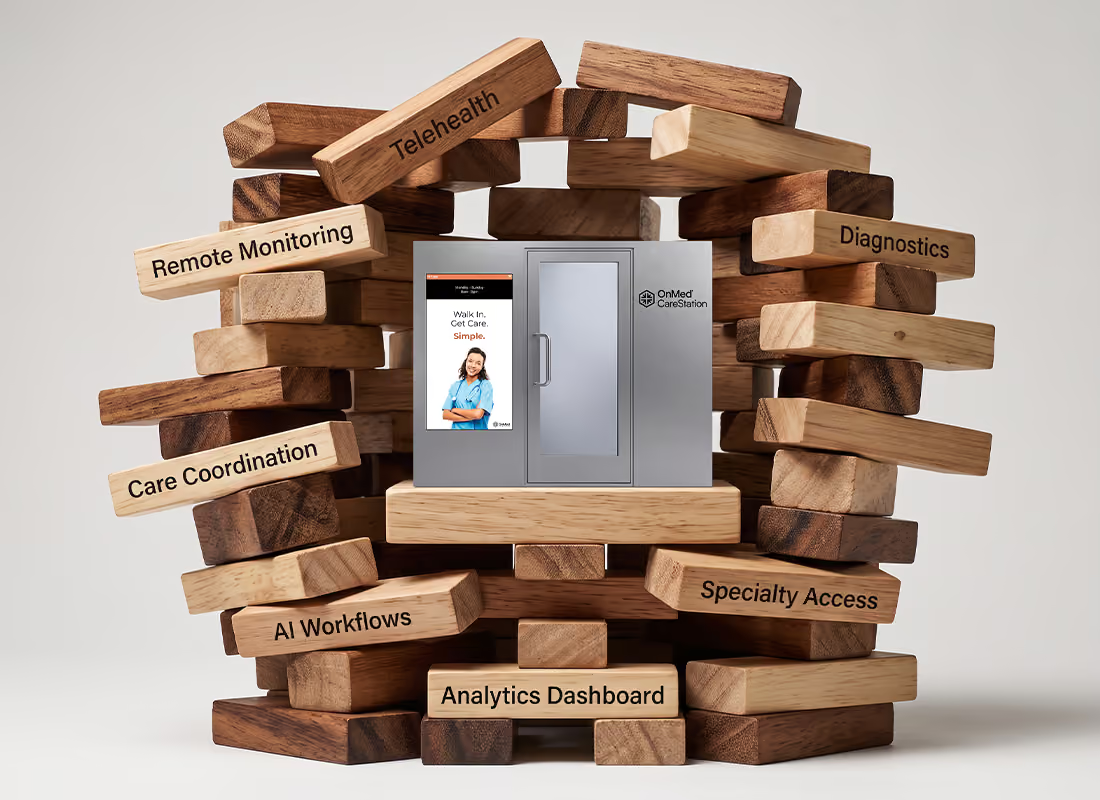
Access alone isn't the finish line. Someone has to call the play. The OnMed CareStation® triages every walk-in, treats the majority on the spot—86% of patients are fully diagnosed without a specialist referral—and routes the rest to exactly the right destination: the local clinic, a specialist, or the emergency department when it is truly warranted. It reads the situation and directs where the patient goes next, so the right care happens in the right place.
Just as important, it does this as an extension of the local health system, not a competitor to it. 78% of CareStation users arrive with no primary care provider—patients the local system never had a way to reach. The CareStation catches them, keeps their care local, and refers them back into the network that serves their community. RHTP is trying to strengthen rural health systems, not route around them. An always-on front door that feeds the local system, captures the unaffiliated, and coordinates where care goes next is exactly that kind of reinforcement.
.avif)
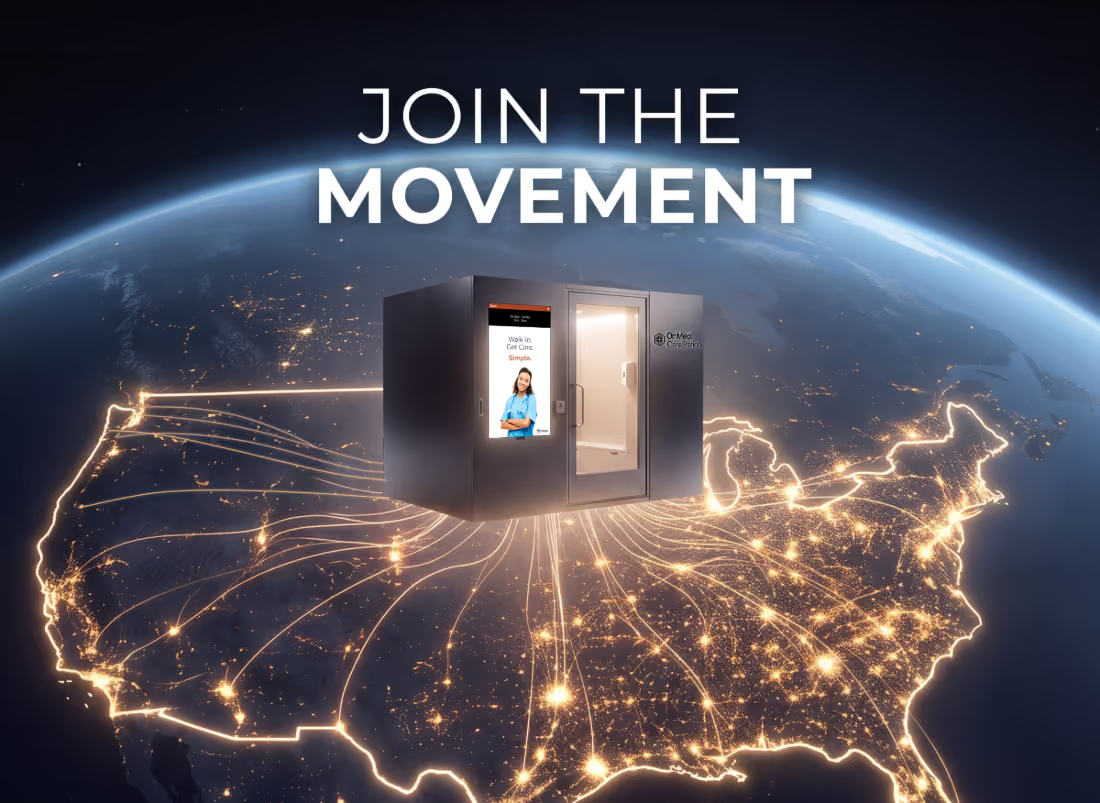
The CareStation answers the access question with a fundamentally different design. It is an 8×10 foot "Clinic-in-a-Box" that needs only a power outlet, installs in as little as 45 days with no construction, and then simply stays—a permanent, private, comprehensive point of care in a place people already trust.
A patient walks in, presses start, and within moments is connected to a licensed clinician on a large screen. The door locks and the glass fogs for complete privacy. Integrated diagnostic tools capture weight, blood pressure, heart rate, oxygen, and temperature; an HD camera and remote stethoscope let the clinician conduct a real exam; and the visit ends the way care should—with a diagnosis, an e-prescription, and next steps, in about twenty minutes, no appointment required. It is tech-enabled, AI-powered, and always human-delivered. Not a van, not a kiosk, not a phone call. Hybrid care in its own lane.
The difference shows up in the data. Patients come back—more than 37% are repeat users within 12 months—and they rate the experience 4.96 out of 5. Most telling of all: 78% of users call the CareStation their medical home. You cannot become someone's medical home on the second Tuesday of the month. You earn that word by being there every day, every time they need you.
Access is the foundational variable in rural health. Everything RHTP is trying to fix—outcomes, cost, workforce strain, the slow disappearance of local care—sits downstream of one question: can people reach a clinician when they need one?
So the choice states and communities face isn't mobile clinic versus CareStation. It is intermittent versus always-on. Both models want to close the same gap. Only one of them is open when the gap actually opens.
Mobile health will always have a role in the reach problem. But the foundational layer of rural access—the always-there, comprehensive, come-as-you-are front door—can't be built on a rotation. It has to be built on something that stays.
RHTP is the once-in-a-generation chance to build that layer the right way. Rural America doesn't need care that comes to town. It needs care that lives there.
| Mobile Clinic | OnMed CareStation® | |
|---|---|---|
| Availability | Scheduled rotation — typically a set day per month or week | 12 hrs/day, 7 days/week |
| Continuity of care | Different clinicians may rotate; limited ability to see the same provider | Consistent access through a fixed, familiar access point |
| Weather & seasonal risk | Routes can be delayed or cancelled by weather, road conditions, or vehicle issues | Fixed installation; not dependent on a vehicle or driving conditions |
| Deployment | Requires vehicle, staffing route, and scheduling logistics | 45 days from contract to operational |
| Staffing | Clinical staff must be physically present on the vehicle for every visit | Remote licensed clinicians supported by on-site |
| Diagnostics | Constrained by what fits and can be maintained in a mobile vehicle | Integrated clinical-grade diagnostic tools |
| Infrastructure | Vehicle maintenance, fuel, parking, routing logistics | Power outlet + broadband or satellite only |
| Connectivity | Broadband dependent | Broadband + satellite backup |
| Patient experience | Must know and plan around the visiting schedule | Always-there; no appointment, no calendar |
| Utilization data | Sparse, visit-by-visit | Daily, reportable |
| Medical home | Low | 78% call it their medical home |
| Languages | Contingent on staffing | Supports 240 languages |
| Capital expenditure | Vehicle + ongoing ops | None |
Ready to bring care that stays? Contact us to learn how OnMed partners with rural communities.
The OnMed CareStation® is an 8-by-10-foot "Clinic-in-a-Box" that connects patients in real time with licensed clinicians and integrated diagnostic tools through a fully integrated device and human platform. Patients can walk in and receive a diagnosis, treatment plan, and e-prescription, often without an appointment or waiting room. Unlike traditional telehealth, the CareStation combines virtual care with diagnostic tools, real-time scans, and vital sign monitoring to support comprehensive clinical evaluations where care is needed most. See how a CareStation visit works.
The Rural Health Transformation Program (RHTP) is a CMS initiative investing $50 billion over five years to expand healthcare access, strengthen healthcare infrastructure, address workforce shortages, and improve health outcomes in rural communities. It is one of the most significant federal investments in rural healthcare in a generation. The program is structured around five priorities: preventive care and chronic disease management, sustainable access infrastructure, workforce development, innovative care models, and technology-enabled diagnostics. CMS cited the OnMed CareStation® in the RHTP Notice of Funding Opportunity (NOFO) as a Rural Health Regional Excellence Initiative example demonstrating how innovation can expand access to care. Read how to turn RHTP funding into rural healthcare access.
Telehealth connects a patient to a clinician without a physical exam, so conditions that need a hands-on assessment often still require an in-person follow-up—one study found this happens after 6.2% of video visits, compared to 1.3% of in-person visits.
Over three years, the CareStation logged 3,877 visits, reached 76% of the town's population, achieved a 4.97/5 patient satisfaction score, and delivered a 67% emergency room and urgent care diversion rate in 2025. The CareStation was deployed through the Auburn Rural Health Initiative, which CMS later cited in the Rural Health Transformation Program (RHTP) Notice of Funding Opportunity as an example of sustainable access innovation. The LaFayette deployment also showed a 39% repeat visit rate.
Both mobile clinics and fixed care sites can expand healthcare access, but they serve different purposes. Mobile clinics are effective for outreach, screenings, and periodic services, while fixed, always-on care sites provide a permanent point of care that supports continuity, chronic condition management, follow-up care, and ongoing patient engagement. Because RHTP is focused on sustainable healthcare access and long-term transformation, many communities are evaluating solutions that remain available year-round rather than only when a mobile unit is scheduled to visit. Read the full comparison of mobile clinics and always-on care.
Follow along as we continue to redefine the healthcare landscape and bring the OnMed CareStation to communities across the U.S.