
Employers are watching healthcare costs climb. Health systems are struggling with overcrowded emergency departments. Universities are working to support students with growing mental and physical health needs. Payors face rising utilization and increasing pressure on affordability.
These may look like separate challenges, but they share a common root cause: too many people still struggle to access care when and where they need it.
In any system, when the front door stops working, pressure builds everywhere else. Healthcare is no different.
Here are eight numbers that help explain why.
This is where every other number on this list begins. When one-third of Americans lack adequate access to healthcare, the effects ripple across the entire system. Costs rise. Care becomes more fragmented. Providers face greater strain. The reasons vary, from geography and provider shortages to long wait times and scheduling challenges, but the outcome is consistent: people wait longer for care, conditions worsen, and pressure builds throughout the healthcare system.
A healthcare desert are areas that lack adequate access to and infrastructure for healthcare services and aren’t defined by geography alone. It can be a rural community without nearby providers, a small town that has lost critical healthcare services, or a densely populated area where long wait times, provider shortages, affordability barriers, and limited appointment availability keep people from getting care when they need it. And despite the common perception, only 22% of the nation's healthcare deserts are rural. At this scale, healthcare deserts are no longer the exception. They're increasingly the norm.

This is not a future workforce projection. It's the size of the physician gap that exists today. According to AAMC, more than 200,000 additional physicians additional physicians would be needed to meet the healthcare needs of underserved populations. A shortage of this magnitude affects far more than staffing levels. It reduces appointment availability, extends wait times, limits access to preventive care, and places additional strain on already overburdened healthcare resources. At that scale, the challenge is no longer simply about recruiting providers. It's about expanding healthcare capacity in ways that can connect more people to care, more quickly.
Burnout isn't a wellness statistic sitting next to the access crisis. It's downstream of it. When the emergency department becomes the default front door for care that should have happened somewhere else, physician time gets consumed by volume it was never built to carry. The system doesn't run out of good doctors. It runs them down.
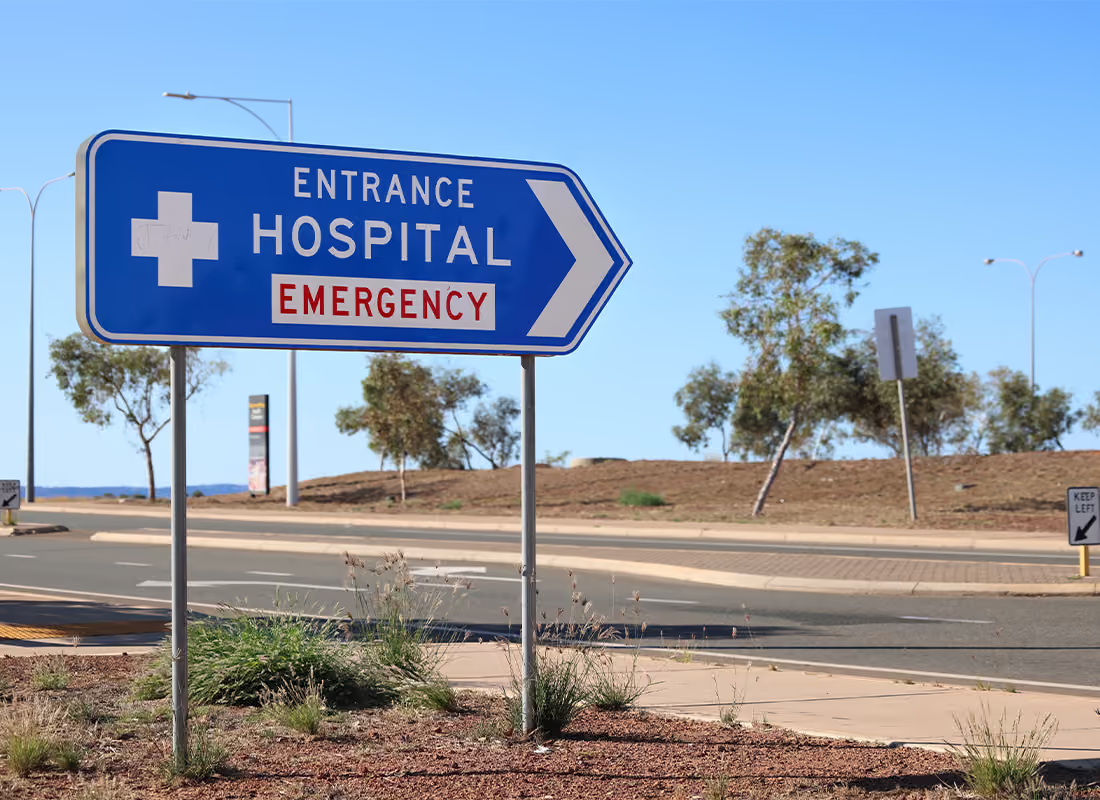
Limiting access doesn't save money. It defers the cost, with interest, to the most expensive setting in the system. Every one of those visits is a failure that happened upstream, in a primary care appointment that didn't exist or didn't happen in time.
That figure combines absenteeism, presenteeism, and disability, and it sits on top of premiums that have risen more than 50% over the last decade. Employers are the largest single purchaser of healthcare in the country. The access gap is a line item on their balance sheet whether they've named it that way or not.
College is one of the largest investments a family makes. When a student's health needs go unmet, that investment doesn't underperform. The value of that investment can be lost entirely. We've seen the same pattern play out firsthand across our own campus deployments: wait times stretching two to three weeks, counselor ratios running three to four times recommended levels, and students opting out of care entirely rather than navigating a system that was never built around them.
Fewer than 150 institutions drive the majority of U.S. clinical trial activity, concentrated almost entirely in major metro areas. That systematically excludes rural populations, communities of color, and low-income patients, the same populations carrying the highest chronic disease burden and needing the drugs being tested the most. That's not a diversity problem. It's a science problem: it shapes which drugs get approved, how they're dosed, and who they're labeled for.
These numbers represent different manifestations of the same underlying challenge: too many people struggle to access timely healthcare.
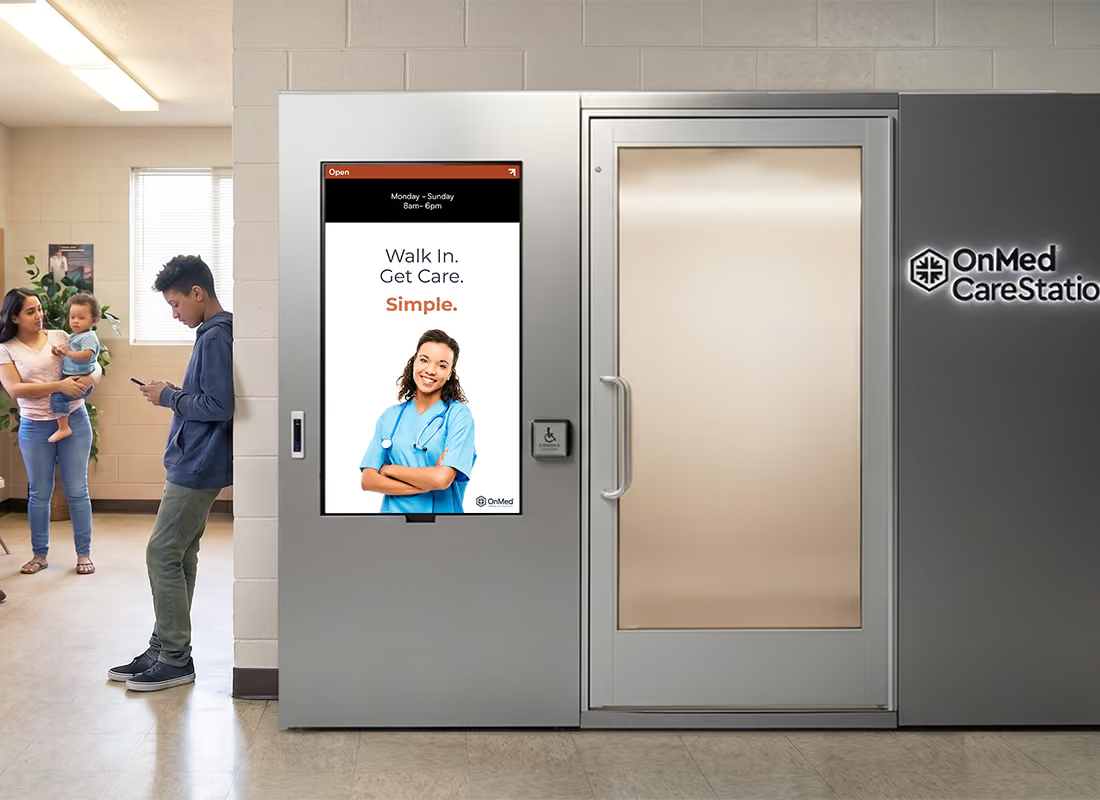
OnMed is solving America's healthcare access crisis with its patented OnMed CareStation®, an 8×10 foot "Clinic-in-a-Box" that delivers comprehensive, immediate care wherever people live, work, and learn. It's a tech-enabled, AI-powered, and human-delivered platform that blends the comprehensiveness of traditional in-person care with the rapid scalability of telemedicine. For 80% of CareStation patients, it has become their medical home, the place they return to and trust for care they couldn't reliably get anywhere else.
Through the CareStation, healthcare organizations, employers, educational institutions, and community partners can bring care closer to the people they serve.
These eight statistics above are only a snapshot. The full Access Gap research report explores the impact of healthcare access challenges across employer, provider, payor, education, government, and biopharma environments.
Want the full data behind every number on this list? Download The Access Gap research report or connect with our team to talk through what closing the access gap could look like for your organization.
A healthcare desert is a community where people face significant barriers to receiving timely healthcare. These barriers may include provider shortages, appointment delays, transportation challenges, limited clinic availability, affordability concerns, or fragmented care delivery.
OnMed is the leader in tech-enabled hybrid-healthcare company expanding access to care through the patented OnMed CareStation®, an 8' × 10' "Clinic-in-a-Box" that brings licensed clinicians and diagnostic tools together through a fully integrated device and human platform. Remote clinicians can examine a patient, assess symptoms, and provide treatment and prescriptions, blending the comprehensiveness and comfort of a traditional doctor's visit with the rapid scalability of virtual care. OnMed's technology and scalable infrastructure are designed to be deployed in communities where people live, work, and gather, bringing access to healthcare without requiring the time, staffing, and physical footprint of a traditional clinic.
The CareStation is a private space where a patient meets with a licensed clinician over live video while integrated diagnostic tools—blood pressure monitoring, pulse oximetry, thermal scanning, and a high-definition exam camera—support the visit. It runs on broadband or satellite and needs only a power outlet.
The physician shortage is driven by three converging forces: an aging population, a physician workforce that's itself nearing retirement, and a capped residency pipeline limiting how many new doctors can enter practice. According to AAMC, that adds up to a shortage of more than 200,000 physicians and clinicians today, with a formally projected gap of up to 124,000 by 2036. It isn't a shortage that corrects itself—it's a structural mismatch between where patient demand is headed and how the system trains people to meet it.
120 million Americans still can't reliably get through the door to basic care. More hospitals, more specialists, more spending—none of it reaches them without a real front door to care. Fort Worth's CareStation location is a small-scale example of what that looks like: a real clinician inside a store people already trust, not one more thing standing between them and care. Read the access gap report →
Follow along as we continue to redefine the healthcare landscape and bring the OnMed CareStation to communities across the U.S.