
Why leaders should view the mental health crisis as a signal that healthcare delivery itself needs to evolve.
Every year on World Mental Health Day, the conversation centers on awareness. This year’s theme from the World Federation for Mental Health, “Lived Experiences Heard: Real Voices, Real Change,” asks leaders to listen to what people actually experience when they try to get help.
That question belongs to more than healthcare. Employers, educators, public-sector and community leaders, health systems, and payors all oversee people whose wellbeing depends on how well care works. For all of them, the question is the same: what does the mental health crisis teach us about the future of care delivery?

Awareness has done important work. Americans know the country is struggling. The harder problem is what happens after someone decides to seek help.
SAMHSA’s 2024 survey found that 23.4% of U.S. adults, or 61.5 million people, had a mental illness in the past year, and that share was unchanged from 2021. The rate was highest among young adults aged 18 to 25, at 33.2% (11.6 million people), the highest of any adult age group. Among adolescents aged 12 to 17, about 1 in 5 (18.8%, or 4.9 million) reported moderate or severe symptoms of generalized anxiety disorder.
The need is large, but it is not suddenly new. According to the American Hospital Association’s summary of the survey, only 52.1% of those adults received any mental health treatment, which means nearly half did not. Awareness cannot close that gap alone. Leaders have to address the structural and operational issues that determine whether care is timely, connected, and resolved, alongside the awareness efforts already underway.
Mental health is not only a clinical concern. It is an operating concern for any organization responsible for people.
Workforce and productivity. In a 2022 Gallup survey, workers who rated their mental health as fair or poor reported nearly 12 unplanned absence days a year, compared with 2.5 days for other workers, a gap Gallup values at $47.6 billion annually in lost productivity. The World Health Organization estimates that depression and anxiety alone cost the global economy about US$1 trillion a year, mostly through lost productivity. The healthcare workforce is affected too: the AMA reports that in 2025, 41.9% of physicians had at least one symptom of burnout, down from 43.2% in 2024, with ineffective EHR systems, inadequate staffing, and administrative burden among the recurring sources of stress.
Healthcare economics. The CDC reports that 90% of the nation’s $5.3 trillion in annual health care spending is for people with chronic and mental health conditions. In a claims study of 43.9 million commercially insured adults, a depression diagnosis was associated with about $2,951 in added annual cost, comparable to the added cost of major chronic physical conditions.
The same dynamics apply wherever leaders are responsible for people, whether that is a workforce, a community, or a covered population. The settings differ. The underlying delivery challenge does not.
America’s mental health crisis cannot be explained by any single factor. Biological, social, economic, and environmental influences all play a role. But leaders should recognize that the way care is delivered can either reduce stress and uncertainty or compound them.
Mental health challenges rarely exist in isolation from the rest of a person’s healthcare experience. People do not experience healthcare in categories. They experience it as one journey: a symptom, an appointment, a referral, a bill, a wait. The cost data above reflect that overlap, since chronic physical conditions and mental health conditions drive spending together. When physical and mental health are handled as separate systems, the person is left to bridge the gap between them.
Delay. Every delay carries more than a clinical cost. Unresolved health concerns create uncertainty, and uncertainty itself can become a source of stress. We do not have a precise measure of that burden, but delay is common: in KFF’s 2026 survey, 15% of adults said their health got worse because they skipped or delayed care.
Fragmentation. Care journeys span plans, clinicians, and settings, and navigating them takes effort. KFF found that 74% of insured adults who received mental health treatment in the past year reported a problem using their coverage. Each unresolved step adds to the burden carried by patients and the caregivers who support them. In our view, expectations are part of the picture too: people increasingly want care to fit into daily life, and the gap between that expectation and today’s experience is felt directly.

Deciding to seek help is only the first step. Even where clinicians exist, many are full: in the American Psychological Association’s 2025 Practitioner Pulse Survey, 46% of psychologists reported having no openings for new patients, and 40% were keeping a waitlist. Among adults ages 18 to 64 who were treated for a mental health condition, KFF found that 29% of those with insurance and 43% of those without said they tried to get care but no appointments were available, and that 40% of insured adults and 84% of uninsured adults skipped or delayed care because of cost.
Add the coverage problems described above, and the path from deciding to seek help to receiving it can take many steps, each one a chance to give up. These are delivery problems as much as demand problems.
The industry has spent years adding capacity the same ways: more facilities, more providers, more programs, more referrals. Those investments matter. But HRSA data show that as of December 2025, 137 million Americans, about 40% of the country, lived in a federally designated Mental Health Professional Shortage Area, up 15 million in a single year, and that as of April 2026 only about a quarter of the workforce need in those areas was being met.
The question facing leaders is no longer whether mental health needs exist. The question is whether existing delivery models were designed to meet today’s demand. In many communities and organizations, demand is growing faster than capacity can be added through traditional approaches alone.
The organizations that make the greatest difference may not be those that simply expand mental health programs. They will be those that examine how healthcare is delivered and address the barriers that prevent people from getting timely support. Five priorities stand out:
America’s mental health crisis is often framed as a shortage of providers or a lack of awareness. Those challenges are real, but they are incomplete.
Healthcare has become increasingly difficult to navigate, coordinate, and fit into everyday life. The organizations that will make the greatest impact may not simply be those that expand mental health programs. They will be the organizations that reduce uncertainty, improve continuity, remove friction, and create faster paths to care resolution.
The opportunity is not simply to respond to the mental health crisis. It is to build a healthcare system that creates less stress, less uncertainty, faster resolution, and better outcomes from the start.
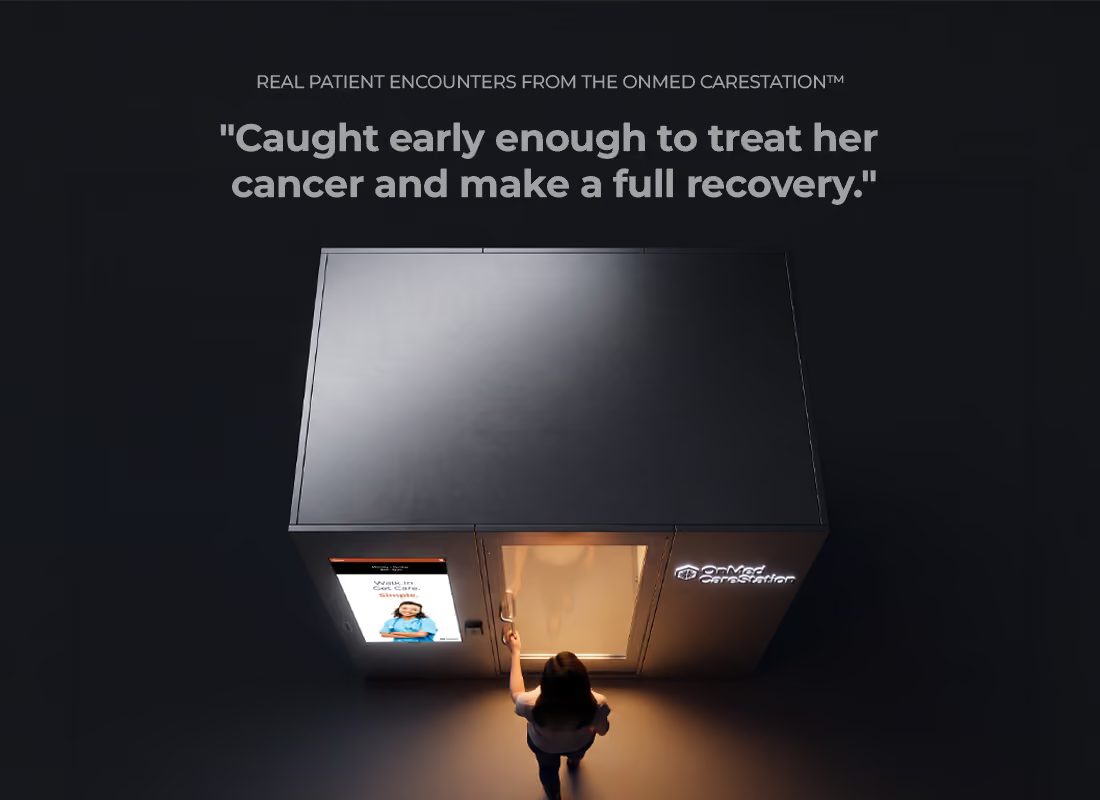
OnMed is transforming how the world accesses healthcare. With its patented OnMed CareStation®, an 8×10-foot "Clinic-in-a-Box," OnMed delivers comprehensive, immediate care wherever people live, work, and learn.
The OnMed CareStation® connects patients in real time with licensed clinicians and diagnostic tools through a fully-integrated device and human platform. Walk in and get a diagnosis, treatment plan, and e-prescription. No appointment. No waiting rooms. Just immediate care when and where you need it most.
At OnMed, we recognize that physical and mental wellbeing are deeply connected. The CareStation currently provides mental health screenings during the same private visit in which individuals can address physical health concerns. As demand for mental health support continues to grow across communities nationwide, OnMed remains committed to expanding services in the CareStation and helping individuals to identify and address concerns earlier.
Powered by public-private partnerships across insurers, healthcare providers, governments, employers, and educational institutions, OnMed is redefining healthcare access, closing critical gaps, restoring trust, and strengthening the health and economic resilience of communities everywhere.
World Mental Health Day is observed every year on October 10. The World Federation for Mental Health describes the day as a chance to raise awareness of mental health issues worldwide and to mobilize efforts in support of mental health.
The World Federation for Mental Health has set the 2026 theme as 'Lived Experiences Heard: Real Voices, Real Change.
In 2024, 23.4% of U.S. adults had a mental illness in the past year, and 52.1% of them received any mental health treatment, which means nearly half did not.
It affects attendance, productivity, and cost. Gallup found that workers with fair or poor mental health reported nearly 12 unplanned absence days a year, compared with 2.5 days for other workers, and the WHO estimates that depression and anxiety cost the global economy about US $1 trillion a year.
No single factor explains the mental health crisis, but delivery matters. Surveys do not measure emotional effects directly, yet they show how common delay and friction are: 15% of adults said their health got worse after skipping or delaying care, and 74% of insured adults who received mental health treatment reported a problem using their coverage. Delays and hard-to-navigate care add uncertainty and burden, so delivery can either reduce stress or compound it.
Common barriers include full practices, waitlists, unavailable appointments, cost, and coverage problems. 46% of psychologists reported no openings for new patients, and KFF found that adults treated for a mental health condition reported being unable to get an appointment and skipping or delaying care because of cost.
As of December 2025, 137 million Americans lived in a federally designated Mental Health Professional Shortage Area, and only about a quarter of the workforce need in those areas was being met. Demand is outrunning what traditional delivery models can scale to meet, which is why delivery design matters alongside hiring.
Five priorities stand out: increase capacity where demand is greatest, reduce wait times to care, bring care closer to where people are, remove friction from the care journey, and measure resolution, not just utilization.
Follow along as we continue to redefine the healthcare landscape and bring the OnMed CareStation to communities across the U.S.