From the South Bronx to Chicago's South Side, healthcare isn't always defined by distance. Increasingly, it's defined by whether patients can receive timely diagnosis, treatment, and resolution.
When most people think about healthcare deserts, they think about rural America.
They don't think about Boston.
They don't think about Houston.
They don't think about neighborhoods sitting just miles from world-class hospitals, major healthcare systems, and some of the country's most densely populated urban centers.
Yet for many residents in cities, getting healthcare can be surprisingly difficult.
In Boston, a city employee keeps postponing a follow-up appointment for high blood pressure because taking time away from work to travel across the city for a daytime appointment isn't practical.
In Houston, a patient with diabetes relies on multiple bus transfers to reach the only specialist covered by his insurance, turning a routine appointment into a half-day commitment.
In Los Angeles, a community college student postpones care for recurring migraines after learning the next available appointment is several weeks away.
Three cities. Three different barriers. One outcome: delayed care.
None of these individuals live in rural America. They're surrounded by healthcare resources, yet they're all experiencing the same challenge: not a lack of healthcare, but a lack of timely diagnosis, treatment, and resolution.
Healthcare is nearby. Resolution is not.
The data backs this up. In the South Bronx—the poorest urban congressional district in the country—residents face some of the highest rates of diabetes, asthma, and heart disease in New York City, despite sitting minutes from some of the region's best hospitals.
A landmark 2019 study found that 73% of predominantly Black neighborhoods in Chicago sat in a “trauma desert”, more than five miles from the nearest Level I or Level II trauma center—in a city with some of the country's most renowned academic medical centers. The pattern hasn't reversed: a February 2025 Urban Institute analysis found that two major hospitals and specialty care lines closed in two of Washington DC's most underserved neighborhoods between 2019 and 2023, cutting off care that had been convenient and timely just a few years earlier.
An October 2025 Georgetown University analysis puts a number on just how widespread this pattern is. Measuring healthcare deserts by health outcomes rather than provider counts alone, researchers found that only 22% of the nation's healthcare deserts are rural—the remainder are urban or semi-urban, including dozens of census tracts across the Chicago metropolitan area alone.
Cities don’t lack healthcare deserts. They’re just better hidden.
When healthcare leaders hear the term healthcare desert, they often think about physical distance between patients and providers. But geography is only part of the story.
A healthcare desert is ultimately defined by barriers that separate people from care. Provider shortages, appointment delays, transportation challenges, limited clinic hours, workforce constraints, childcare responsibilities, and fragmented care delivery can all create distance between a patient and resolution, even when providers are located nearby.
The reality is that proximity and access are not the same thing.
What makes these gaps easy to miss is that they rarely come from a single missing service. They emerge when multiple barriers compound at once: shortages of primary care, mental health services, specialty care, pharmacies, transportation, and affordable points of care. Clinics close. Specialists migrate toward wealthier markets. The providers who remain become overwhelmed. Over time, residents can live blocks from major hospitals and still struggle to receive the care they need.
Consider the evidence:
More than 80% of U.S. counties lack adequate healthcare access in at least one critical category, according to GoodRx Research, and nearly 60% experience multiple types of healthcare deserts simultaneously, including shortages of primary care, hospitals, trauma services, pharmacies, or community health centers.
In designated primary care deserts, the average ratio is one full-time primary care provider for every 7,597 residents, more than 2.5 times the recommended level.
Nationally, roughly 92 million people live in a primary care shortage area, and 137 million live in a mental health shortage area—a scale of gap that no scheduling app or virtual-visit platform closes on its own.
Together, these findings point to a larger truth: healthcare deserts are not simply places where healthcare is absent. They are places where people struggle to receive timely diagnosis, treatment, and resolution despite the presence of healthcare infrastructure around them.
In many urban communities, healthcare is available on paper but difficult to navigate in practice. The result is a growing disconnect between where care exists and where people can realistically receive it. That disconnect carries consequences not just for patients, but for the organizations responsible for improving health outcomes.
Healthcare deserts are often discussed as a public health issue. Increasingly, they have become a financial, operational, and workforce challenge for employers, payors, providers, government agencies, and educational institutions alike.
Employers invest heavily in healthcare benefits, yet employees continue delaying care because appointments do not fit the realities of their schedules.
Health plans are increasingly measured on their ability to engage members earlier, improve preventive care utilization, and reduce avoidable downstream costs.
Government agencies and community organizations invest in population health initiatives while underserved communities continue struggling to receive timely care.
Universities work to support student well-being while campus health resources face growing demand.
The outcome is familiar across every sector:
When routine healthcare becomes difficult to navigate, minor concerns have a way of becoming major ones.
What could have been addressed through early intervention becomes a higher-cost event that impacts both individual health and organizational performance.
For years, healthcare organizations have looked to technology to help address care gaps.
Patient portals, scheduling platforms, virtual visits, and telehealth solutions have all improved convenience. Yet none has solved the underlying challenge.
Technology can support care delivery, but it cannot alone create provider capacity, eliminate workforce shortages, or resolve the structural barriers that continue to separate communities from care.
The challenge is growing. Today, it takes an average of 31 days to secure a new-patient physician appointment across the 15 largest U.S. metropolitan areas. Meanwhile, As of 2021, the country needed up to 200,000 more physicians just to meet existing demand.
Organizations making meaningful progress are focusing less on the next tool and more on care delivery models that bring diagnosis, treatment, and resolution closer to where people already are.
Leading organizations are increasingly recognizing that improving outcomes starts with reducing friction.
Instead of asking people to rearrange their day, travel across a city, wait weeks or months for availability, or delay care until symptoms become more serious, healthcare can be embedded directly into workplaces, educational institutions, government facilities, community spaces, and residential developments.
The goal is to help people receive care sooner, support earlier intervention, and improve the likelihood that health concerns are addressed before they become more serious and more expensive.

Urban healthcare deserts do not require a hospital on every corner. They require care models that remove friction.
That is why forward-thinking employers, health systems, and community organizations are embedding healthcare directly into the environments where care gaps actually occur.
In Atlanta, the City of Atlanta deployed two OnMed CareStation locations to provide municipal employees, including Fire Rescue and Police Department personnel, with on-site primary and urgent care. As Calvin Blackburn III, Commissioner of the City's Department of Human Resources, noted, the initiative was designed to remove barriers by bringing care directly to employees.
"The City of Atlanta is committed to supporting the health, wellness, and overall quality of life of our employees. Our partnership with OnMed represents an innovative step forward in providing convenient, accessible healthcare solutions for our workforce. By bringing healthcare access directly to employees, we're helping to remove barriers to care and ensuring our team members have the resources they need to stay healthy, informed, and supported."
Also in Atlanta, a deployment through the Georgia State Health Benefit Plan demonstrates what that can look like at scale. Since launch, the program has recorded more than 5,100 visits, a 4.95 out of 5 patient satisfaction score, and 89% of conditions resolved on-site. According to Cathy Craven, Deputy Executive Director of SHBP, half of users reported they would have otherwise visited the emergency department.
In Miami's historic Overtown neighborhood, OnMed partnered with the Overtown Youth Center (OYC) to bring care directly into a trusted community organization at no cost and with no insurance requirement. The deployment has generated more than $89,000 in emergency department and urgent care savings while serving more than 218 patients on-site, with the vast majority of visits resolved without outside referral.
A partnership among Jackson Health System, The Salvation Army, and OnMed brought care directly into the Allapattah community. As Javier Gutierrez of Jackson Health System explained, the initiative was designed to bring trusted healthcare closer to where residents live and gather.
"As Miami-Dade County's only public health system and one of the county's leading healthcare providers, Jackson Health System is always looking for innovative ways to expand access to care beyond the walls of our hospitals and clinics. Our mission is to build the health of our community by providing high-quality care to all residents of Miami-Dade County, regardless of their ability to pay. Through our partnership with OnMed and The Salvation Army, we're bringing trusted care closer to where people live, and making it easier for residents to get the care they need, when and where they need it."
These organizations share a common realization: the challenge is not convincing people healthcare matters.
The challenge is bringing healthcare into places where people can realistically use it.
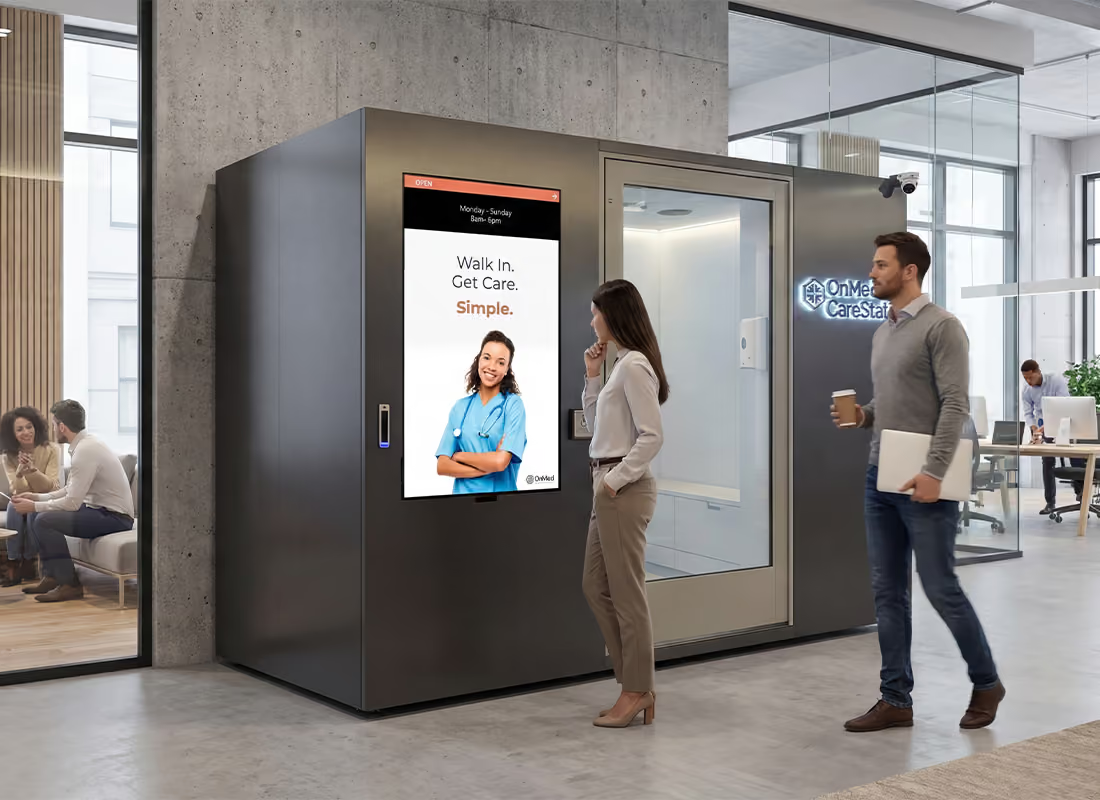
This is precisely why the OnMed CareStation™ was created.
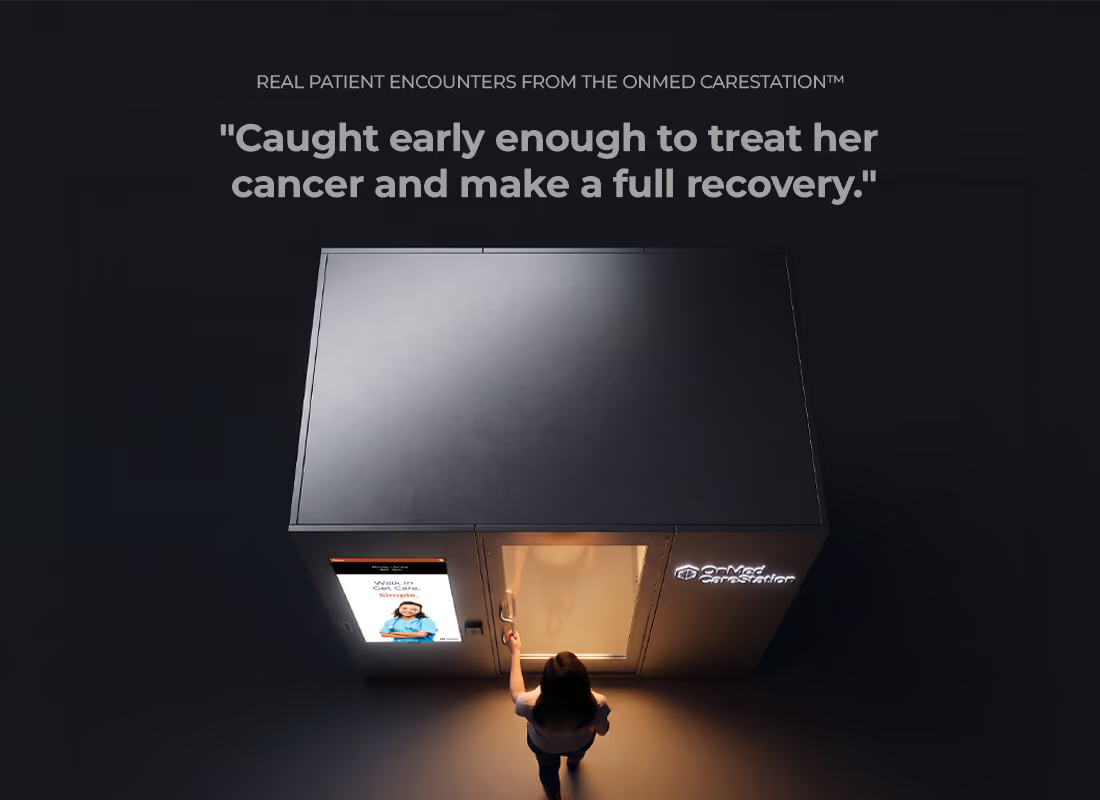
The CareStation is a patented 8×10-foot “Clinic-in-a-Box” that combines real-time clinician care with integrated medical-grade diagnostic tools, bringing comprehensive healthcare directly into the places where people already are.
Patients simply walk in and press start.
From there, they connect with a licensed clinician who can conduct a comprehensive evaluation using HD cameras, digital stethoscopes, otoscopes, calibrated blood pressure monitoring, pulse oximetry, thermal imaging, and integrated vital sign capture.
Unlike traditional telehealth models that often end with a recommendation to seek care elsewhere, the CareStation is designed to help patients move from concern to resolution in a single encounter whenever clinically appropriate.
The results demonstrate that impact:
For employers, that means lowering claims costs, reducing absenteeism, supporting earlier intervention, and helping prevent chronic conditions from becoming more costly health events.
For health plans, it means creating new opportunities for member engagement and earlier intervention.
For government agencies and community organizations, it means extending healthcare services into underserved populations without the cost and complexity of building additional facilities.
For health systems, it means expanding reach, supporting continuity of care, and reducing avoidable demand on higher-cost settings.
Urban healthcare deserts reveal an important truth about modern healthcare.
The challenge is no longer simply whether care exists.
The challenge is whether people can realistically receive timely diagnosis, treatment, and resolution—on their terms.
Organizations that successfully address healthcare deserts will be the ones that reduce friction, meet people where they are, and create care delivery models designed around how people actually live.
Because healthcare deserts are not defined by how far patients are from a hospital.
They are defined by how difficult it is to access care.
America's healthcare crisis isn't going away. The organizations that will lead the next generation of healthcare delivery won't simply expand where and when care is available.
They'll rethink where care happens in the first place.
Solving healthcare deserts requires more than healthcare facilities. It requires partnerships. OnMed works alongside employers, governments, educational institutions, health systems, payors, biopharma companies, and community organizations to bring healthcare closer to the populations they serve.
Together, we're creating new front doors to care in workplaces, schools, community centers, municipal buildings, and other everyday environments, helping organizations improve outcomes, reduce costs, strengthen engagement, and deliver timely diagnosis, treatment, and resolution where healthcare is needed most.
Ready to bring care closer to the people you serve? The CareStation helps employers, health systems, health plans, government agencies, and educational institutions reduce barriers to care, improve population health, divert non-emergent demand from high-cost settings, and deliver meaningful healthcare resolution closer to the people they serve.
A healthcare desert is a community where people face significant barriers to receiving timely healthcare. These barriers may include provider shortages, appointment delays, transportation challenges, limited clinic availability, affordability concerns, or fragmented care delivery.
Yes. Healthcare deserts are not exclusively rural. Urban healthcare deserts occur when residents face persistent obstacles that make timely diagnosis, treatment, and resolution difficult despite living near healthcare resources.
Contrary to popular assumption, most are not rural. A 2025 Georgetown University analysis that measures healthcare deserts by health outcomes rather than provider counts alone found that only 22% of the nation's healthcare deserts are rural—the majority are urban or semi-urban, a pattern that traditional supply-based measures often miss.
Healthcare deserts can contribute to delayed treatment, absenteeism, presenteeism, unmanaged chronic conditions, higher healthcare spending, and lower workforce productivity.
Telehealth can improve convenience, but many healthcare concerns still benefit from clinician-guided evaluations supported by medical-grade diagnostic tools. Telehealth alone cannot fully address provider shortages, appointment delays, or other care delivery challenges.
The CareStation is a patented “Clinic-in-a-Box” that connects patients with licensed clinicians in real time while leveraging integrated medical-grade diagnostic tools to support comprehensive evaluations, diagnosis, treatment, and care coordination.
The CareStation brings clinician-guided healthcare directly into workplaces, educational institutions, government facilities, and community settings, helping reduce barriers that often prevent people from receiving timely care and resolution.
The CareStation supports employers, health systems, health plans, government agencies, educational institutions, community organizations, and other groups looking to improve healthcare delivery, population health outcomes, and care engagement.
Follow along as we continue to redefine the healthcare landscape and bring the OnMed CareStation to communities across the U.S.