Show: Purpose 360
Host: Carol Cone
Guest: Karthik Ganesh, CEO of OnMed
Published: October 20, 2026
Duration: 32:16
In this episode of the Purpose 360 Podcast, host Carol Cone sits down with OnMed CEO Karthik Ganesh to ask whether the future of healthcare is less about getting people to care and more about bringing care to people. Karthik explains why access is healthcare’s “broken door,” why traditional clinics and telemedicine have each hit their limits, and how the OnMed CareStation® closes the gap with a live clinician and integrated diagnostic tools inside a private 8×10 foot space.
The conversation covers where the CareStation is already deployed, including rural health systems, correctional facilities, a Georgia deployment for state employees in downtown Atlanta, and a partnership between Jackson Health System and the Salvation Army. The episode also previews plans to bring mental health care to the CareStation and explains the “human last mile” principle behind its design.
“We have taken the best of in-person care, the best of telemedicine, put it into a CareStation, and we neutralize the weaknesses.”
“If you don’t take care of the people who continue to fall sick, who are in the earlier stages, all you’re doing is you’re putting a band-aid on a dam that is already bursting without fundamentally going back and fixing the infrastructure.”
“There is a very core design constraint to the way we built the CareStation. It is a human last mile.”
“This is not aspirational. This is not a pilot. This is deployed, active, in communities, making a difference.”
“Healthcare in America especially is not a field of dreams. If you build, they will not come. You have to show up where they are.”
Access has been the throughline of Karthik’s career. He tells Carol Cone that 80% of U.S. counties contain healthcare deserts. Complex and chronic conditions matter, he says, but people need access before they can even learn whether they have a condition.
His analogy is a homeowner who upgrades the master bath while the front door is broken: no one can get in to see the upgrade. OnMed was built to fix that entry point.
In his view, healthcare’s two dominant models have each hit a ceiling. Brick-and-mortar clinics are too expensive to stand up, and the country is running out of clinicians. Telemedicine, which many saw as a silver bullet during COVID, is limited without vitals, scans, and biometrics, which is where the CareStation’s integrated diagnostic tools come in.
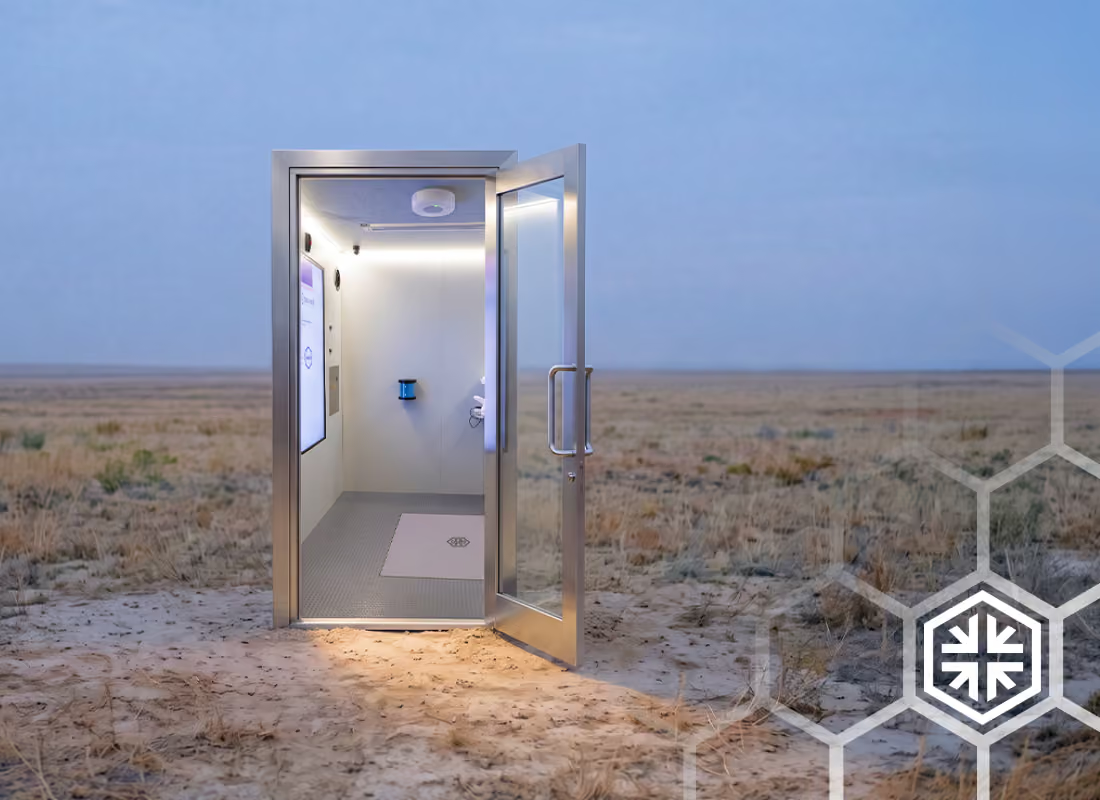
As Karthik describes it, a visit to the OnMed CareStation® starts with a built-in scale and a check of vitals. A clinician appears on a 55-inch screen, the door closes, and the glass fogs for privacy. Using a stethoscope, a high-definition camera, and infrared scans, the clinician conducts a live visit and writes any e-prescription or referral. UVC light then disinfects every surface before the next patient.
Technology is a constant theme in the conversation, but the last step is always a person. Karthik calls a human last mile a core design constraint of the CareStation, and he describes the unit as re-engineering the first mile of healthcare: the entryway from which a patient can go to the ER, a specialist, or wherever they need to go next.
Carol Cone notes the 37% return rate, which he calls a higher level of engagement than almost any other patient-provider relationship, with pediatricians as the exception because visits are often school-mandated. She also cites the 86% of conditions handled inside the CareStation, and he expects that number to rise.
OnMed is actively working on bringing mental health care to the CareStation, Karthik says. He calls stigma the single largest reason people avoid mental health care, and he sees the private setting as an answer to it.
In the model he describes a clinician who notices a sign such as poor sleep can use a brief screening questionnaire and bring in a psychiatric nurse, so one care team looks after the whole person.
OnMed acts as an extension of the hospital, Karthik says: hospitals place CareStations in their own communities under their own brand, and OnMed operates them. From contract signing, a CareStation can be in the ground in six weeks.
Because it is a subscription, not a capital purchase, hospitals avoid large upfront outlays and the burden of staffing, and Karthik says it costs not even one-tenth of what brick and mortar does. Hartford HealthCare has done this in rural central Connecticut. Deployments also include correctional facilities, a foster care center, a Georgia deployment for state employees in downtown Atlanta, and a partnership between Jackson Health System and the Salvation Army.
OnMed is transforming how the world accesses healthcare. With its patented OnMed CareStation®, an 8×10-foot “Clinic-in-a-Box,” OnMed delivers comprehensive, immediate care wherever people live, work, and learn.
The OnMed CareStation® is a tech-enabled, AI-powered, and human-delivered platform that blends the comprehensiveness of traditional in-person care with the rapid scalability of telemedicine. Each CareStation serves as a local access point within a scalable, connected grid that delivers everyday healthcare at scale.
Powered by public-private partnerships across insurers, healthcare providers, governments, employers, and educational institutions, OnMed is redefining healthcare access, closing critical gaps, restoring trust, and strengthening the health and economic resilience of communities everywhere.
See how the OnMed CareStation® brings care to employers, health systems, universities, government agencies, and communities across the country. Connect with the OnMed team to talk about deploying one in yours.
Follow along as we continue to redefine the healthcare landscape and bring the OnMed CareStation to communities across the U.S.