
A 74-year-old retiree postpones her blood pressure follow-up because the clinic is a long drive across town, and she no longer feels comfortable making that drive alone.
A 51-year-old executive schedules her children's checkups and a parent's specialist visit during a lunch break, then realizes it has been years since her own physical.
A 35-year-old construction worker has been meaning to see a dermatologist for months, but between researching who's actually in-network and finding someone with an opening, he still hasn't booked an appointment.
A 22-year-old graduate student manages nearly every dimension of daily life from a smartphone in minutes, yet the severe migraines that flare up during finals week lead to an hours-long wait at the ER.
Four different life stages. Four different sets of obligations. And, on the surface, four different relationships to the healthcare system.
But beneath those differences sits a single, more consequential pattern: for each of them, the constraint was never willingness. It was friction.
For decades, the healthcare access conversation centered on geography, insurance design, provider supply, and social determinants of health. Those forces remain real. But a second, less-examined variable has emerged alongside them: generational tolerance for friction is diverging sharply, and that divergence is now shaping utilization more than availability alone.
For employers, government agencies, educational institutions, health systems, payors, and biopharmaceutical organizations, the operative question is no longer whether care exists within reach of a population. It is whether that population will actually engage with it. Whether that population consists of employees, students, residents, members, patients, or clinical trial participants, engagement is increasingly determined by how much friction stands between a person and care.

It is tempting to treat generational differences in healthcare behavior as differences in values. The data suggests something more precise: each generation is straining against a different kind of friction, and each reveals where the access system breaks first.
They grew up with a single family physician as the default model of care, then watched employer coverage shift from fee-for-service to HMOs and now to Medicare Advantage plans that cover more than half of beneficiaries and grant access to only about half the physicians available under traditional Medicare, according to KFF.
Government moved just as directly: Medicare and Medicaid were signed into law in 1965, while this entire generation was still growing up, creating the safety net most of them now depend on directly. That dependence is intensifying at the worst possible moment for supply: one in four healthcare workers nationally, roughly 5 million people, are over 55 and approaching retirement themselves, according to the Michigan Health Council, just as this generation's own care needs peak—93% of adults 65 and older now manage at least one chronic condition, and nearly 79% manage two or more, according to a 2025 analysis in the CDC's Preventing Chronic Disease journal.
None of this is nostalgia. It's a generation that watched every layer of the system they now rely on change around them, which is exactly why a known, trusted physician still matters more to them than it does to anyone else.
For this generation, access is not simply about availability. It is about maintaining trusted relationships while removing the barriers that make care harder to reach.
Gen X grew up as the self-reliant "latchkey generation," raised in dual-income households that came home to an empty house after school—independence that, as adults, has hardened into caregiving loads split between children and aging parents.
According to AARP and the National Alliance for Caregiving's 2025 Caregiving in the US report, 63 million Americans, nearly 1 in 4 adults, now serve as family caregivers, with the typical caregiver 51 years old and devoting 27 hours a week to the role, 24% providing 40 hours or more. Nearly 3 in 10 are sandwich-generation caregivers, managing children and aging parents at once, with far higher rates of work disruption than caregivers overall.
This generation isn't looking for less oversight.
They're looking for less friction in reaching the physician-led care they still prefer—and a scheduled, business-hours appointment is the hardest thing to fit into an already overextended caregiver's day.
Millennials entered the workforce during or after the 2008 financial crisis, just as Amazon, the iPhone, and Uber were resetting consumer expectations for speed across every industry, healthcare included.
A national Kaiser Family Foundation poll found that 28% of adults ages 30 to 49 have no primary care provider at all. That's less surprising when you consider timing. Millennials are the first generation to come of age after healthcare's gatekeeper era, when strict referral-based insurance models were beginning to give way to greater consumer choice and more flexible access. As a result, convenience and direct access feel less like a luxury and more like an expectation.
Yet a separate American Hospital Association survey found 93% of Millennials still want an ongoing relationship with a provider, even as 85% feel that provider only engages with them when they're already sick.
Their preferred modality, fast and digital-first, delivers speed but not continuity. This generation still wants a trusted clinician. They've simply abandoned the friction of traditional scheduling in search of one.
Gen Z has never known a world without a smartphone in hand, and for the oldest members of this generation, then in their late teens and early twenties, COVID-19 was the event that most shaped their view of healthcare: when clinics closed their doors in 2020, telehealth visits jumped 154% in a single week that March, per CDC data, normalizing virtual, on-demand access as the default.
CNN reported that more than one in four young adults have no primary care provider at all.
The 2026 Aflac Wellness Matters survey found nearly two-thirds of Gen Z (65%) delay or skip routine checkups altogether, with reliance on emergency rooms and urgent care climbing to 62%, up from 51% the year before—a shift researchers describe as a move from proactive to reactive healthcare-seeking.
OnMed's own analysis of the Gen Z workforce found that 58% expect an immediate response from a provider and another 18% within a few hours, a bar almost no traditional scheduling model is built to meet.
Their preferred modality, virtual and on-demand, satisfies the need for immediacy. But it does not solve the deeper problem: without a primary care relationship, routine healthcare often remains episodic, while urgent needs continue to funnel toward urgent care and emergency departments.
Set side by side, these four profiles do not describe four different populations with four different values. They describe four different thresholds for the same set of frictions. What varies by generation is not whether trust, time, convenience, and access matter, but which one is most likely to stand between a person and care.
Trust. Time. Convenience. Access.

The consequence of ignoring these thresholds is measurable, and it compounds. Every organization ultimately pays for friction somewhere, whether through avoidable ER utilization, worsening chronic disease, lower preventive care engagement, poorer member outcomes, lost productivity, reduced retention, or delayed diagnosis. Every missed preventive visit, delayed diagnosis, or deferred chronic-care appointment eventually resurfaces somewhere else in the system, as higher acuity, higher cost, and worse outcomes.
The Centers for Disease Control and Prevention attributes roughly 90% of the nation's $5.3 trillion in annual health care expenditures to people managing chronic and mental health conditions — precisely the population for whom delayed engagement carries the steepest downstream cost.
Separately, research from GoodRx found that more than 80% of U.S. counties, home to over 120 million Americans, qualify as a healthcare desert in at least one critical category, meaning proximity to a facility is frequently not the operative barrier at all.
This reframes the strategic question facing employers, health systems, payors, government agencies, and biopharmaceutical organizations: not how to design a separate care experience for every generation, but how to build a single model with enough range to resolve trust, time, convenience, and access at once. Any model that resolves only one of those frictions will continue to lose the segment of the population for whom a different one is binding.
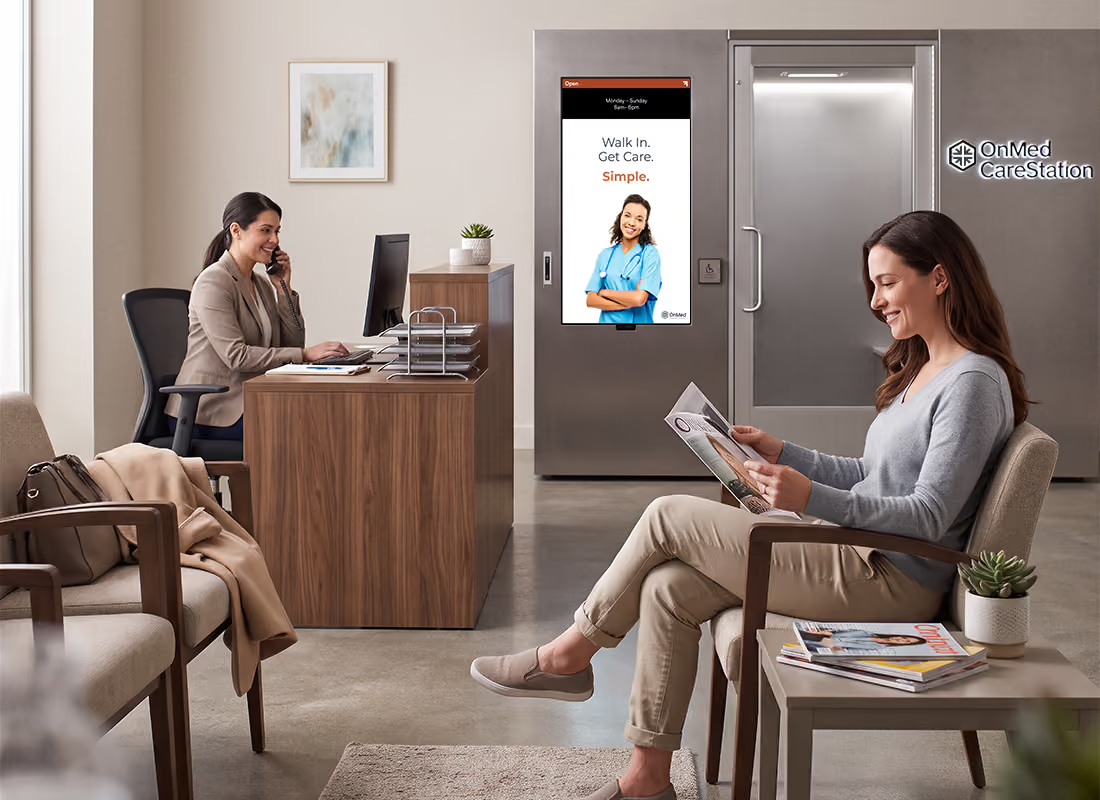
The OnMed CareStation® was designed against this exact set of constraints rather than against a single generational profile. It brings a live clinician visit, supported by integrated medical-grade diagnostic tools, directly into the places people already spend their time: workplaces, schools, government facilities, multifamily housing communities, health system networks, pharmacies, and community centers.
A CareStation visit combines a live clinician consultation with integrated diagnostic tools capable of measuring blood pressure, heart rate, pulse oximetry, temperature, and weight, as well as supporting HD visual, digital stethoscope, and otoscope examinations.
Each dimension of the CareStation maps directly to one of the four frictions.
Each unit deploys in as little as 45 days, needing only a power outlet and a broadband or satellite connection.
For organizations, the strategic value extends well beyond any single visit:
Employers
Lower healthcare costs, reduce absenteeism, improve productivity, support workforce wellbeing, and deliver measurable ROI across a multigenerational workforce.
Government
Convert healthcare investment into measurable community impact, improve population health outcomes, strengthen local economic vitality, and expand reach without new facility construction.
Education
Support student retention and success, improve campus wellness, and reduce strain on student health resources by meeting students where their routines already take them.
Providers and Health Systems
Expand reach across service areas, engage underserved populations, reduce system strain, and retain patients and revenue without constructing new clinical facilities.
Payors
Improve member engagement, increase preventive care utilization, identify risk earlier, and reduce avoidable ER utilization across every generation in a covered population.
Biopharma
Reach overlooked and underrepresented populations, improve clinical and commercial engagement, support decentralized trial strategies, and generate real-world evidence at the point of care.
The future of healthcare access belongs to organizations that can deliver trusted care with less friction.
Because regardless of generation, better outcomes begin with the same first step: getting people connected to care.
Learn how the OnMed CareStation® is helping organizations eliminate friction, expand access, and bring comprehensive care directly to the people they serve.
Each generation is negotiating a different kind of friction. Baby Boomers weigh trust and continuity most heavily, having grown up with, and largely still preferring, a high-touch, relationship-based model of care. Generation X is constrained primarily by time, often while simultaneously caregiving for children and aging parents. Millennials expect the speed and digital convenience they receive from other services, but research shows they still want an ongoing provider relationship. Gen Z is the least likely generation to have a primary care provider at all, and expects immediate, low-friction access to care, particularly for mental health needs, making it the most willing generation to adopt fully digital-first models. The organizational implication is not to build four different care models, but to build one flexible enough to resolve all four frictions at once.
For many Americans, the barrier isn't willingness, it's friction in the system itself. 28% of adults ages 30 to 49 have no primary care provider, according to a national Kaiser Family Foundation poll, and CNN reports that more than one in four young adults are in the same position. Reasons vary by generation, but the pattern is consistent: scheduling models, wait times, and access points haven't kept pace with how people actually need to reach care.
The OnMed CareStation® is a patented, 8×10-foot "Clinic-in-a-Box" that pairs a licensed clinician with integrated diagnostic tools in a single encounter. It's tech-enabled, AI-powered, and always human-delivered, and it deploys in as little as 45 days with no construction required—just an electrical outlet.
Yes. On average, 86% ofCareStation visits are resolved on-site with no referral needed. The remainingvisits are escalated or referred for further care.
Yes. Roughly 80% of CareStation patients have no primary care provider. For many of them, the CareStation becomes their consistent point of contact for both routine and unexpected health needs, effectively serving as a medical home.
58% of CareStation patients report that they would have gone to an emergency room or urgent care facility had the CareStation not been available, indicating meaningful potential to reduce unnecessary ER and urgent care utilization at the population level.
A CareStation typically deploys in as little as 45 days and requires only a power outlet and a broadband or satellite connection, allowing organizations to expand care access without constructing new clinical facilities.
Follow along as we continue to redefine the healthcare landscape and bring the OnMed CareStation to communities across the U.S.