
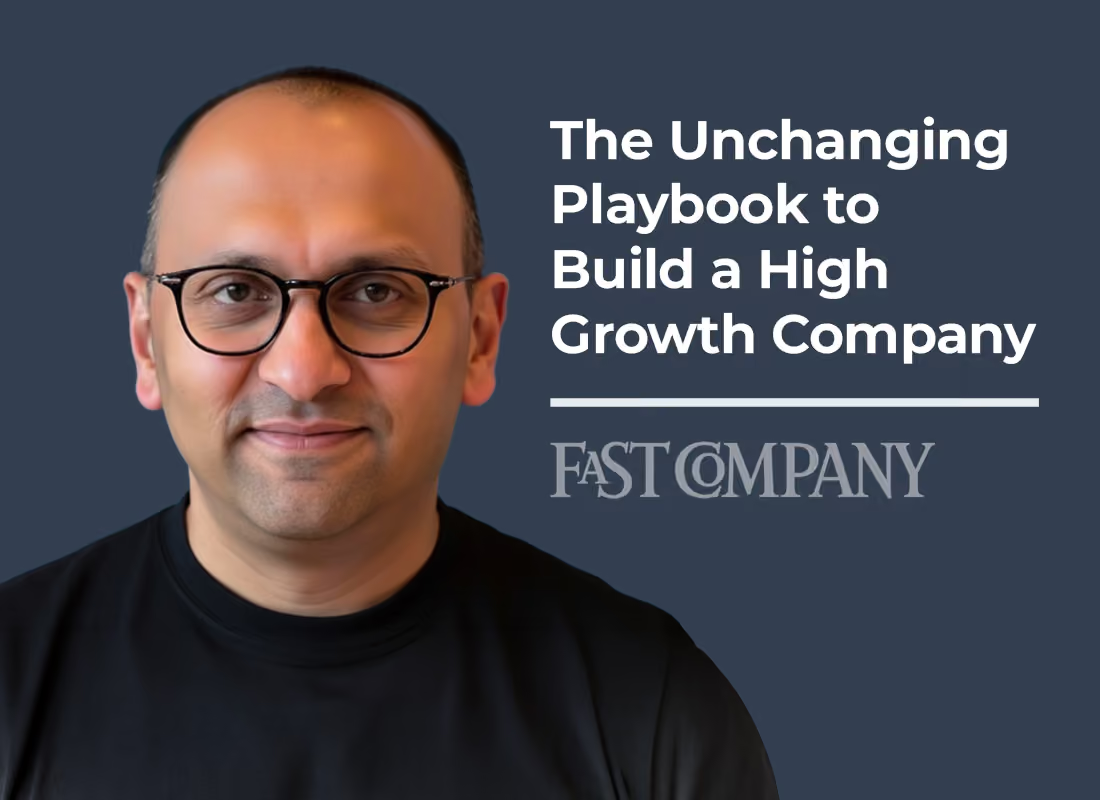
What does it really take to build a high-growth company—and sustain that growth across different markets, models, and moments in time? While many leaders search for new frameworks or shortcuts, the reality is far more consistent: enduring companies are built on repeatable principles, disciplined execution, and a clear operating model.
In the article below, originally published in Fast Company, OnMed CEO Karthik Ganesh shares a proven perspective on building and scaling high-growth companies. Drawing from experience leading two organizations recognized on the Inc. 5000, he outlines a repeatable leadership and growth playbook centered on organizational clarity, disciplined execution, team alignment, and operational simplicity.
For leaders focused on enterprise growth strategy, healthcare innovation, digital health, and organizational scale, this piece challenges the idea that growth requires constant reinvention. Instead, it highlights the fundamentals that remain constant—defining a clear north star, building resilient culture, eliminating complexity, and making decisions with conviction.
As organizations navigate rapid scaling, market expansion, and increasing operational pressure, the takeaway is clear: sustainable growth comes from consistently applying the fundamentals that drive alignment, focus, and performance over time.
Continue reading the original article below:
People ask me what it takes to build a high-growth company, with a rapidly growing footprint and enterprise value. They want the formula, a secret, or a shortcut.
There isn’t one. But there is a playbook. And after more than 13 years leading organizations across the healthcare spectrum, I can tell you that the playbook does not change. The industry or sector changes. The team changes. The product changes. But the playbook does not.
I have led two companies onto the Inc. 5000 list. The first was EmpiRx Health, a pharmacy benefit management (PBM) company that I took from early stage to a scaled, nationally recognized tech-enabled PBM. The second is OnMed, where we grew revenue 3,500% in a little over two years, deploying care infrastructure into communities left behind by traditional medicine. Two different companies with two different problems, but the same playbook.
The most dangerous thing a leader can do is assume the team understands the mission. They do not. The North Star has to be communicated so often, so clearly, and so consistently that it stops feeling like communication and starts feeling like the air everyone breathes.
At OnMed, that North Star is simple: quality, affordable, equitable care for every person, in every community, regardless of ZIP code. That is not marketing language, but the operating principle behind every partnership, product, and hiring decision we make. When a team member faces a hard call, they should orient themselves against that North Star without asking me. If they cannot, I have failed at my job.
The obsession with outcomes is the single biggest trap leaders fall into. Outcomes matter, but they are the result of doing the right things, the right way, relentlessly—not of chasing the outcome itself. When you organize around outcomes, you start cutting corners. You make decisions that look good on a scoreboard but erode the foundation underneath you.
Every company I have led has had chapters where nothing worked as expected. The headwinds felt too strong, the timeline too long, the obstacles too many. Those are the moments that reveal whether a culture is real or aspirational. I do not change the destination. I go back to the process. Execute in the present. Stay close to the customer. Lead with integrity. Do the right thing—not when it is easy, but especially when it is hard. Do those things relentlessly, and the outcomes figure themselves out.
This is a culture, not a mindset. The teams that break down aren’t facing the hardest circumstances. They are spending energy second-guessing decisions already made. What-ifs are corrosive. They pull people out of the present and into a past they cannot change, creating hesitation at exactly the moment execution demands certainty.
The culture I build is deliberate: Gather the best information, make the decision, commit fully, execute without looking back. If it is wrong, correct forward. Own the decision, learn, and move. Have accountability at its highest level.
Daniel James Brown’s The Boys in the Boat chronicles the 1936 University of Washington crew that went to the Berlin Olympics and beat the global competition. What Brown captures so precisely is that those eight men were not the most gifted rowers individually. They won because they achieved something rare. It’s what Brown calls “the moment of swing”— when the shell moves on its own, carrying eight men as one, each stroke indistinguishable from the next, every man surrendering individual glory for collective force.
That is the culture I build toward. A team that has internalized the North Star so deeply they pull together instinctively, when conditions are hard, when the race is close, when no one is watching.
Most CEOs misunderstand the job. It is not about sitting above the organization with the strategic view. It is about being in it—hands-on, close to the action, visible to the team.
The CEO is communicator in chief. The mission must be stated, restated, and lived out loud. It cannot be delegated. The CEO is chief simplification officer. Growth creates complexity, and complexity is the silent killer of execution. My job is to strip the noise, cut the distractions, and refocus the management team on exactly what matters right now. Do fewer things but do them brilliantly. Every time the organization drifts toward doing more, the CEO pulls it back. That is the work.
There will always be a faster path, a convenient shortcut, a deal that works if you look the other way. The playbook says no—not because of reputation risk, but because companies that endure are built on foundations that hold the weight of growth. Shortcuts leave hairline fractures you do not see until you are scaling fast and the structure cracks.
Skill is teachable, conviction is not. Hire for conviction first. The playbook is simple, but it is not easy. It is repeatable, and I intend to run it again.
To learn more about OnMed and Karthik Ganesh's leadership, visit our news and content page.
Follow along as we continue to redefine the healthcare landscape and bring the OnMed CareStation to communities across the U.S.


.png)