
CUPA-HR, the College and University Professional Association for Human Resources, represents more than 25,000 HR professionals at over 1,725 member institutions. It publishes the benchmark Benefits, Employee Experience, and Structure Survey (BEES Survey), as well as an annual Employee Retention Survey.
Its relevance has sharpened as rising GLP-1 and specialty drug spend becomes a top-line budget concern: Princeton, Penn State, the University of Michigan, and the University of Minnesota have all publicly revisited benefits design in response to climbing costs. CUPA-HR data captures dynamics general employer benchmarks don't, given higher ed's mixed faculty, staff, adjunct, and student-worker population.
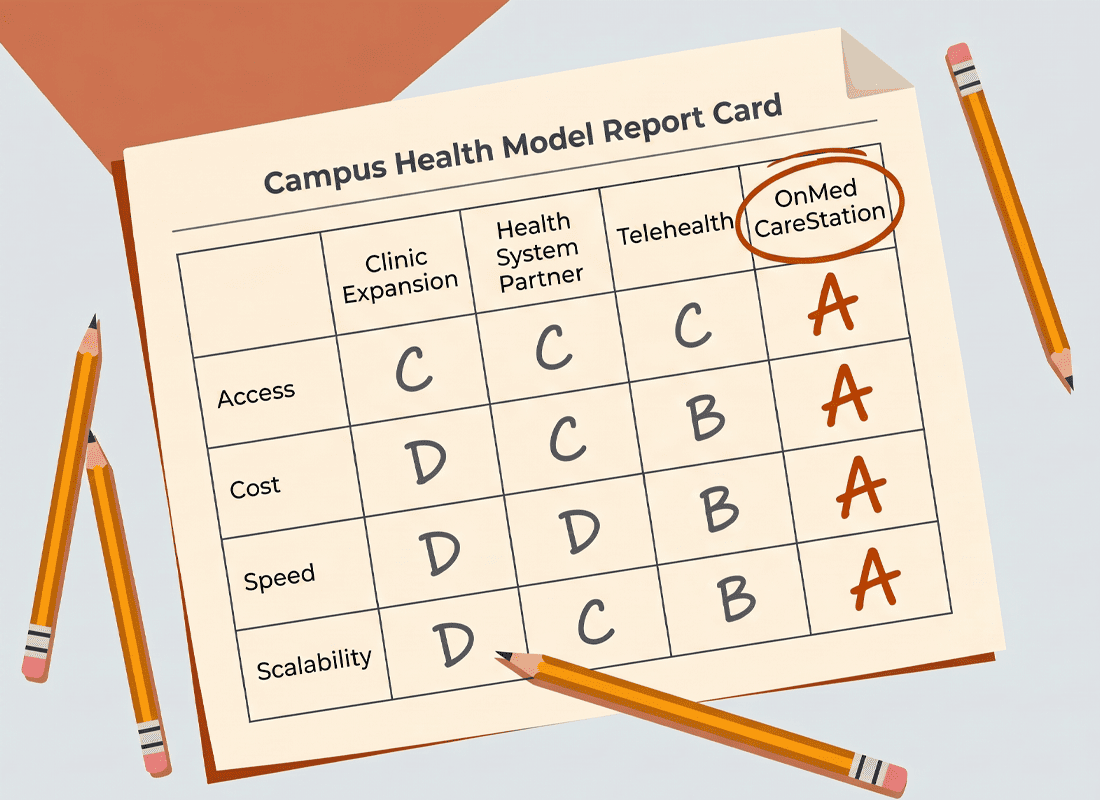
A university is, functionally, an employer facing the same claims-cost pressure as any large employer—just with less room to maneuver. Tenure protections, adjunct and part-time carve-outs, and tuition-constrained operating budgets all limit how aggressively a university can restructure benefits when costs climb. The OnMed CareStation® addresses a related piece of that same pressure: on-site, walk-in care that catches chronic conditions early—the same category of conditions driving the specialty-drug spend CUPA-HR members are now benchmarking—before they escalate into avoidable ED visits and a worsening claims spiral.
CUPA-HR represents more than 25,000 HR professionals at over 1,725 member institutions, including nearly 1,000 organizations with 20-plus years of membership.
CUPA-HR publishes the benchmark Benefits, Employee Experience, and Structure Survey, along with an annual Employee Retention Survey, both widely used by higher education CHROs to set strategy.
Princeton, Penn State, the University of Michigan, and the University of Minnesota have all had to publicly revisit benefits design in response to climbing GLP-1 and specialty drug costs.
Every term here points to the same gap in healthcare access. See how the CareStation closes it.
Talk to Our Team