See how healthcare access gaps contribute to clinical trial delays, recruitment challenges, and participant dropouts.

Pharmacovigilance can only capture what it can see. When patients lose contact with care, important parts of their treatment journey can go unseen. Community healthcare access creates ongoing touchpoints that help keep that story visible over time.
A patient has been on a GLP-1 medication for eight months. She picked up the prescription after one visit with a doctor she hasn't seen since. She has no primary care provider, no standing follow-up, and no one to call if the drug stops working or starts causing problems. If it's working, nobody records it.
If a side effect shows up, her dose needs adjusting, or she quietly stops taking the medication, who captures what happened? Each event matters to her health record and to understanding the medication. Without a point of care, those parts of her treatment story can go unrecorded.
She is not a rare case. A 2026 national survey found that more than half of adults who discontinue a GLP-1 medication do so within six months, citing cost, side effects, lost coverage, or simply reaching a goal, and researchers only know that because they spent the time and money to go find her after the fact.
The gap is not simply missing data. It is missing contact with the patient. Biopharma may know that a medication was prescribed, dispensed, or discontinued, yet still miss what happened between those events. Without ongoing community access, side effects, adherence challenges, dose changes, treatment response, and reasons for discontinuation can remain disconnected fragments rather than a longitudinal patient story.
Post-market safety monitoring, known formally as pharmacovigilance (PV), depends on real-world evidence (RWE) collected after a drug is already in circulation. Today that mostly means three things: spontaneous adverse event reports that a patient or provider has to actively choose to file, periodic safety updates compiled from whatever data happens to be available, and claims-based surveillance systems that infer a safety signal from billing codes months after an event occurred. The FDA's Sentinel Initiative reflects the value of supplementing traditional methods with broader, more connected data sources. It now pulls from the electronic health records of hundreds of millions of Americans, because any single source of post-market data is too sparse and too delayed to catch a signal early on its own.
These methods can capture only the experiences that reach them. Ongoing contact with a provider, pharmacy, or health system creates opportunities to record what happens over time; without that contact, important parts of the story may be missed. Among people who visit an OnMed CareStation®, 80% had no primary care provider. That does not mean they cannot report a side effect. It means they may lack a regular clinician to discuss it with, a scheduled visit where a dose can be reviewed, or a continuing chart where a pattern becomes visible.

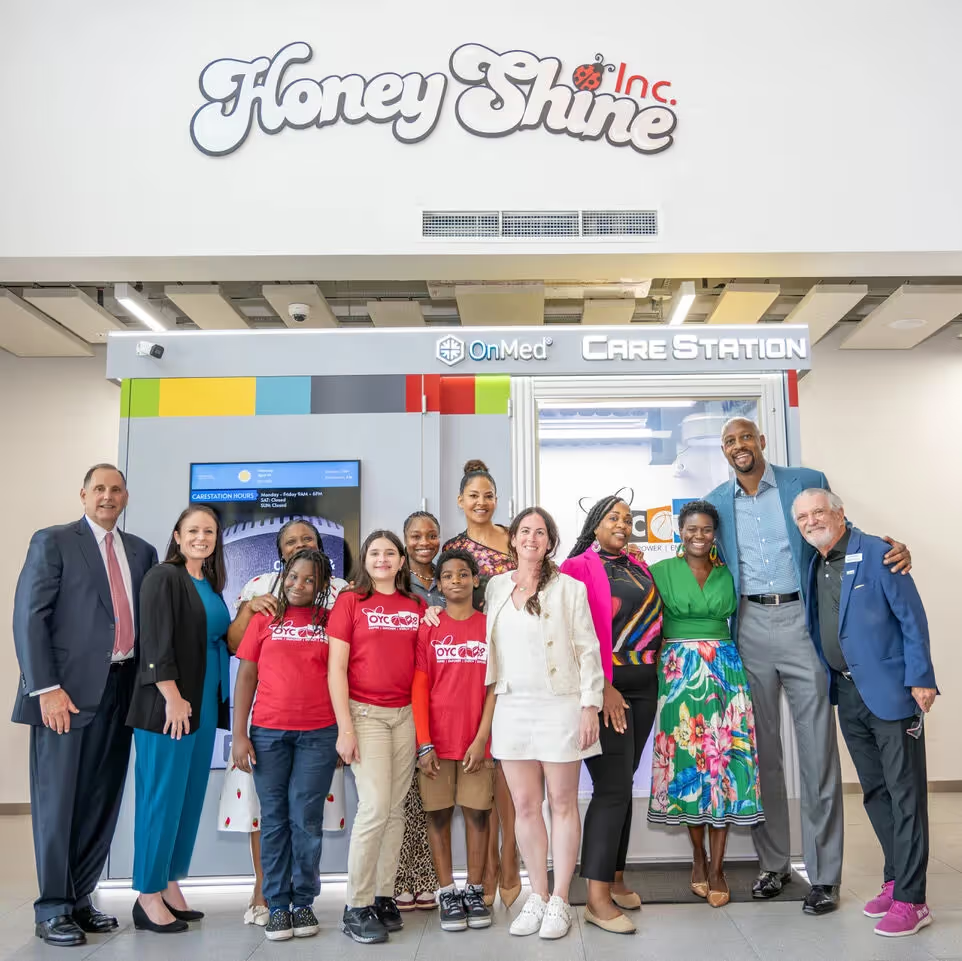
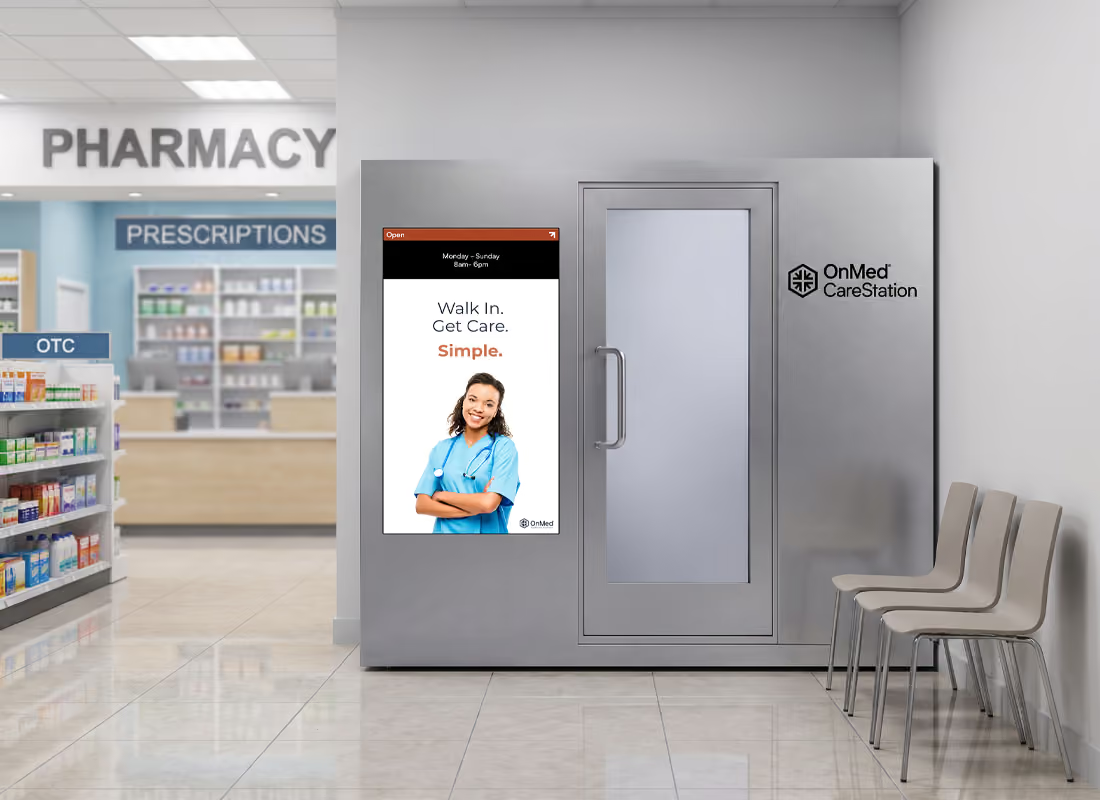
The CareStation offers a place for patients to return after the first prescription—even when they do not already have a provider to go back to. Deployed in pharmacies, employer sites, community centers, and retail locations, it creates a recurring, low-friction touchpoint where people return for refills and ongoing care. That access role complements the three traditional PV methods by creating opportunities for contact rather than relying on existing contact alone. The OnMed CareStation is a patented, tech-enabled, AI-powered, always human-delivered clinic deployed inside a purpose-built 8×10 unit.
It changes what's possible at a routine visit. A real clinician, supported by integrated diagnostic tools, can ask the questions a claims code or an annual chart review never gets the chance to ask in the moment: is the medication working, is there a side effect, has the patient actually kept taking it. It's a front door that stays open long after the trial ends and the first prescription is filled, for patients who would otherwise have no door to walk back through at all.
Reaching missing patients matters only if they can remain visible after treatment begins. CareStation patients are 80% without a primary care provider, 62% female, and 73% minority—the same populations chronically underrepresented in the clinical trials these drugs were approved on, and the populations least likely to have an existing point of contact where a treatment story gets recorded. Community access doesn't just reach them once; it gives them somewhere to keep returning, which is what turns a single encounter into a longitudinal record.
The GLP-1 example brings the need for continued contact into focus. National utilization grew 84.6% between 2023 and 2024, but more than half discontinue within twelve months of starting. In both cases, the question is the same: can more of that treatment story be captured while patients are still in contact with care, rather than reconstructed afterward through a national survey, the way the six-month finding above was.
A continuous local touchpoint creates opportunities to capture the treatment story closer to the moment it unfolds. At a visit, a patient can confirm that they are still taking a medication or flag a side effect, creating a structured, timestamped record. A missed visit is different: it identifies a gap in contact, not the reason for that gap. These repeated touchpoints can help build the longitudinal patient data that spontaneous reporting alone may not produce.
For those touchpoints to strengthen pharmacovigilance, the record needs to reach the people who can act on it—the prescriber managing the patient's care, the sponsor's patient support program, or existing hub services. Done well, community access becomes a complementary layer, not a parallel system: it brings treatment experiences from populations otherwise missing from the record into the infrastructure already in place, so they can be seen.
Go back to the patient from the opening. Without a place to return for care, she may stop her GLP-1 without anyone recording why. A national survey might eventually reach her, but that is not the same as ongoing contact. With continuous community access, a refill or care visit becomes an opportunity to ask what changed while her treatment story is still unfolding.
Biopharma does not lack data altogether; it lacks continuity. Community healthcare access connects isolated events into a longitudinal patient story, giving pharmacovigilance systems earlier, richer insight into how medications perform in the real world. The gap cannot be solved by a better algorithm alone. It closes when patients have somewhere to go between the prescription and the follow-up survey.
Ready to see how continuous community access can help pharmacovigilance capture the full patient story? Learn how OnMed partners with pharmaceutical companies →
The OnMed CareStation® is an 8-by-10-foot "Clinic-in-a-Box" that connects patients in real time with licensed clinicians and integrated diagnostic tools through a fully integrated device and human platform. Patients can walk in and receive a diagnosis, treatment plan, and e-prescription, often without an appointment or waiting room. Unlike traditional telehealth, the CareStation combines virtual care with diagnostic tools, real-time scans, and vital sign monitoring to support comprehensive clinical evaluations where care is needed most. See how a CareStation visit works.
Pharmacovigilance (PV) is the science of detecting, assessing, and understanding the effects of a medication after it’s already on the market—tracking side effects, adverse events, and real-world performance that clinical trials, by their size and duration, can’t fully capture on their own. It depends on real-world evidence gathered through adverse event reports, safety updates, and claims data once a drug is in wide circulation.
Community access points like the OnMed CareStation give patients a recurring, low-friction place to return to, even without an existing provider. Each return visit is a chance for a licensed clinician to ask whether a medication is working, whether a side effect has appeared, and whether the patient is still taking it. That turns isolated, after-the-fact data points into an ongoing patient story.
Learn how OnMed partners with pharmaceutical companies.
Biopharma organizations are seeking innovative ways to improve patient access, accelerate clinical trial recruitment, strengthen participant retention, support diversity goals, generate real-world evidence, and engage underserved populations. The OnMed CareStation® provides scalable, community-based infrastructure that helps advance both clinical development and commercial objectives.
Millions of Americans face barriers that prevent them from routinely accessing healthcare services. The OnMed CareStation® helps biopharma organizations engage these hard-to-reach populations by creating convenient access points within the communities where patients live, work, learn, and shop, helping close gaps in both care delivery and clinical research participation. Traditional clinical research is often separated from where patients receive everyday healthcare, and the CareStation helps create opportunities for patient identification, engagement, education, and follow-up within community settings.
Follow along as we continue to redefine the healthcare landscape and bring the OnMed CareStation to communities across the U.S.