.png)
Show: The Pick Now Podcast
Host: Jeff Munn
Guest: Karthik Ganesh, CEO of OnMed
Published: July 3rd, 2026
Duration: ~62 minutes
Listen on Apple Podcast
Listen on Spotify
Watch on YouTube
In this episode of The Pick Now Podcast, host Jeff Munn sits down with OnMed CEO, Karthik Ganesh, to talk about the real fault line in American healthcare: not cost, not technology, but access. He explains why a $5.1 trillion industry still leaves a third of the country without viable care, why brick-and-mortar clinics and telehealth both hit a ceiling, and how the OnMed CareStation® is built to close that gap—one community at a time.
Karthik also walks through the economics that make the model work: OnMed sells to enterprise customers—payers, providers, employers, universities, and government—because roughly 80% of the American healthcare system is paid for by those stakeholders, not by patients directly.
"There's 120 million Americans who don't have access to viable care, which tells us that's one-third of the country that we don't really know very much about, in terms of what's going on with their healthcare."
"OnMed... creates a tech-enabled, hybrid care environment... it brings the best of brick-and-mortar, it brings the best of telemedicine."
"The CareStation has saved lives. You cannot put a price on what the care station has done for these rural communities in West Alabama."
"You feel the most in control when you give, when you let it go. We tend to hold it closer. We think that's control. Actually, letting go offers much greater control, because at that time, you're not bound."
"Every decision is reversible. You don't like it, change it. But don't make a decision because of it."
One of the main themes of the podcast was about how the current doorway to healthcare access is broken. OnMed is a new fourth model for companies, and the modern consumer, to choose from when selecting care. In the podcast, Karthik doesn't frame healthcare access as an insurance problem. "I don't really care if the person is insured or not," he says. "My perspective is whether you can afford it or not, we should be able to take care of you as a society." That reframing—from coverage to access—is the throughline of the conversation.
The scale of the gap is what animates OnMed's strategy. An estimated 80% of U.S. counties qualify as healthcare deserts, and 120 million Americans lack viable access to care. The industry has spent decades building more of what already exists—more specialists, more facilities, more insurance products—without fixing the one thing that determines whether any of it gets used: whether people can walk through the door in the first place.
Brick-and-mortar clinics are capital-intensive to build and depend on a shrinking clinical workforce—the country produces roughly 16,000 to 17,000 new clinicians a year against a shortage that's far larger, with close to half the existing workforce nearing retirement. Telehealth solved for convenience during COVID, but without vitals, scans, or biometrics, a video call often can't do more than point a patient toward a guess.
The CareStation is built as the response to both failures at once: a private, tech-enabled, AI-powered, and always human-delivered environment that pairs a real clinician with integrated diagnostic tools—the comprehensiveness of an in-person visits with the scalability of a screen.
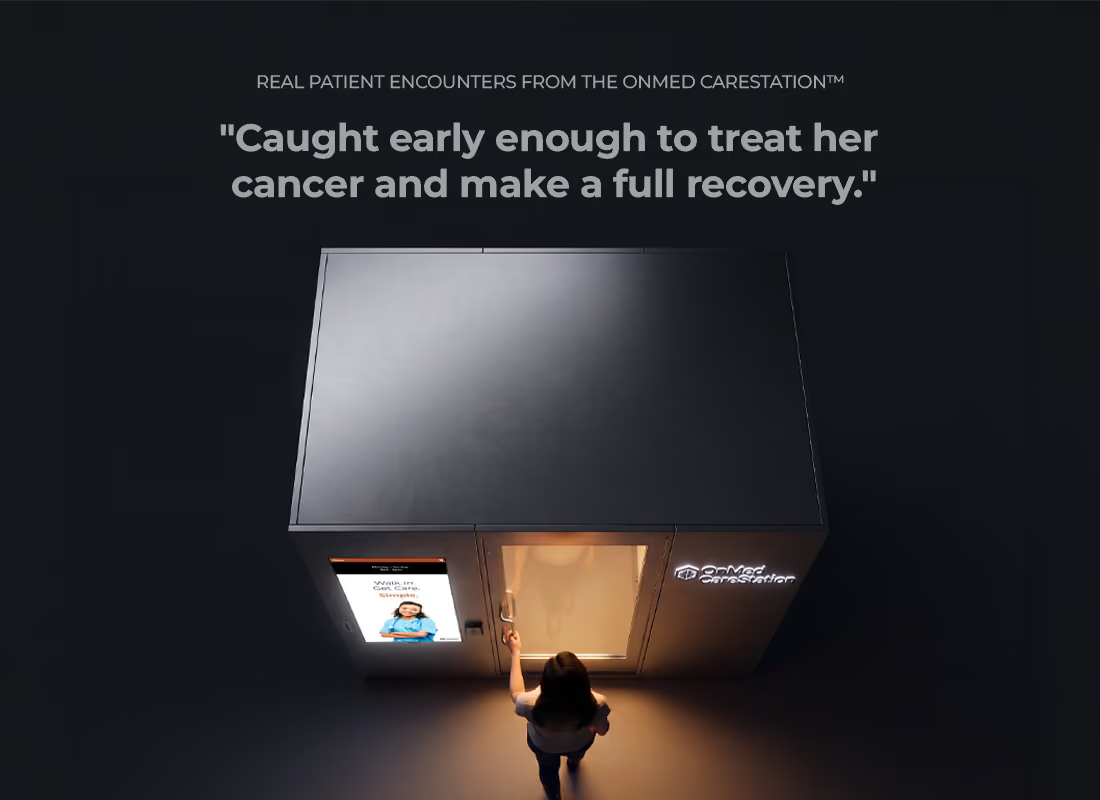
Each OnMed CareStation® is an 8×10 foot "Clinic-in-a-Box": a private, soundproofed, fogged-glass room equipped with diagnostic tools that capture vitals and biometrics in real time, connected to a licensed clinician. Ganesh describes the goal simply: make the patient feel like the clinician is in the room and give that clinician enough clinical data to resolve the visit rather than refer it elsewhere.
The results are 86% of visits are resolved on-site without referral, 78% of patients describe the CareStation as their medical home, and 54% say they would have gone to the emergency department if the CareStation hadn't been available. Patients return voluntarily—a 37% return rate within 12 months—which is a higher stickiness factor than almost anywhere else in American healthcare, with no mandate or reminder drawing patients back.
One of our largest deployments, with the Auburn University's Rural Health Initiative was a highlight of the conversation. Across multiple sites in West Alabama, the CareStation has saved lives. Utilization looks different by geography—urban deployments see higher volume and lower acuity; rural deployments see lower volume and higher acuity—and Karthik reframes that raw utilization was never the right measure to begin with. Impact is.
That same logic extends to where OnMed has placed the CareStation outside traditional healthcare settings: homeless shelters, senior centers, children's centers, prisons, and airports. Military bases specifically, are a large share of care deserts for the service members stationed there—a population the country says it prioritizes but, is underserved in healthcare access.
OnMed is transforming how the world accesses healthcare. With its patented OnMed CareStation®, an 8×10 foot “Clinic-in-a-Box”, OnMed delivers comprehensive, immediate care wherever people live, work, and learn. The OnMed CareStation is a tech-enabled, AI-powered, and human-delivered platform that blends the comprehensiveness of traditional in-person care with the rapid scalability of telemedicine. Each CareStation serves as a local access point within a scalable, connected grid that delivers everyday healthcare at scale.
Powered by public-private partnerships across insurers, healthcare providers, governments, employers, and educational institutions, OnMed is redefining healthcare access, closing critical gaps, restoring trust, and strengthening the health and economic resilience of communities everywhere.
See how the OnMed CareStation is closing healthcare deserts for employers, health systems, universities, government agencies, and communities across the country. Connect with the OnMed team to talk about deploying one in yours.
Follow along as we continue to redefine the healthcare landscape and bring the OnMed CareStation to communities across the U.S.