
Across every sector of American healthcare from hospital boardrooms and employer benefits offices to university campuses, biopharma pipelines, and the kitchen tables of families drowning in medical debt. The same structural crisis keeps surfacing. The physician shortage is real. The cost crisis is real. The insurance dysfunction is real. But every one of those problems is made dramatically worse by the access gap and none of the investments made to address them can deliver their full value until people can actually get through the door.
Think about a house. You can gut the kitchen. You can retile the bathrooms. You can repaint every room, install smart lighting, upgrade every appliance. You can put the most sophisticated, innovative, forward-thinking interior inside those walls. If there's no front door—if people cannot get in, every dollar spent inside delivers a fraction of its intended value.
This is American healthcare in 2026.
We have built extraordinary things behind the door. The finest medical training in the world. Nobel-winning research. Breakthrough therapies. AI-powered diagnostics. Gene therapies that were science fiction a decade ago. Surgical techniques so precise they border on miraculous. We have spent, collectively, more than any nation in history, more than $4.8 trillion annually on the machinery of health.
And for 120 million Americans, one in three, the door doesn't open.
The physician shortage is real. Rising costs are real. Insurance dysfunction is real. Workforce burnout is real. But every one of these problems is compounded by the access gap. When people can't get in, conditions escalate into the most expensive settings. Physician time gets consumed by non-emergent volume it was never meant to carry. Preventable costs become unavoidable ones. The access gap doesn't just create its own problems. It makes every other problem in healthcare harder, costlier, and less solvable. That is why access is not one variable among many. It is the variable every other solution depends on.
The front door is missing. And until we fix it, everything we build inside keeps failing the people it was built to serve.
The access crisis in American healthcare is not a fringe phenomenon. It is not confined to poor rural counties or uninsured populations. It is structural, pervasive, and accelerating and it touches virtually every sector of the economy and every corner of the country.
The physician pipeline compounds the crisis. Fewer than 29,000 new doctors enter the workforce annually. Half of all currently practicing physicians are approaching retirement age. 44 million Americans live in a designated primary care shortage zone, and 28 million live more than 30 minutes from the nearest hospital. The gap between the care we need and the care we can deliver is not closing—it is widening. And the AAMC has calculated that if underserved populations had the same healthcare access as the rest of America, the U.S. would need 202,800 more physicians than it has today just to meet existing demand. That number does not describe a future problem. It describes the scale of inequity that exists right now.
Meanwhile, the traditional solutions have hit their limits. Brick-and-mortar clinics cost $2–5 million to build and cannot serve the communities that most need them. Traditional telehealth, adoption still below 8%, cannot capture vitals, perform examinations, or deliver the diagnostic confidence that most clinical decisions require. And 42 million Americans lack reliable broadband access, leaving them excluded from even that incomplete solution.
The access crisis is not a medical problem. It is an infrastructure problem. And infrastructure requires infrastructure solutions—not more of the same approaches that have already proven insufficient at scale.
A healthcare desert is any area where population healthcare needs are partially or entirely unmet due to inadequate access or poor-quality care. These gaps stem from shortages of clinicians, limited facilities, long wait times, high costs, or sociocultural barriers. Healthcare deserts are not limited to rural counties—they exist in urban neighborhoods, on tribal lands, inside correctional systems, and in ZIP codes adjacent to world-class hospitals that cannot be reached without money, insurance, transportation, and time.
The burden of health deserts falls most heavily on the most vulnerable. Diabetes rates are 30% higher among Native American and Latino populations compared to White Americans. Six conditions account for 86% of excess mortality among Black Americans—most of them preventable with earlier detection and equitable access to care.
Hospital closures accelerate the desert dynamic in rural communities. When the nearest hospital is 45 minutes away, and the nearest specialist is two states away, the practical reality is that people don't get care. Not because they don't want it. Not because they don't value their health. But because the infrastructure to deliver it doesn't exist where they live.
"Underserved is underserved—no matter your ZIP code or your net worth. Sitting eight hours in an ER because your child has an ear infection. Missing a day's wages just to see a doctor. Driving two hours for urgent care. Living in a major city where getting an appointment is a months-long wait."
— OnMed, America's Forgotten Utility (2025)
→ Read more: America's Forgotten Utility: Hope for Healthcare Access | America's Actual Healthcare Desert: An Infrastructure That Has Run Dry
There is a persistent myth embedded in American healthcare economics: that limiting access reduces cost. That when people don't go to the doctor, the system spends less. The data says otherwise, decisively and expensively.
When people cannot access care early, conditions escalate. A $25 antibiotic becomes a $5,000 hospitalization. A managed blood pressure check becomes a $150,000 stroke workup. A $200 chronic disease management appointment becomes a $40,000 readmission. The cost of untreated illness doesn't disappear—it compounds, defers to higher-acuity settings, and redistributes across the entire system in the form of emergency department overuse, preventable hospitalizations, lost productivity, and ultimately, medical debt.
The emergency department is the most expensive access point in the healthcare system, and it has become the de facto front door for tens of millions of Americans. Studies consistently show that 60–70% of ED visits are for non-emergent conditions: ear infections, UTIs, sinus infections, prescription refills, and blood pressure checks. These visits generate little or no reimbursement, consume disproportionate clinical resources, and do nothing to address the underlying access gap that sent the patient there in the first place.
Federal law requires hospitals to evaluate and treat anyone who arrives at the emergency department regardless of their ability to pay—and that mandate, however essential, means health systems absorb the cost of tens of millions of non-emergent visits every year. U.S. hospitals have absorbed nearly $745 billion in total uncompensated care costs since 2000, with the burden falling hardest on safety-net and rural institutions already operating on razor-thin margins.
Every dollar not spent on accessible primary care generates approximately $4–7 in downstream costs through emergency intervention, hospitalization, specialist escalation, and chronic disease management. Access isn't an expense. It's the most cost-effective investment in the healthcare system, and the one we're currently refusing to make.
Employers are the largest single purchaser of healthcare in the United States, covering over 160 million Americans through workplace benefits. And the cost of that coverage has become one of the fastest-growing line items on the corporate balance sheet—with no sign of slowing down.
The premium increase is the symptom. The claims pattern is the cause. And the claims pattern is almost entirely driven by access failure: employees who cannot get a primary care appointment in a reasonable timeframe end up in urgent care, emergency departments, and specialist offices—generating claims that are 3–12 times more expensive than the primary care visit that should have come first. Chronic conditions that go undetected or unmanaged until they reach acute thresholds. Mental health needs that go untreated until they generate disability claims. Preventive screenings that don't happen until something goes wrong.
Most employer healthcare analytics focus on what happened in claims. The more powerful question is what didn't happen and why. The Monday morning where 12% of a shift doesn't show because they couldn't get a doctor's appointment last week. The high performer managing undiagnosed hypertension who works at 60% capacity for months before a cardiac event pulls them out entirely. The employee with untreated anxiety who calls in sick, stays less engaged, and leaves within 18 months, taking $25,000 in replacement costs with them. None of these show up in a benefits report until it's too late. All of them are access failures.

Gen Z now represents the fastest-growing segment of the U.S. workforce, and they are reshaping what employees expect from workplace health benefits. Research shows that healthcare access quality is increasingly a factor in whether Gen Z employees join, engage with, and remain at an organization. Traditional benefits structures—a PPO card, an EAP number, a list of in-network providers—are not meeting the moment.
Employers who invest in on-site or near-site access infrastructure reduce the claims that drive premium increases: fewer avoidable ER visits, earlier chronic condition detection, improved medication adherence, reduced mental health disability claims, and lower absenteeism. The return is not theoretical—it shows up in the renewal. Access infrastructure is not a wellness perk. It is a claims management strategy with a direct line to the cost that keeps rising every year.
→ Read more: The Greatest Untapped Source of ROI — Employee Health | The Hidden Cost Centers Employers Aren't Measuring — But Should Be | How Gen Z Is Redefining Workplace Health and Retention | Using Wellness Budgets to Bring Care On-Site with the OnMed CareStation™
Providers built the healthcare system. They trained for decades to staff it. They sacrificed more than most professions ask of anyone. And the access crisis is now consuming them.
Emergency departments are designed for true emergencies but have become the nation's primary care safety net. When a patient can't get an appointment for six weeks, can't afford an urgent care copay, or lives in a county without a single primary care physician, the ED is the only door that doesn't close.
Every patient who walks out without being seen doesn't just cost the system one visit. They represent a lifetime of care that shifts to a competitor or to no one—and the erosion of a relationship that should have been built.
"This isn't a breakdown in care. It's a breakdown in access—and it demands a new blueprint."
— OnMed, Returning Emergency Departments to Emergency Medicine (2026)
Beyond the ED, the access crisis creates a structural patient leakage problem for health systems that compounds annually. A patient who seeks care outside your network doesn't just cost you one specialist visit. They cost you every downstream encounter that care generates: imaging, labs, follow-up, interventional procedures, hospitalization. The lifetime value of a captured patient is enormous. The lifetime cost of a lost one compounds in a competitor's favor.
→ Read more: Returning Emergency Departments to Emergency Medicine | The Healthcare Access Gap Driving Nurse Burnout and ER Overload | How Health Systems Are Reducing ED Strain, Cutting Leakage, and Expanding Access Without Building
The American insurance market is caught in a paradox of its own making: the product it sells, health coverage, is becoming simultaneously more expensive and less useful, because the thing that makes coverage valuable, access to care, is eroding beneath it.
Payers are spending enormous amounts on the most expensive settings, emergency departments, urgent care chains, unnecessary specialist escalation, precisely because the least expensive settings are inaccessible. A non-emergent ED visit costs payers 10–12 times what the same care would cost in a primary care setting. When the only door that opens is the most expensive one, everyone pays for it.
Between April 2023 and mid-2025, more than 25 million people were disenrolled from Medicaid during the post-pandemic coverage unwinding. Nearly 70% lost coverage for procedural reasons—not because they became ineligible, but because they couldn't navigate the renewal paperwork. These individuals did not stop needing care. They stopped having coverage for it. The downstream costs are flowing toward emergency departments, public health systems, and the uncompensated care budgets of every safety-net hospital in the country.
Payers who invest in access infrastructure, CareStation deployments at employers, in communities, at schools, reduce avoidable ER utilization, lower claims costs, improve medication adherence, enable earlier chronic condition intervention, and build member relationships that reduce churn. Access is not a member benefit. It is a claims management strategy.
Across the country, university campuses are facing a quiet but escalating crisis. It doesn't show up in rankings. It doesn't make it into guidebooks. It rarely gets addressed in an admissions packet. But it is shaping the daily experience of millions of students in ways that affect their academic performance, their long-term health, and in the most serious cases, their lives.
Students arrive on campus managing chronic conditions that were handled at home—by a parent who scheduled the appointments, filled the prescriptions, and knew the family doctor by name. That infrastructure disappears the moment they move into a dorm. Add congregate living, irregular sleep, inconsistent nutrition, and the physical stress of academic pressure, and you have a population with substantial ongoing medical needs—and shrinking access to care.
Today's students, part of Gen Z, have grown up with on-demand everything. The students most likely to delay care are not indifferent to their well-being. They are unwilling to navigate a system that was not designed for them. That gap between expectation and experience is where early physical health problems quietly become serious ones.
"Fewer than four in ten college students report actively flourishing—and health is a primary reason why. That is not a mental health statistic alone. It is a whole-person health statistic that starts with whether students can get care at all."
— OnMed, The Campus Health Crisis No One Puts in the Brochure (2026)
South Carolina State University, Auburn University, Tuskegee University, the University of West Alabama—these institutions have recognized what the data makes undeniable: the campus health crisis is a retention crisis, an academic performance crisis, and an equity crisis, all rooted in the same physical access failure.
→ Read more: The Campus Health Crisis No One Puts in the Brochure | Expanding Access to Care at South Carolina State University | Auburn University Bridging Healthcare Gaps in Rural Communities

There is a quiet truth living inside nearly every school system in America—one we feel every day but rarely say out loud. We are asking children to learn while their bodies, minds, and families are struggling to stay well.
If a child isn't well, they can't focus. If they can't focus, they fall behind. If they fall behind, they disengage. And once that spiral begins, it doesn't stop at graduation. It follows students into adulthood, shaping income, health, stability, and opportunity for the rest of their lives. Healthcare access isn't adjacent to education. It is foundational to it.
One of the most overlooked drivers of absenteeism has nothing to do with the child's health at all. It's the health of their caregiver. Research shows that caregiver illness and lack of healthcare access significantly increase student absenteeism, particularly in underserved and rural communities.
The connection between healthcare access and generational poverty is not metaphorical. It is documented, quantified, and devastating in its consistency. Children from low-income families face disproportionately high barriers to healthcare access, which leads to higher rates of untreated illness, higher absenteeism, lower academic attainment, and ultimately lower lifetime earnings. Lower earnings mean less ability to afford healthcare as adults. And the cycle continues into the next generation.
Breaking the cycle requires breaking the access barrier—not with willpower or policy aspiration, but with infrastructure that makes care available at the point of life, wherever that life is being lived.
→ Read more: Breaking the Cycle Starts at School: How Healthcare Access Changes Life Trajectories | OnMed and 22Beacon Partner to Bring Healthcare Access to U.S. Charter Schools
The U.S. drug development model has a structural problem—and it has nothing to do with the science. It has everything to do with the same access gap that runs through every other sector of American healthcare.
Fewer than 150 institutions drive the majority of clinical trial activity in the United States. These are academic medical centers—world-class institutions concentrated in major metropolitan areas, serving a patient population that represents a fraction of the Americans who live with the conditions being studied. The result is a trial ecosystem that systematically excludes the 120 million Americans who lack adequate access to those centers.
Trials are delayed by an average of 6–9 months due to enrollment challenges, at a cost of $37,000–$40,000 per day in delayed revenue for a Phase III asset. The drugs that emerge from this system are tested on populations that don't represent the patients who will use them.
"The patients most likely to need a new drug are the least likely to be in the trial that proved it works. One third of the U.S. population—the same communities carrying the highest burden of chronic disease, the highest rates of health disparity, and the greatest unmet medical need—is generating none of the data that determines what gets approved, how it gets dosed, and who it's labeled for. That is not a diversity problem. It is a science problem."
— OnMed, The True Cost of the Clinical Trial Access Gap (2026)
→ Read more: The True Cost of the Clinical Trial Access Gap — And How to Close It
76% of American adults live with at least one chronic condition. Four in ten have two or more. Chronic disease drives 90% of the $4.1 trillion in U.S. healthcare spending annually. Heart disease, cancer, diabetes, COPD, obesity—these conditions are the dominant drivers of mortality, disability, healthcare cost, and quality of life decline in the United States. And they have one thing in common: most of them are either preventable, detectable early, or manageable, if care is accessible.
The cruel arithmetic of the access crisis is most visible in chronic disease. Hypertension, Type 2 diabetes, COPD, and early-stage cardiovascular disease often go undetected for years—not because patients are indifferent, but because they lack an accessible, low-friction point of entry into the care system.
The window for intervention in chronic disease is wide and systematically missed. Blood pressure that's been silently elevated for three years. A respiratory pattern suggesting early-stage COPD. Pre-diabetic glucose levels that could be reversed with early lifestyle intervention. These are not complex diagnoses requiring subspecialty expertise. They are conditions that a comprehensive primary care encounter with vitals, screenings, and appropriate diagnostic tools, can identify and begin managing in a single visit.
The access gap doesn't just fail patients when they're sick. It fails them before they know they're sick. And that failure is where the most preventable costs in American healthcare accumulate.
When comprehensive, diagnostic-capable care is placed where people already are such as at their employer, in their school, in their community—conditions are detected at the earliest, most manageable, least expensive stage. Every undetected hypertension patient found in a workplace CareStation is a potential stroke prevented. Every pre-diabetic identified before progression is a lifetime of insulin costs avoided. The value is not theoretical. It is measurable, per patient, per encounter.
→ Read more: The Importance of Preventative Healthcare: Now More Than Ever | Beyond Telehealth: Why Diagnostic Tools Unlock Real Care
Medical debt is the final insult of the access crisis. It is what happens when a person waits too long, because they couldn't get care sooner, and then receives care in the most expensive setting, at a point when their condition can no longer be ignored. The debt is not the cause of the crisis. It is the receipt.
The demographics of medical debt track precisely with the demographics of access failure. Rural communities. Communities of color. Low-income households. People with chronic conditions. These are the same populations drowning in debt that was generated, in large part, by the cost multiplication that happens when access-deferred illness reaches emergency acuity.
Medical debt is not a financial literacy problem. It is not a personal responsibility failure. It is the predictable downstream consequence of a system that does not provide adequate access to affordable early care, and then charges catastrophic prices when the deferred illness can no longer wait.
A telehealth kiosk is a physical, self-contained clinical environment that combines real-time connection to a licensed clinician with integrated diagnostic tools—allowing patients to be examined, diagnosed, and treated on-site, without an appointment, in a single visit. Unlike traditional telehealth—which is limited to video calls and cannot capture vitals, perform examinations, or deliver diagnostic-grade clinical confidence—a telehealth kiosk brings the full clinical encounter into a single physical environment.
Traditional telehealth adoption remains below 8%. 42 million Americans lack reliable broadband, leaving them excluded from even that incomplete solution. A diagnostic-capable telehealth kiosk operates without broadband dependency and delivers the clinical confidence that video calls cannot.
→ Read more: Beyond Telehealth: Why Diagnostic Tools Unlock Real Care | Beyond the Telehealth Kiosk: Why Rural Communities Need More Than Connectivity | As Telehealth Kiosks Gain Momentum, OnMed Demonstrates How Hybrid Care Can Close Critical Access Gaps
Every argument in this paper converges at a single question: what does the front door look like?
It cannot be a brick-and-mortar clinic. Those cost $2–5 million to build, take years to open, and serve only the geography immediately around them. They cannot scale to meet the demand of a 120-million-person access crisis.
It cannot be traditional telehealth. With adoption below 8%, no ability to capture vitals or perform examinations, and 42 million Americans without reliable broadband, telehealth can expand communication—but it cannot deliver the clinical confidence most care decisions require.
The front door has to be different. It has to be deployable anywhere, at the employer, the school, the senior center, the hospital waiting room, and the rural community with no clinic for 60 miles. It has to be diagnostically capable, not a symptom screener, but a real clinical environment with the tools to evaluate, diagnose, and treat. It has to be human-delivered because healthcare requires trust, and trust requires human connection. And it has to scale to the 120 million people who need it, in the communities where they actually live.
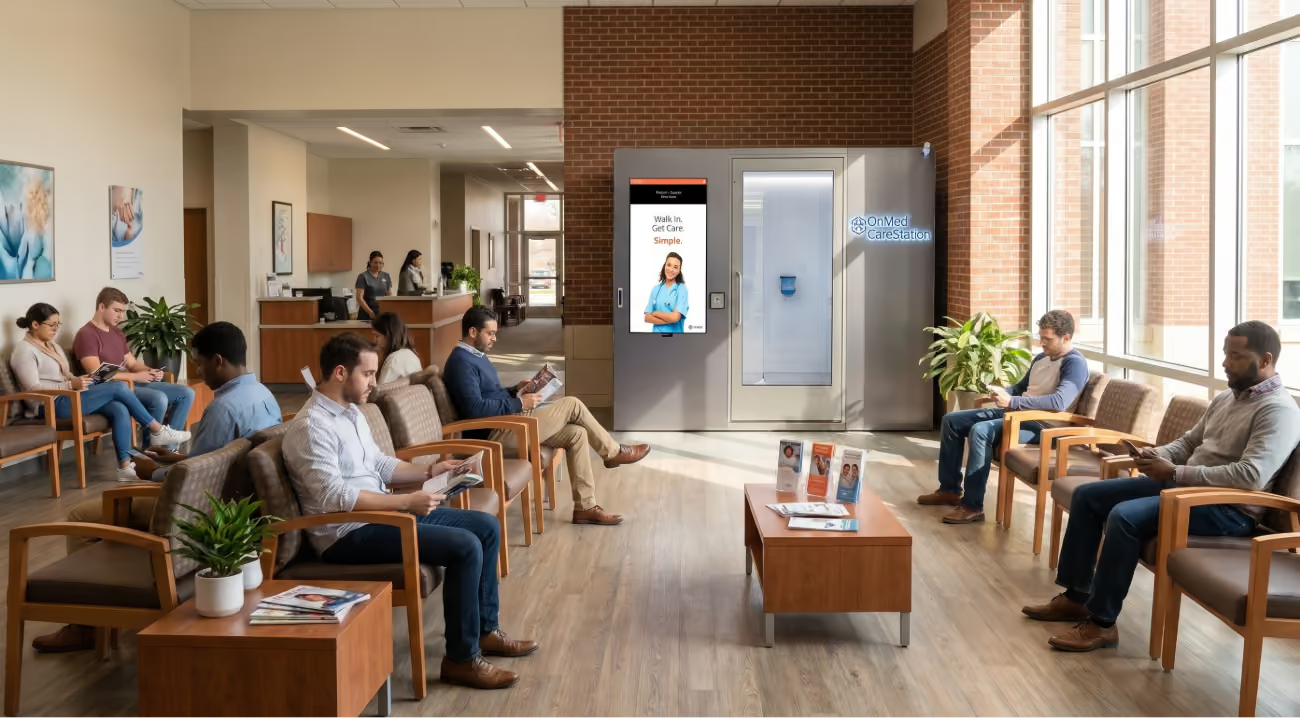
The OnMed CareStation™ is an 8×10 foot, tech-enabled, AI-powered, human-delivered clinical environment that can be deployed anywhere with an electrical outlet in 45 days. It combines medical-grade diagnostic instruments (digital stethoscope, HD camera, thermal imaging, pulse oximetry, blood pressure monitoring), a 55-inch life-size display connecting patients to licensed clinicians in real time, and AI-enabled clinical decision support. It requires no construction, no permanent staffing, and no broadband-only connectivity. It operates on broadband or satellite to serve even the most underconnected communities.
The results are not theoretical. The CareStation has a 4.96 out of 5 patient satisfaction score. 86% of patients are fully diagnosed and treated without escalation. 80% have no primary care provider. For many, this is the first time they have experienced care they can count on. And 37% return voluntarily—no reminder, no mandate, nothing forcing their hand. That number is built entirely on trust.
That 37% voluntary return rate: consistent across rural, suburban, and urban settings, across demographic groups, across clinical contexts, is not the return rate of a stopgap. It is what happens when people feel genuinely cared for. In a healthcare system where urgent care follow-up is below 8%, where retail clinic chains have shuttered nationwide after failing to earn continuity, the CareStation's 37% is not just a metric. It is proof of something the system has struggled to build for decades: trust.
→ See how the CareStation works: onmed.com/carestation-experience
We have spent decades and trillions trying to fix American healthcare from the inside and much of that work has real value. Better technology. Better clinical protocols. Better insurance products. Better billing systems. Better outcomes metrics. Better training. These things matter.
But the argument of this paper is not that the inside doesn't matter. It is this: every major problem in American healthcare—rising costs, soaring premiums, escalating chronic disease, crushing medical debt, workforce burnout, generational poverty, failed drug trials, crumbling university health systems, closing rural hospitals, is made measurably, demonstrably worse by the same structural failure. People cannot get in.
OnMed is building that infrastructure. One CareStation at a time, in employers and schools and rural communities and hospital waiting rooms and campus health centers and correctional facilities and senior centers and airports. In every ZIP code that has been told, for decades, that care is coming—just not yet, just not here, just not for you.
The front door doesn't fix the physician shortage on its own. It doesn't restructure insurance markets or reprice drugs. But it changes what every other solution can accomplish because it determines who those solutions can actually reach. A physician who isn't buried under non-emergent volume can practice at the top of their license. A payer no longer drowning in avoidable ED costs has room to invest in preventive infrastructure. A biopharma company with access to 120 million previously unreachable patients can run better science. Every solution in healthcare gets more effective when the access gap closes.
"Access is not a feature of healthcare. It is the variable every other solution depends on. When people can reliably enter care through a consistent, trusted access point, everything downstream works better—the physician shortage hurts less, the chronic disease burden shrinks, the costs come down. Without that first step, every promise in healthcare is made to people who can't get through the door."
— OnMed, The Platform Where Healthcare, Intelligence, and Humanity Converge (2026)
The front door to healthcare is the front door to everything.
The OnMed CareStation™ is deployable in 45 days. No construction. No excuses.
→ Partner with OnMed: onmed.com/contact
→ See the CareStation in action: onmed.com/carestation-experience
→ Rural Health Transformation Program: onmed.com/rhtp
Why do so many Americans still lack access to healthcare?
For the 120 million Americans living without reliable access, the barriers are structural and compounding—distance, cost, coverage, and a fragmented system that demands significant navigation before anyone receives treatment. Adding channels did not change that calculus. It added options for people who already had them. Solving this requires more than availability. It requires care that can be completed, not simply accessed.
What is a healthcare desert?
A healthcare desert is any area where population healthcare needs are partially or entirely unmet due to inadequate access or poor-quality care. These gaps stem from shortages of clinicians, limited facilities, long wait times, high costs, or sociocultural barriers. Today, 80% of U.S. counties qualify as healthcare deserts, not only in rural communities but in urban neighborhoods, on tribal lands, and in correctional environments.
How does lack of healthcare access affect employers?
When employees cannot access primary care in a timely way, conditions go undetected or unmanaged until they reach acute thresholds, generating emergency and specialist claims that are 3–12 times more expensive than early primary care. The Integrated Benefits Institute estimates that poor employee health costs U.S. businesses $575 billion annually in lost productivity alone. Employers who invest in on-site healthcare access reduce avoidable ER claims, improve chronic condition management, lower absenteeism, and create measurable return on their benefits spend.
What is hybrid healthcare?
Hybrid healthcare combines physical environments, real-time clinician interaction, and integrated diagnostic tools into a unified experience. It reduces the number of steps required to resolve care and shortens the distance between need and treatment. The CareStation is built on this model—physical environment plus live clinician plus diagnostic tools, delivering clinic-grade care wherever it is deployed.
Why do avoidable ER visits cost the system so much?
Studies consistently show that 60–70% of ED visits are for non-emergent conditions: ear infections, UTIs, sinus infections, prescription refills, blood pressure checks. Emergency departments cost 10–12 times more per visit than primary care settings for the same conditions. $168 billion is wasted annually on these avoidable visits—not because patients want to be there, but because the front door to primary care is closed.
What makes the OnMed CareStation different from traditional telehealth?
Traditional telehealth—adoption still below 8%—cannot capture vitals, perform examinations, or deliver the diagnostic confidence that most clinical decisions require. The OnMed CareStation™ combines medical-grade diagnostic instruments with a 55-inch life-size display connecting patients to licensed clinicians in real time. 86% of patients are fully diagnosed and treated without escalation to a specialist. The CareStation also operates on dual broadband and satellite, reaching communities that traditional telehealth cannot serve.
How quickly can the OnMed CareStation be deployed?
The OnMed CareStation can be fully operational in 45 days. It requires nothing more than an electrical outlet—no construction, no permanent staffing, no lengthy permitting process. It is deployable in any environment: employer, university campus, K–12 school, rural community, health system, correctional facility, senior center, airport, or community center.
How does on-site healthcare access affect chronic disease outcomes?
76% of American adults live with at least one chronic condition, and chronic disease drives 90% of U.S. healthcare spending. When comprehensive, diagnostic-capable care is placed where people already are—at their employer, in their school, in their community. Conditions are detected at the earliest, most manageable, least expensive stage. 50% of unmanaged chronic conditions will ultimately escalate to emergencies. Access prevents that escalation.
Follow along as we continue to redefine the healthcare landscape and bring the OnMed CareStation to communities across the U.S.