There is a quiet truth living inside nearly every school system in America. One we feel every day but rarely say out loud. We are asking children to learn while their bodies, minds, and families are struggling to stay well.
We talk about test scores, graduation rates, teacher burnout, and workforce readiness as if they are separate challenges. As if another curriculum, another assessment, or another mandate will finally fix what’s broken. But underneath all of it is the same root issue: access to healthcare—or the lack of it.
If a child isn’t well, they can’t focus. If they can’t focus, they fall behind. If they fall behind, they disengage. And once that spiral begins, it doesn’t stop at graduation. It follows students into adulthood, shaping income, health, stability, and opportunity for the rest of their lives. Healthcare access isn’t adjacent to education. It is foundational to it.
Chronic absenteeism, defined as missing 10% or more of the school year, or approximately 18 days, is one of the strongest predictors of academic failure and dropout (U.S. Department of Education). And the numbers are staggering: roughly 26 to 28% of U.S. students were chronically absent in 2022–2023, a rate still 71% higher than pre-pandemic levels (American Enterprise Institute; NCES). In roughly half of urban school districts, more than 30% of students missed that threshold in 2024–2025 alone (RAND Corporation).
Health is a major driver. In the most recent RAND survey of American youth, illness was cited by 67% of students as the primary reason they missed school—the single most common cause. Students with unmanaged chronic conditions miss significantly more school than their peers (CDC; Basch, 2011). This is what it looks like in real life: a fever that lingers because care isn't easy to reach, a sore throat that turns into three missed days, an asthma flare that could have been managed earlier, a toothache that becomes unbearable. Individually, these feel small. Collectively, they change trajectories.
Much of health-related absenteeism is driven by common, treatable conditions:
When healthcare access is delayed by transportation barriers, cost, time off work, or sheer scarcity of appointment availability, minor issues become multi-day absences and learning gaps widen. The 2025 AMN Healthcare Survey of Physician Appointment Wait Times found that the average wait to see a physician ranges from 31 to 67 days depending on location—and specialists take even longer. Overall, physician wait times have surged 48% since 2004 (AMN Healthcare, 2025). No child should fall behind because a treatable condition sat unaddressed for six weeks while a family waited for an appointment.
One of the most overlooked drivers of absenteeism has nothing to do with the child's health at all. It's the health of their caregiver. Research shows that caregiver illness and lack of healthcare access significantly increase student absenteeism, particularly in underserved and rural communities (Child Trends). When a parent can't get care, can't miss work, or can't reliably manage transportation, children stay home even when they are well.
Deploying CareStations in schools makes healthcare access available to more than only students and staff. Parents, caregivers, and family members can use it too—making it a health resource for the entire community, not just the classroom. A parent who gets care quickly is a parent who shows up for work, manages their household, and gets their child to school. Healthcare access stabilizes families. Stable families support attendance. That connection is not incidental—it is structural.
This challenge doesn't stop with students. Teacher absenteeism has been shown to negatively affect student achievement, especially when absences are frequent and substitutes are inconsistent (Clotfelter et al., National Bureau of Economic Research). Educators face many of the same barriers: delayed preventive care, untreated respiratory illness, chronic condition management gaps, and stress-related health challenges. When teachers miss work, continuity breaks. Colleagues absorb the strain. Burnout deepens.
Healthcare access isn't just a student issue. It's a workforce issue for every school in this country.
Many of the complaints that keep children out of school, including headaches, stomachaches, and fatigue, aren't rooted in physical illness. They are often manifestations of mental and emotional distress. The American Academy of Pediatrics notes that anxiety, depression, trauma, and chronic stress frequently present as somatic symptoms in children. The CDC further links untreated mental and behavioral health conditions to absenteeism, academic difficulty, and long-term adverse outcomes.
When mental health needs go unmet, students don't just struggle emotionally—they disengage academically. And without accessible points of care, these patterns can persist unnoticed for years.
Here is where the math becomes impossible to ignore.
Students who are chronically absent for any year between 8th and 12th grade are more than 7 times more likely to drop out (U.S. Department of Education). Research from the Chicago Longitudinal Study found that chronic absence in the middle grades alone reduced the probability of four-year graduation by 18 percentage points (PMC). Among high school graduates, 7 in 10 with satisfactory attendance enrolled in postsecondary education—compared to just 3 in 10 graduates with profound chronic absence (National Assessment of Educational Progress).
What happens after dropout is not a mystery. It is a documented cascade.
Earnings: A student who drops out doesn't just lose a diploma. According to the Georgetown Center on Education and the Workforce, they stand to lose more than $1.5 million in lifetime earnings potential compared to peers who go on to complete a college degree. Each dropout costs taxpayers an average of $292,000 over their lifetime in lost tax revenue and increased social services—including incarceration (Alliance for Excellent Education).
Incarceration: High school dropouts are 3.5 times more likely to be arrested in their lifetime than graduates (multiple studies, Bureau of Justice Statistics). Nearly 1 in 10 young male high school dropouts was institutionalized on any given day in a recent study period—compared to fewer than 1 in 33 graduates. A 1% increase in high school graduation rates would reduce national incarceration costs by an estimated $1.4 billion annually (Lochner & Moretti; National Dropout Prevention Center).
Life expectancy: The gap between those with less than a high school education and college graduates has grown to 10.7 years and continues to widen. For men specifically, the gap is now 11.8 years (The Lancet Public Health, 2024). This is not a subtle difference. It is more than a decade of life, shaped in large part by whether a child could stay in school.
This is how generational poverty takes hold—through compounding barriers that begin far earlier than adulthood.
Schools are among the most trusted institutions in many communities. Families show up daily. Children feel safe. Stigma is lower. A cross-sectional study of more than 66,000 students published in JAMA Network Open (2025) found that students with access to school-based health services had significantly fewer absences than those without. The most pronounced effects are among students with mental health diagnoses.
Healthcare in schools doesn't compete with education. It protects it.
For many districts, the options have been limited: doing nothing, building expensive and hard-to-staff clinics at a cost of $2–3 million annually, or offering part-time services that leave gaps. None of these options meet the moment. This is where OnMed's CareStation enters the picture.
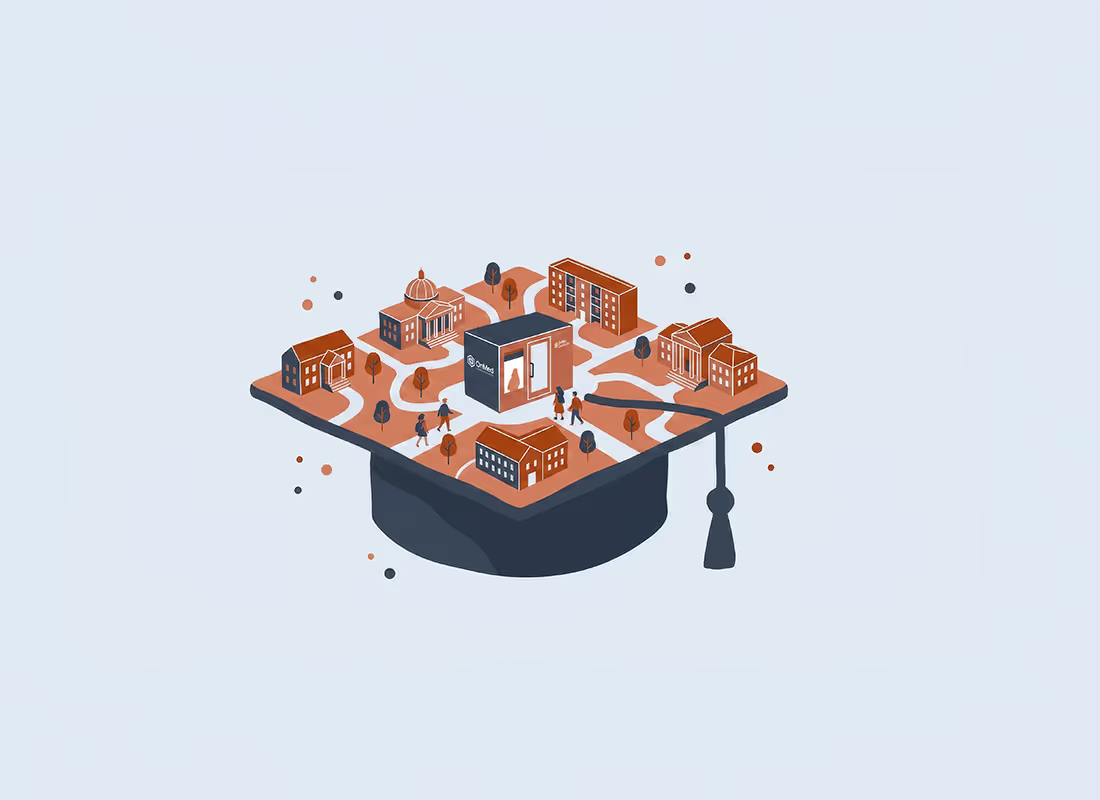
The OnMed CareStation® provides on-demand access to licensed clinicians directly within the school environment without requiring full-time, on‑site medical staff or costly construction. It’s an 8×10 foot “Clinic-in-a-Box” that delivers everyday healthcare through live clinicians and integrated diagnostic tools. Students or faculty can walk in and receive an evaluation, a treatment plan, or an e‑prescription—and return to class or work. No appointment. No waiting rooms. No disruption to the day.
For schools, this means:
CareStation patients report a 4.96 out of 5 patient satisfaction score and a 99% willingness to recommend. Of all CareStation patients, 82%+ are fully diagnosed onsite without the need for escalation. More than 50% of those users report they would have otherwise gone to the ER or urgent care unnecessarily.
OnMed is already deployed in 7 states plus Puerto Rico, including a partnership with 22Beacon to deploy in charter schools.
It keeps students healthier and engaged in the classroom. Compared to traditional alternatives, it is faster to deploy, easier to scale, and far more realistic for the communities that need it most. Most importantly, it turns healthcare from a barrier into a stabilizer.
Breaking generational poverty doesn't start at graduation. It starts with attendance, with stability, with health.
Kids can stay in school because care is accessible. Teachers can stay in classrooms because support exists. Families aren't forced to choose between a paycheck and a doctor's visit. This is how life trajectories shift. Not marginally. Measurably. In years of life. In hundreds of thousands of dollars in lifetime earnings. In communities that stop losing a generation to the incarceration pipeline one preventable illness at a time.
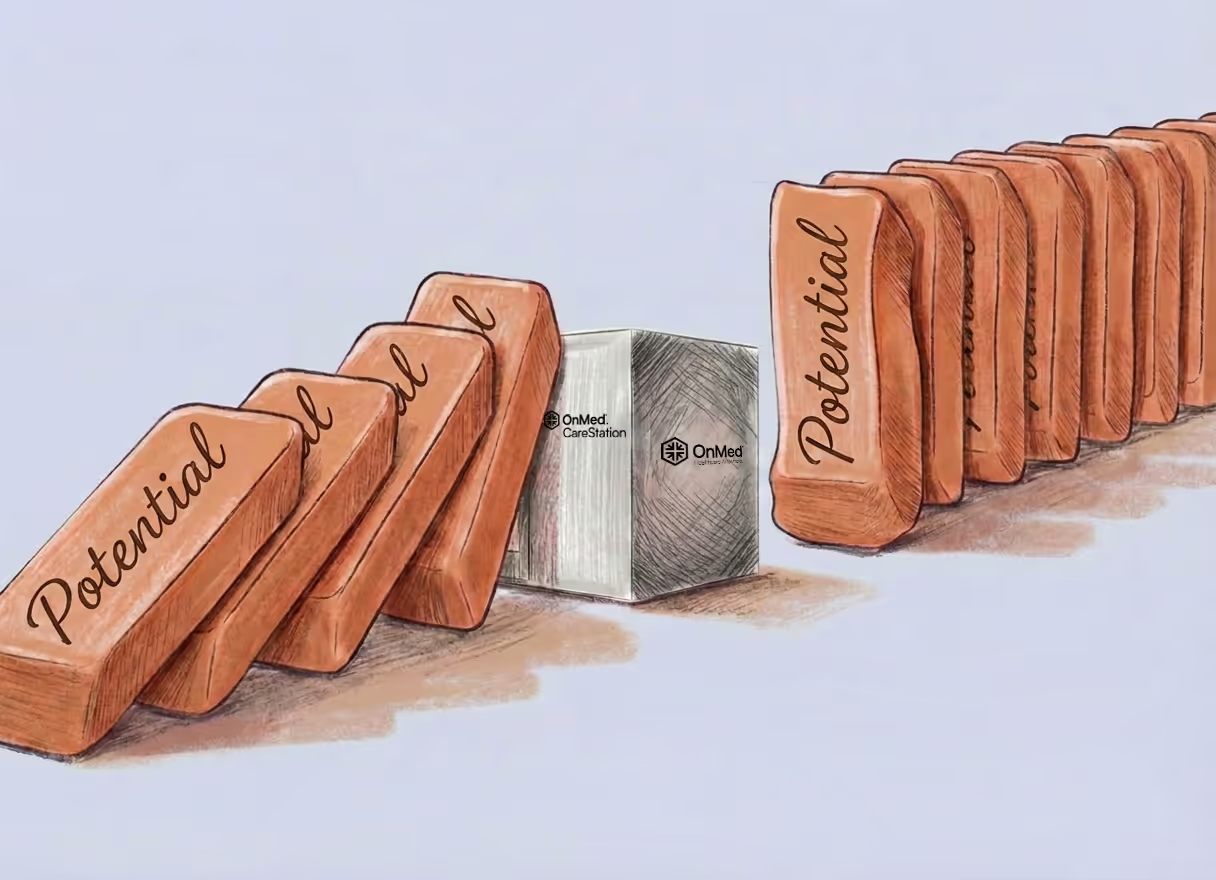
Healthcare access in schools doesn't just treat illness. It interrupts the chain reaction. And when you interrupt it early enough, you break the cycle.
Access is not the outcome. Access is the catalyst.
To learn more about how OnMed provides comprehensive, immediate healthcare directly in schools and universities, contact us.
The OnMed CareStation® is a private, on-campus healthcare environment that connects students, faculty, and staff with licensed clinicians in real time. The CareStation combines live clinician care with integrated diagnostic tools, allowing providers to evaluate symptoms, support diagnosis, develop treatment plans, and provide e-prescriptions when clinically appropriate.
26–28% of U.S. students were chronically absent in 2022–2023, 71% higher than pre-pandemic levels. 67% of students cite illness as the primary reason for missing school, and 13.8 million school days are missed annually due to asthma alone. Chronic absenteeism, missing 10% or more of the school year, is one of the strongest predictors of academic failure and dropout. When care is not accessible, a treatable fever becomes three missed days. An asthma flare that could have been managed earlier becomes a week out. Breaking the cycle of health-driven absenteeism requires care infrastructure at or near the point of learning—not a referral system that sends families elsewhere.
No. Only existing HRSA Health Center Program grantees—organizations that already hold an active H80 grant—can apply for this funding; schools and districts cannot apply on their own. Funded services must be delivered face-to-face or virtually to the health center's own patients at the school site. Most school-based sites operate as satellite locations of a sponsoring health center rather than standalone clinics.
Yes. South Carolina State University hosts a dedicated OnMed CareStation® giving students, faculty, and staff convenient, private access to healthcare on its campus in Orangeburg, SC. OnMed's partnership with 22Beacon is separately exploring how a similar model could reach charter-school students.
Yes. The CareStation can help absorb routine and non-emergent visits, freeing health center resources for more complex needs. It is designed to complement existing healthcare resources and expand access rather than replace a campus health center.
Follow along as we continue to redefine the healthcare landscape and bring the OnMed CareStation to communities across the U.S.
.png)
.png)