Show: The Scaling CEO Podcast
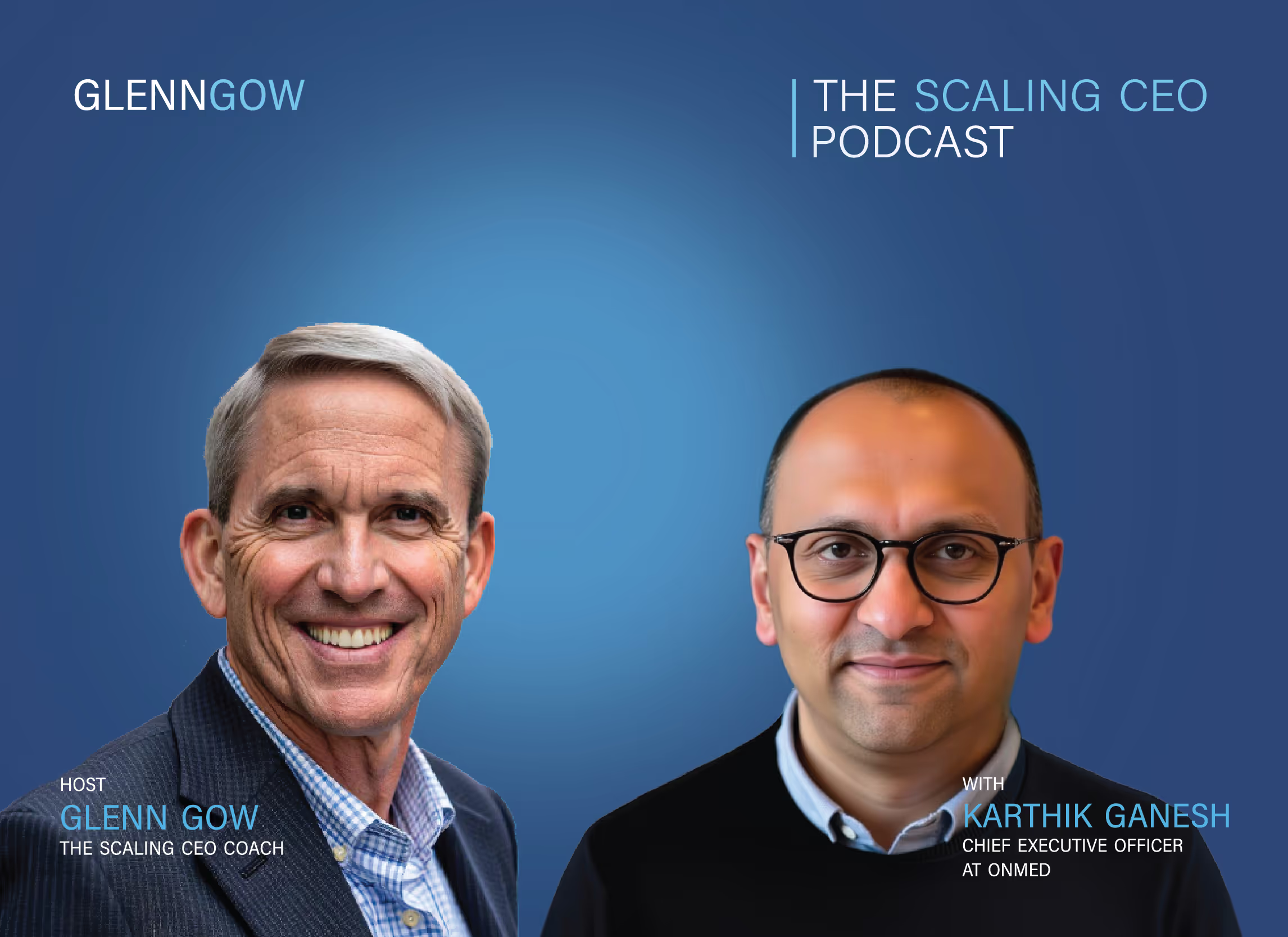
Host: Glenn Gow
Guest: Karthik Ganesh, CEO of OnMed
Published: February 27, 2026
Duration: ~20 minutes
Watch on YouTube
Listen to on Spotify
In this episode of the Scaling CEO Podcast, host Glenn Gow sits down with OnMed CEO Karthik Ganesh to explore the personal philosophy and leadership principles behind one of healthcare's most ambitious companies. The conversation is anchored in Ganesh's Happiness Model, a framework shaped by personal loss and years of study in Eastern philosophy, and how that foundation has translated directly into how he leads, builds culture, and makes decisions.
Ganesh scaled a prior company from $48 million to nearly half a billion in revenue, growing EBITDA from $1 million to $52 million over five years and delivering a 60x increase in enterprise value for investors. He brings that same intensity to OnMed, a company reimagining healthcare access infrastructure with its patented OnMed CareStation®. But what drives him is not the financial metrics. It is the fact that 167 million Americans delay care and 120 million have no viable access at all.
This episode is essential listening for any leader navigating the tension between high performance and personal stability, and for anyone building a company where purpose is the north star.
"You can't control where you're going. You can only be planful about it. All you can control is how you respond to the present and the market pressures and the market dynamics and how you adjust according to those."
— Karthik Ganesh, CEO of OnMed
"For me, purpose is societal. A mission is stakeholder focused. What OnMed is doing today is societal. There are 120 million Americans who do not have viable access to care."
— Karthik Ganesh, CEO of OnMed
"Brand and culture are more important than the strategy. The strategy can be whatever you want it to be and it needs to be resilient and malleable based on market dynamics."
— Karthik Ganesh, CEO of OnMed
"We are tech enabled, AI powered, but human delivered care. At the end of the day, healthcare needs to be human delivered. The last mile will always be human."
— Karthik Ganesh, CEO of OnMed
Ganesh's leadership philosophy is rooted in a framework he calls the Happiness Model, which he later formalized in a book of the same name. It draws on the Vedanta, an Eastern philosophy grounded in dispassion, process obsession, and acceptance of outcomes beyond one's control. At its core, the model is about redirecting energy away from results and toward the quality of the work itself. What you control, Ganesh says plainly, is the journey.
He cites Nick Saban and Kobe Bryant as the clearest examples of this principle in action. Both were consumed by process, not scoreboard. Saban has said repeatedly that as soon as you start fixating on the outcome, you have already lost the battle. For Ganesh, that same orientation is what separates leaders who build something durable from those who don't.
The practical implication for how he leads is a daily habit of reassessment: every morning, he revisits the decisions he made the day before and asks whether any should be rethought. That practice, he argues, is not a sign of indecision. It is the discipline that keeps a leader responsive rather than rigid.
Ganesh is direct about the limits of long-range planning. The organizations that struggled most during COVID were the ones most rigidly attached to their three-to-five-year strategies. Commitment to a plan, in his view, is not discipline. It is fragility.
His alternative is a daily practice of reassessment. Every morning, he revisits the decisions he made the previous day and asks whether any should be rethought. The goal is not inconsistency but responsiveness: staying planful about the destination while remaining completely adaptable to current conditions.
OnMed does not use the word "mission." Ganesh explains why with a distinction that shapes how the entire organization operates. A mission is stakeholder-focused: it is about delivering a defined set of outcomes for a defined group. Purpose, in his framing, is something larger.
OnMed's purpose is to solve the healthcare access crisis in America. There are 167 million Americans who delay care and 120 million who have no viable access. For the person working three jobs who goes to bed with a tickle in their throat not knowing whether seeing a doctor tomorrow will cost them a shift, a rent payment, or a prescription refill, the stakes are immediate.
That is what Ganesh means when he says OnMed's work is societal. And that clarity of purpose, he argues, is what enables an entire organization to operate as one.
Ganesh places brand and culture above strategy in the organizational hierarchy. Strategy shifts with market conditions. Brand and culture are what hold an organization together through those shifts.
For OnMed, culture is not about perks or flexibility. It is about total alignment with the company's purpose. Ganesh is explicit in how he talks about hiring: OnMed is taking on a hard problem that has not been solved. People who want to write a meaningful line in their own story should come in.
Ganesh describes his greatest professional superpower as the ability to get an entire organization operating as one entity, with one set of motivations. Purpose, clearly communicated and consistently reinforced, is what makes that possible.
Ganesh addressed AI on two tracks. Internally, OnMed is moving toward an AI-first operating posture, with the expectation that AI will drive efficiency across every function of the business. The challenge he recently put to his senior leadership team: find your next gear and make it AI.
On the patient side, AI is central to the OnMed CareStation® experience, enabling clinicians to prescribe and diagnose more effectively. But Ganesh draws a clear line. Technology is the enabler. The last mile of care will always be human.
It is a distinction that defines OnMed's position in the market: tech-enabled, AI-powered, and human-delivered. Not a telehealth replacement. Not a self-service kiosk. A clinical environment designed to meet people where they already are and deliver care that sticks.
Karthik is naturally drawn toward companies that want to challenge the status quo. He is also at a stage in his career where it is imperative that his work is deeply purpose-driven, having a broader societal impact as against just a stakeholder one.
Making healthcare more accessible is a hugely important purpose that drew Karthik to OnMed. OnMed is reimagining America's healthcare access infrastructure in partnership with public and private organizations, while improving health equity in underserved communities. OnMed was a CES 2025 top pick and the winner of multiple prestigious awards including TIME's Best Inventions of 2025, 2026 Edison Award, and Fast Company's Most Innovative Companies of 2026.
With a focus on tech-enabled healthcare, Karthik has built and transformed companies, delivered market-leading results, created significant enterprise and investor value, developed high-performing teams, and driven meaningful M&A transactions with strategic investors and private equity.
Along the way, Karthik has had the privilege of touching the healthcare ecosystem from most angles including payer (Aetna, Cigna), pharmacy benefits (EmpiRx Health, Express Scripts), provider-sponsored plans and value-based care (QualCare, CareAllies), and consulting (EY, Deloitte).
A prolific writer and speaker on healthcare, leadership, and resilience, Karthik has been featured in leading industry journals and podcasts. He is also the author of The Happiness Model: A Roadmap to Inner Peace.
OnMed is transforming how the world accesses healthcare.
With its patented OnMed CareStation®, an 8×10 foot "Clinic-in-a-Box," OnMed delivers comprehensive, immediate care wherever people live, work, and learn. The OnMed CareStation is a tech-enabled, AI-powered, and human-delivered platform that blends the comprehensiveness of traditional in-person care with the rapid scalability of telemedicine.
Each CareStation serves as a local access point within a scalable, connected grid that delivers everyday healthcare at scale.
Powered by public-private partnerships across insurers, healthcare providers, governments, employers, and educational institutions, OnMed is redefining healthcare access, closing critical gaps, restoring trust, and strengthening the health and economic resilience of communities.
Learn more at onmed.com.
Follow along as we continue to redefine the healthcare landscape and bring the OnMed CareStation to communities across the U.S.