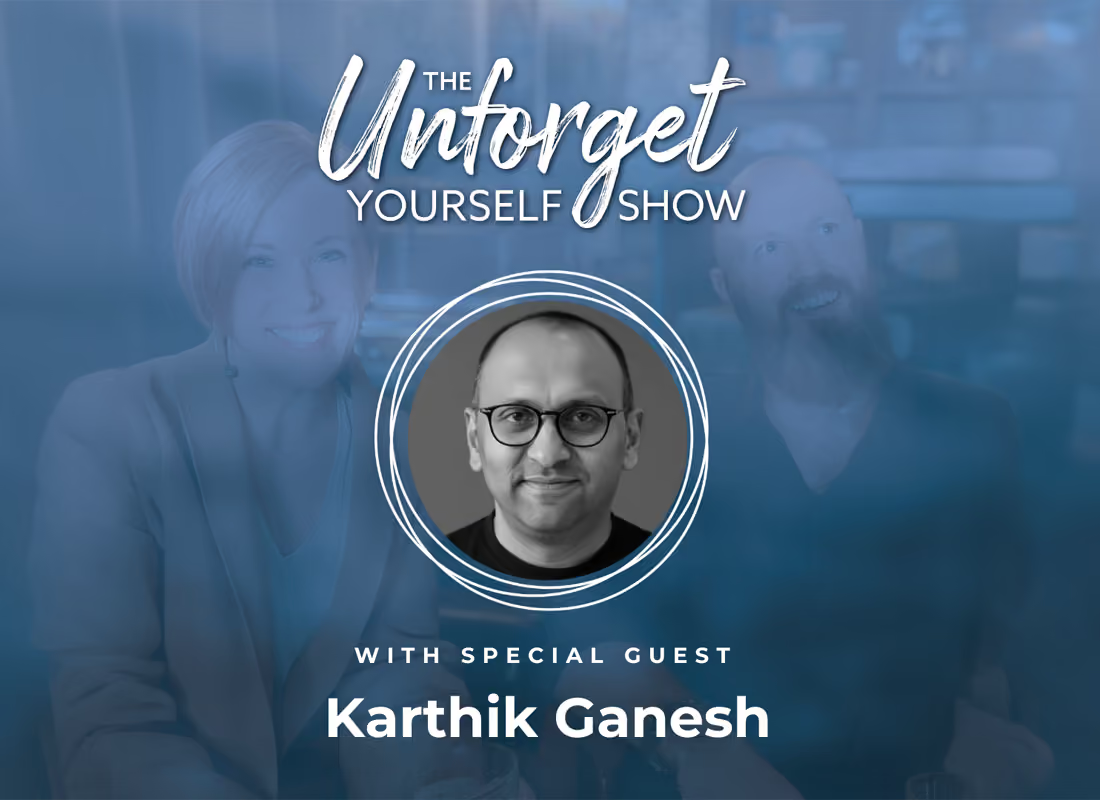
Show: The Unforget Yourself Show
Host: Mark Adams
Guest: Karthik Ganesh, CEO of OnMed
Published: August 8, 2026
Listen on Apple Podcasts
Listen on Spotify
In this episode of The Unforget Yourself Show, host Mark Adams sits down with OnMed CEO Karthik Ganesh to talk about why two of healthcare's dominant models—the traditional clinic and telemedicine—have each hit a structural ceiling, and what it takes to close the access gap they leave behind. He explains why 120 million Americans still lack viable access to care, and how the OnMed CareStation™ is built to resolve that gap in a single visit rather than simply get patients closer to one.
Karthik also walks through how he leads: an authenticity-first philosophy built on treating people as adults, and a CliftonStrengths exercise every OnMed employee goes through—not to find weaknesses, but to build roles around what people already do best. He draws a hard line between brand and culture, mission and purpose, and argues that for OnMed, purpose has to come first.
"Our purpose is simple: healthcare anywhere. That is our stated goal... when people think about access to healthcare, they think about either traditional clinics or telemedicine. Both of these have inherently hit a ceiling."
"You can't throw the baby out with the bathwater, and that's where OnMed comes in. We have taken the best of traditional care... and married it with the rapid scalability of telemedicine to create a clinic in a box that is now in seven states and Puerto Rico."
"The American Medical Association said we needed 200,000 more physicians as of five years ago. We're producing 15 or 16,000 a year."
"For me, brand and culture have been more important than strategy, consistently... Your people need to know where you stand. They need to know what you're about."
"If most things in life converge around health and wealth, you really don't have wealth without health. If health were home, the doorway to that home is broken. We just do not have enough access to health care as a country. We need to do better. We must do better."
Asked to describe OnMed's purpose, Karthik doesn't hedge: "healthcare anywhere." The framing matters because it names the gap directly. Traditional clinics are comprehensive but expensive to build, and the country is running out of the clinicians needed to staff them. Telemedicine solved for convenience, but a meaningful share of Americans still lack the broadband a clinical-quality video visit requires, and even a good connection can't produce vitals, scans, or biometrics. Two different modalities, Karthik argues, and both have hit a natural ceiling.
The OnMed CareStation™ is built as the response to both limits at once: the comprehensiveness and comfort of traditional care, married to the rapid scalability of telemedicine. Karthik calls it a "clinic in a box," now active in seven states and Puerto Rico.
Karthik walks through the experience step by step. A patient walks—or rolls—into an 8×10 foot CareStation. The door shuts, the glass fogs for privacy, and a weighing scale, blood pressure cuff, and pulse oximeter capture vitals immediately, automatically adjusting for a wheelchair's weight if needed. From a command center, the clinician can deploy a stethoscope, an otoscope, or a high-definition camera in real time, conducting a live consult with the same diagnostic depth as an in-person visit.
86% of the time, Karthik says, patients are fully diagnosed and treated without needing to go anywhere else. When they do need more, the CareStation sends a specialist referral, an e-prescription to a pharmacy of the patient's choice, or a lab order. The full visit, start to finish, takes about 20 minutes. Once the patient leaves, UVC light—which Karthik says is known to kill 99.9% of germs, including COVID*—sanitizes every surface before the next patient walks in.
Karthik turns the conversation toward the clinicians on the other side of the screen. The country doesn't have enough physicians—the American Medical Association identified a need for 200,000 more as of several years ago, and Karthik says the U.S. is producing only 15,000 to 16,000 new physicians a year. Nurse practitioners are taking on a bigger share of frontline care, but many are leaving traditional hospital roles due to burnout and the administrative weight of the job.
The CareStation model, he argues, gives clinicians something closer to work-life balance: in a 20-minute visit, administrative overhead takes up only three to four minutes, leaving the clinician roughly 90% of the visit to actually practice medicine at the top of their license.
Karthik is candid that OnMed's biggest obstacle isn't patient demand—it's institutional inertia. Enterprises, employers, insurers, hospitals, and universities have to move faster to adopt a model this different from what they've always done. That's where he sees the $50 billion Rural Health Transformation Program changing the equation. The program, now rolling out across states, explicitly challenges states to abandon approaches that haven't worked and to fund care differently. Karthik calls it a trampoline: not a guarantee, but the added lift OnMed needs to proliferate across rural America faster than it could on its own.
OnMed is transforming how the world accesses healthcare. With its patented OnMed CareStation™, an 8×10 foot "Clinic-in-a-Box", OnMed delivers comprehensive, immediate care wherever people live, work, and learn. The OnMed CareStation is a tech-enabled, AI-powered, and human-delivered platform that blends the comprehensiveness of traditional in-person care with the rapid scalability of telemedicine. Each CareStation serves as a local access point within a scalable, connected grid that delivers everyday healthcare at scale.
Powered by public-private partnerships across insurers, healthcare providers, governments, employers, and educational institutions, OnMed is redefining healthcare access, closing critical gaps, restoring trust, and strengthening the health and economic resilience of communities everywhere.
See how the OnMed CareStation is closing healthcare deserts for employers, health systems, universities, government agencies, and communities across the country. Connect with the OnMed team to talk about deploying one in yours.
Follow along as we continue to redefine the healthcare landscape and bring the OnMed CareStation to communities across the U.S.