
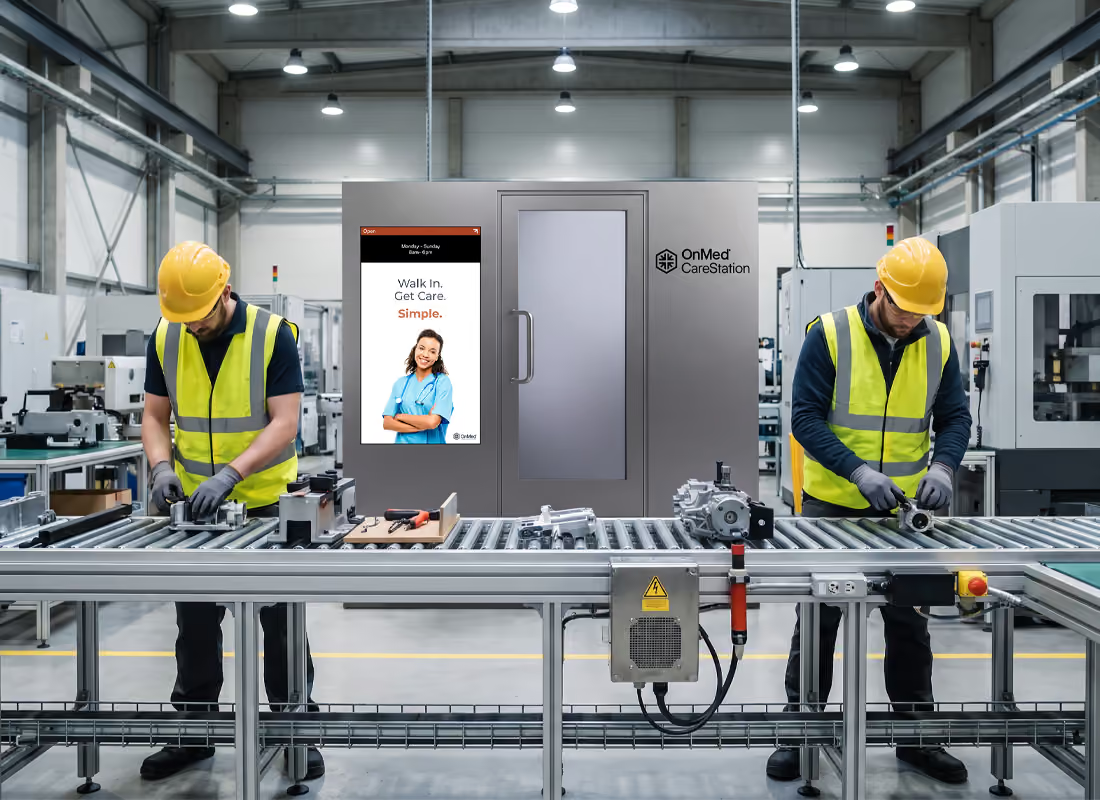
A line worker feels the ache in his chest three hours into a shift. It's probably nothing—heartburn, maybe, or the flu going around the plant. He has two options. Push through until the shift ends, because the nearest urgent care is 25 minutes away and leaving means losing the rest of the day. Or clock out, drive off-site, wait, and come back tomorrow if he comes back at all that week.
Neither option is good. Both are common, on production lines, in food processing plants, at automotive suppliers, and across distribution centers alike. And neither has anything to do with how much he cares about his health.
Health-related absenteeism costs U.S. employers $575 billion annually. $168 billion more is wasted treating non-emergencies in the emergency department—visits that are 12x more expensive than the same condition resolved in a lower-acuity setting. And employer healthcare costs overall have risen 50% over the last decade. Frontline and shift-based industries absorb a disproportionate share of all three.
Manufacturing environments weren't built around healthcare access, and it shows. Shifts run around the clock. Plants sit in industrial corridors and rural corridors alike, often far from urgent care or a primary care physician with an open slot. The average wait for a new primary care appointment runs 31 to 90 days—a timeline that doesn't fit a production line worker, maintenance technician, or warehouse associate who can't predict their schedule three weeks out and can't afford a half-day absence for something minor.
This isn't a workforce that lacks access to insurance. It's a workforce that lacks access to care during the hours it's actually available to receive it. And in safety-sensitive positions—operating machinery, working a loading dock, handling equipment on a food processing line—an employee working through pain, fatigue, or unmanaged illness isn't just less productive. They're a safety risk, and an OSHA-reportable incident waiting to happen.
For self-funded manufacturers, which carry direct claims exposure under ERISA, that gap compounds fast: into missed shifts, into avoidable ER visits, and into workers' comp claims that could have been caught and resolved on day one.
Telehealth solved a real problem for a lot of employers, but it wasn't built for a manufacturing workforce. A virtual visit can't examine a chemical exposure, check vitals after a fall from a loading dock, or capture the thermal reading that separates a minor sprain from something that needs immediate escalation. Without diagnostic tools, telehealth can start a conversation, but it can't resolve most of what actually happens on a plant floor.
A full on-site clinic solves the diagnostic gap, but at a cost most manufacturers can't justify against a single facility's headcount: $1.5M+ upfront to build, plus roughly $65K/month to operate, and two or more years before it's operational. By the time it opens, the shift roster it was built for may look nothing like it did at approval.
That leaves most manufacturers choosing between a solution that can't diagnose and a solution that costs too much to build—while every month in between is a month of preventable claims, downtime, and turnover risk already being absorbed.
For occupational health directors, risk managers, and EHS leaders, the access gap isn't just an absenteeism problem—it's a claims problem. A minor strain, cut, or repetitive-motion complaint that gets seen and treated within the hour rarely becomes a workers' comp case. The same complaint, left untreated for days because the nearest care is a scheduling and transportation problem, is far more likely to escalate into one.
On-site access changes the trajectory in three specific ways: earlier evaluation, where an employee reports a symptom or minor injury during their shift instead of waiting it out until it's worse; faster, more accurate triage, where a live clinician with real diagnostic tools, not a phone conversation, decides whether something is minor, needs monitoring, or needs to be escalated immediately, reducing both under-treatment and unnecessary ER referrals; and better return-to-work outcomes, where immediate documentation and treatment support a faster, better-supported path back to full duty, instead of a claim that drifts open for lack of timely follow-up.
Some stop loss carriers already recognize this connection: self-funded employers deploying on-site care can qualify for a renewal reduction, reflecting the lower downstream claims trajectory that earlier intervention produces.
Claims and downtime aren't the only costs on the table. In an environment where skilled machine operators, maintenance technicians, and line supervisors are increasingly difficult to recruit and replace, accessible healthcare becomes a competitive advantage, not just a cost lever. Benefits employees can actually use—without burning a day of PTO or driving 25 minutes each way—improve retention and reduce the turnover costs that come with replacing skilled frontline talent in a tight labor market.

The OnMed CareStation® closes the access gap without asking a manufacturer to choose between a solution that can't diagnose and one that costs too much to build. It's a patented, 8x10ft "Clinic-in-a-Box" that fits into existing floor space—no construction, no permits, and no clinical staff to hire. It connects employees with a live, licensed clinician in seconds, backed by integrated diagnostic tools: HD clinical cameras, a digital stethoscope, thermal imaging, and calibrated vitals capture. An employee walks in, gets examined, diagnosed, and treated, and walks out with a plan and an e-prescription if needed—all in about 20 minutes, without leaving the building.
It's tech-enabled, AI-powered, and always human-delivered: the technology captures what the clinician needs to make a confident call, but the clinician is the one making it. And it's operational in as little as 45 days from contract, with no capital expenditure approval required.
The impact shows up exactly where manufacturing feels cost the most—claims, downtime, and turnover: 86% of conditions are resolved on-site, without referral to a specialist, urgent care, or the ER; 58% of employees would have otherwise gone to the ER or urgent care, driving up claims costs that now get resolved on-site instead; $1,400 saved per user annually on average, driven by reduced absenteeism and lower downstream claims.
Put in scale: a 500-person facility avoiding even 20 unnecessary ER visits a year—a modest fraction of what 58% redirection implies—already represents meaningful claims savings, before absenteeism reduction or productivity gains are factored in at all.
None of this requires waiting for a multi-year payback to show up on a P&L. Because deployment takes 45 days and the model runs on a monthly subscription rather than a capital build, the savings curve starts in year one—the kind of in-year, accretive case finance leadership needs to see before signing off, not a return that shows up three budget cycles from now.
Manufacturers don't need another wellness program. They need fewer claims, fewer missed shifts, and healthier employees.
See how the CareStation could help your organization reduce workers' compensation and claims costs, improve productivity and reduce downtime, lower absenteeism across shifts, support worker retention, and strengthen workforce health and safety.
Contact Us to request your Manufacturing Workforce ROI Assessment.
The CareStation is an 8x10 foot "Clinic-in-a-Box" that brings everyday primary and urgent care to your workforce. Employees walk in and a live, licensed clinician uses clinic-grade diagnostic tools to provide a diagnosis, treatment plan, or e-prescription. No need for any staffing or new construction is needed.
When employees cannot access care quickly, minor conditions become reasons to miss work. A single unplanned absence reduces team output by nearly 37%. For shift-based industries, one absence cascades into overtime, rescheduling, and service gaps. On-site healthcare access removes the friction that turns a treatable condition into a missed day—employees can be seen on a lunch break rather than calling out. The employee who might have missed three days for an untreated infection gets seen on-site and stays on the floor. Combined with earlier chronic condition detection and improved medication adherence, on-site access creates measurable absenteeism reduction that shows up in productivity data, not just claims reports.
Earlier triage means fewer claims escalate to recordable or lost-time status. On-site clinical care for distributed, frontline workforces resolves minor injuries on the production floor instead of generating an off-site trip and a larger claim.
Employer clients have seen 86% of patients fully treated inside the CareStation without redirection to a specialist, urgent care, or emergency department, 58% of patients who would otherwise have gone to the ER or urgent care, and 2+ hours of productivity returned per visit. Patient satisfaction averages 4.96 out of 5, and 99% would refer the CareStation.
No. The CareStation is a Clinic-in-a-Box solution designed to be installed without requiring new construction.
Follow along as we continue to redefine the healthcare landscape and bring the OnMed CareStation to communities across the U.S.

.png)