
.png)
Jordyn is six months into her first job out of college, on a fast track she worked hard to earn. When a sinus infection creeps in on a Tuesday, she doesn't call in sick. She pushes through three days of meetings, feeling worse each day, because taking an afternoon off to sit in an urgent care waiting room feels like it would cost her the momentum she just started building.
A few states away, Marcus is a sophomore managing a chronic condition for the first time without a parent to call. His campus health center closes at 5 p.m. and books out for a week. He tells himself he'll go this weekend. He doesn't.
Neither of them is careless about their health. Both are stuck in a system that asks them to trade momentum for care, and they choose momentum. That trade-off is quietly reshaping how employers and universities compete for Gen Z's attention, and the data behind it is more specific than most people realize.

A 2026 KPMG survey of more than 900 U.S. summer interns found that career growth ranked as Gen Z's top priority when choosing a full-time employer, ahead of workplace culture, work-life balance, and salary, with 93% of respondents aiming for a C-suite or senior executive role, according to KPMG's Summer Intern Pulse Survey. This generation is unusually clear-eyed about how competitive the workplace has become as AI reshapes entry-level roles. Fortune's coverage added that 76% of respondents believe long-term success will require both strong human skills and the ability to direct AI effectively.
That ambition doesn't reduce the need for support. It raises the stakes. Nearly all employees, 92%, say their benefits package affects whether they stay with an organization, and 75% of Gen Z say they'd leave a job that doesn't meet their expectations, according to OnMed's The Gen Z Effect white paper. 70% of students also factor healthcare access into their college choice. Career growth gets Gen Z in the door. Access to care is what keeps them there.

Career ambition and purpose aren't separate conversations for this generation, they're the same conversation. 97% of Gen Z sees work as part of their identity, and four in five say their current job gives them a sense of purpose. At the same time, 73% say they'd prioritize mental health and well-being over maximizing salary.
This is a generation racing toward leadership without sacrificing its health to get there. Employers who treat healthcare access as a line item rather than a retention lever are misreading the room, and losing Jordyns because of it.
Here's where the ambition data and the healthcare data meet. Gen Z grew up inside Web 2.0, where on-demand is the only "normal" they've known, and they hold healthcare to the same bar. 58% expect an immediate response from a provider and another 18% expect one within a few hours, 76% expecting same-day contact at minimum. Yet 80% of U.S. counties contain care deserts, and a typical primary care visit still costs an employer two to four hours of lost productivity per employee.
Jordyn's sinus infection wasn't a motivation problem. It was a system problem. The system made "get care" and "keep pace" mutually exclusive, then asked her to choose.
Marcus's experience is playing out at scale. NASPA's 2024 survey of vice presidents for student affairs found that health, safety, and wellbeing education ranked as the single most important issue facing their institutions, at 83%, ahead of every other area surveyed, per NASPA's 2024 Top Issues in Student Affairs report. Traditional health centers, built around Monday-through-Friday, appointment-required models, weren't designed for a student population managing complex health needs for the first time, often without a parent to call or an established provider.
Telehealth has helped close the after-hours gap, but it has real limits: no physical exam, no vitals, no stethoscope, and little real privacy for a student calling from a shared dorm room. The gap that's left is physical, not scheduling.
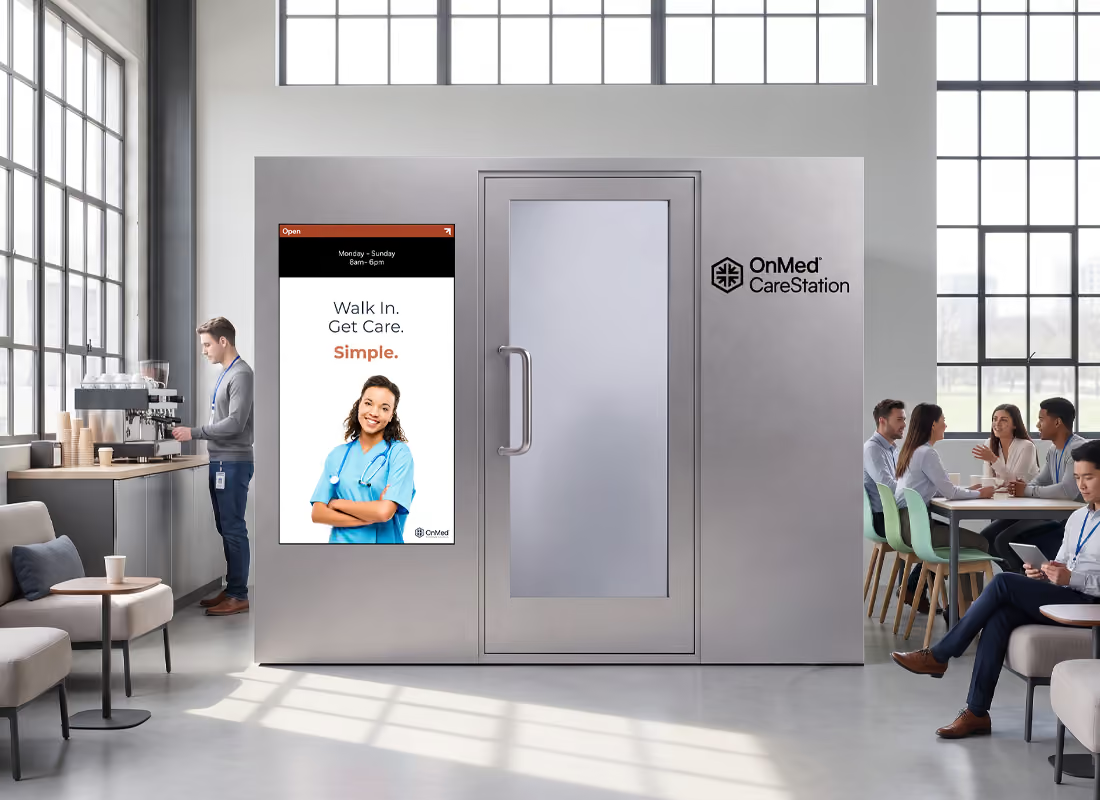
Organizations looking to close that gap are increasingly turning to care models that bring healthcare directly to where people already are. One example is the OnMed CareStation®, a “Clinic-in-a-Box”—tech-enabled, AI-powered, and always human-delivered—placed where employees and students already are, so getting care never requires leaving the building, waiting for an appointment, or working around business hours. For someone like Jordyn or Marcus, it means walking in between meetings or between classes instead of choosing to wait it out.
Inside, a patient connects in real time to a licensed clinician, supported by integrated diagnostic tools including a digital stethoscope, thermal imaging, and calibrated blood pressure and pulse oximetry monitoring. A typical visit takes about 20 minutes.
The results, per OnMed's current partnership data:
“Over 98% walk out and say their needs were met. OnMed has been hands down the best partner that I've ever worked with. This OnMed CareStation is literally saving lives.”
— Hollie C. Cost, PhD, Assistant Vice President of University Outreach & Public Service, Auburn University
That's the bar the CareStation is built to clear, whether it's on a warehouse floor, in a corporate headquarters, or in a campus wellness hub.
Career growth may attract Gen Z talent, but access to care helps retain it. As healthcare expectations continue to evolve, organizations that reduce friction in getting care will be better positioned to improve engagement, productivity, and retention. Talk to OnMed about how the CareStation® helps organizations deliver care where people already are.
Both, and they're connected. KPMG's 2026 survey found career growth outranks salary as Gen Z's top hiring factor, but 92% of employees say benefits directly affect whether they stay, and 75% of Gen Z say they'd leave a job that doesn't meet their expectations. Career growth gets Gen Z in the door; access to care and support keeps them there.
Gen Z grew up with on-demand digital services in every part of life. Per OnMed's research, 76% expect same-day response from a healthcare provider at minimum, and delayed access is more likely to result in disengagement or avoided care than in previous generations.
Telehealth can't perform a physical exam, take vitals, or use a stethoscope. The CareStation pairs a live clinician with integrated diagnostic tools inside a private, walk-in space, so most visits are fully resolved without a referral.
A CareStation is operational within 45 days of contract signing. It requires only an electrical outlet, with no construction or permitting.
Follow along as we continue to redefine the healthcare landscape and bring the OnMed CareStation to communities across the U.S.