

Every renewal season, the same question surfaces from a self-funded client: why did claims go up again?
The answer usually gets chased through plan design. Deductibles get restructured. Networks get re-tiered. Formularies get renegotiated. And sometimes that's the right call. But for a growing share of clients, the real driver of the claims trend sits somewhere else: access.

Employees who can't get a primary care appointment for 31 to 90 days don't wait patiently. They push through minor issues until they escalate, or they default to the emergency department for something that never needed to be an emergency. By some estimates, roughly a quarter to over a third of ED visits could be safely managed in a primary care, urgent care, or retail setting. Emergency care itself can cost up to 12 times more than the same condition resolved in one of those lower-acuity settings.
For clients with dispersed, shift-based, or multi-site workforces, especially in manufacturing, logistics, and distribution, that gap compounds fast. A minor strain or infection that could have been resolved same-day turns into a workers' comp claim, an ER bill, or a chronic condition that goes unmanaged until it's expensive.
This is rarely the line item a client points to when premiums climb. But it's very often the mechanism underneath the number they are pointing to.
Two forces are converging on brokers and consultants at once. First, healthcare costs continue to climb, with employers reporting a median health insurance premium increase of 18%, putting renewed pressure on organizations to identify solutions that can meaningfully impact claims trends.
Second, the Consolidated Appropriations Act's compensation disclosure requirements mean every recommendation now needs defensible evidence behind it, not just a familiar story.
A wellness program with a projected engagement lift is a hard case to defend with a clean before-and-after number. A claims-trend intervention with a measurable resolution rate is a different conversation entirely.

On-site and near-site healthcare access resolves the access gap at its source, before it becomes a claim. With OnMed, 86% of visits are resolved on-site without a referral to a specialist, urgent care, or the emergency room, and 58% of patients report they would have otherwise defaulted to one of those higher-cost settings.
For a client evaluating this, the relevant question isn't whether it's a nice benefit. It's whether their claims and utilization data shows the pattern this addresses: elevated ED use for non-emergent conditions, workers' comp claims tied to delayed treatment, or both. When it does, this becomes one of the few remaining levers that's both underused and measurable.
This works best when positioned as a claims-trend conversation, not a wellness-program conversation. Wellness programs compete for a client's attention against a dozen other line items. Claims-trend interventions get budget attention because they speak the language finance and risk leadership are already using.
It also travels well across stakeholders. HR and benefits leadership respond to the retention and access story: convenient care without burning a day of PTO. Finance and operations leadership respond to the claims and premium numbers, especially framed as an in-year, accretive case rather than a multi-year bet.
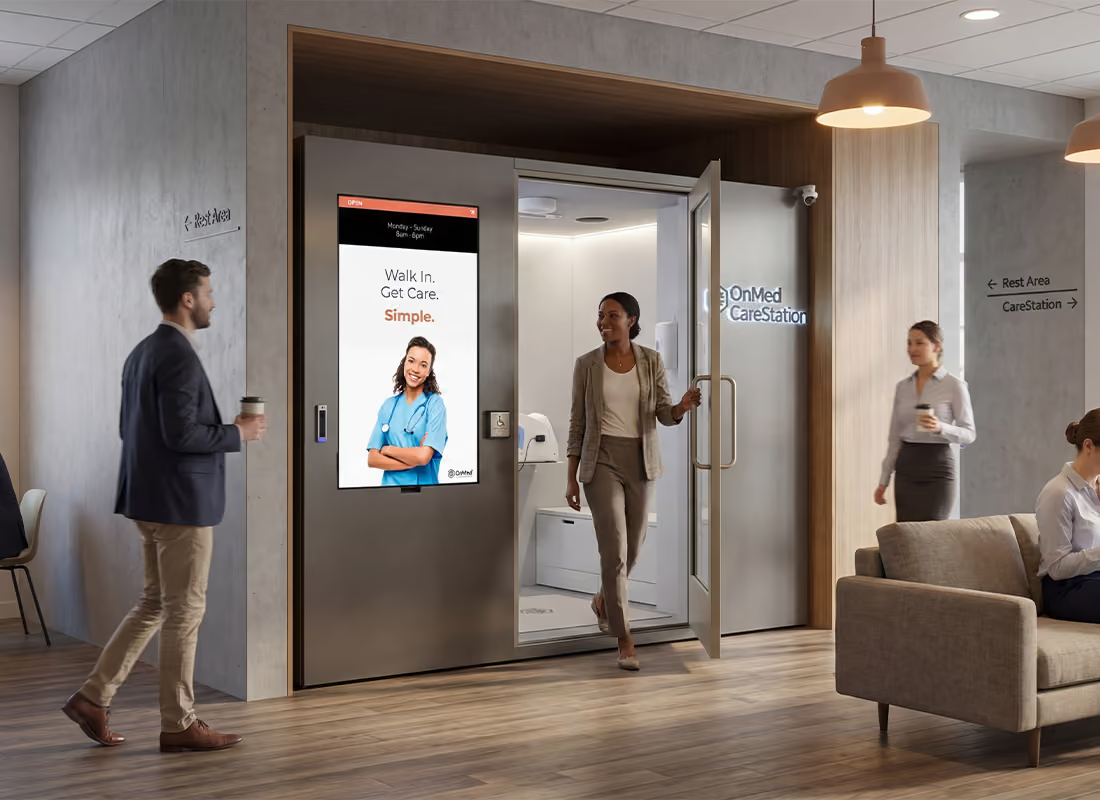
Historically, "on-site care" meant recommending a client build a clinic: roughly $1 to $5 million to build and operate, depending on size and staffing, two or more years to open, and a staffing model that has to be managed indefinitely. That's a hard recommendation to make with confidence.
The OnMed CareStation® changes that math. It's a patented, 8x10ft "Clinic-in-a-Box" that deploys in as little as 45 days from contract, no construction, no permits, no clinical staff to hire. Employees connect with a live, licensed clinician backed by integrated diagnostic tools—HD clinical cameras, a digital stethoscope, thermal imaging, and calibrated vitals capture—and leave with a diagnosis, treatment plan, and e-prescription if needed.
That's a recommendation you can bring to a client without asking them to make a multi-year capital commitment on your word alone.
If a client's claims trend looks like the pattern described here—elevated ED use, rising workers' comp claims, an access gap in a dispersed or shift-based workforce—this is worth surfacing before the renewal conversation turns defensive.
Reach out to OnMed to talk through what this could look like for a specific client's claims profile.
The CareStation is an 8x10 foot "Clinic-in-a-Box" that brings everyday primary and urgent care to your workforce. Employees walk in and a live, licensed clinician uses clinic-grade diagnostic tools to provide a diagnosis, treatment plan, or e-prescription. No need for any staffing or new construction is needed.
Employer healthcare costs are projected to rise approximately 9% in 2026, the highest single-year forecast in over a decade, according to Business Group on Health CEO Ellen Kelsay, driven in large part by GLP-1/specialty drug spend and continued avoidable ED utilization.
Limited access to healthcare can increase employer healthcare costs by delaying care until conditions become more serious and expensive to treat. Employer healthcare spending has increased more than 50% over the last decade, while poor employee health costs U.S. employers an estimated $575 billion annually in lost productivity. The OnMed CareStation® helps expand access to primary and urgent care, enabling earlier intervention, chronic condition management, reduced absenteeism, and fewer avoidable emergency room visits. Learn more: Download The Complete Employer Guide to On-Site Healthcare.
Across OnMed employer deployments, 86% of conditions are resolved on-site, 58% of patients would have otherwise sought care in an emergency room or urgent care setting, and more than two hours of productivity are returned per visit. Employer deployments have also demonstrated 2-3x higher wellness engagement and more than $1,300 saved per employee patient. Patient satisfaction averages 4.96 out of 5, and 99% of patients would recommend the CareStation.
The Georgia State Health Benefit Plan (SHBP) case study reports separate program-specific outcomes. Download the Georgia SHBP case study.
Some stop loss carriers offer a 1% renewal reduction for employers deploying on-site care solutions, reflecting the lower downstream claims trajectory that proactive chronic care management and ER diversion produce.
Follow along as we continue to redefine the healthcare landscape and bring the OnMed CareStation to communities across the U.S.
.png)