

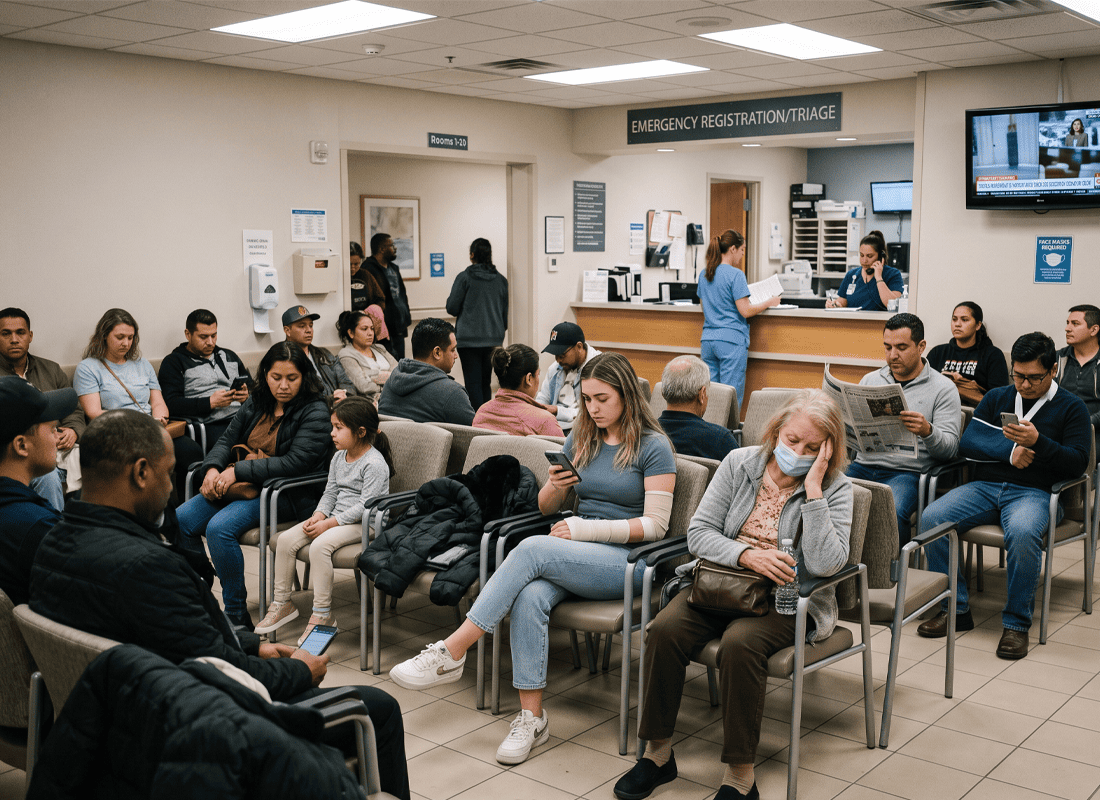
Image Source: Fast Company - Why the Tool Is Not the Solution to Healthcare Access
Despite decades of technological innovation in healthcare, millions of Americans still face significant barriers to accessing care. In his latest article featured in Fast Company, Karthik Ganesh, CEO of OnMed, argues that solving the access crisis requires more than new tools. It requires investment in the infrastructure that makes care possible.
From workforce capacity and care delivery sites to data connectivity and community trust, Ganesh outlines the foundational elements needed to expand access at scale. He also explores the role of AI in supporting clinicians and improving patient experiences while keeping human relationships at the center of care.
Read the full article below:
I have spent 26 years in healthcare. I have watched apps launch, algorithms deploy, platforms get funded, and payment models get reinvented, all in the name of fixing American healthcare. Yet, millions of Americans still cannot get a timely doctor’s appointment. Emergency rooms remain the default care setting for people with nowhere else to turn. Provider shortages are accelerating. The system is breaking under the weight of its own complexity.
The problem is that we have confused the tool for the solution. Technology is an enabler. Treat it as a destination and we will continue to build sophisticated solutions to the wrong problems.
Consider the first and second generations of telehealth. The promise of removing distance as a barrier was correct in theory. In practice, the people who needed care most were often the least able to use it. Broadband gaps, device limitations, and the reality that a complex diagnosis needs more than a video call all worked against the premise. Telehealth solved for distance but not for infrastructure.
This is not only a rural problem. Underserved America lives in the South Bronx and South Chicago, in the suburbs of Detroit, and the exurbs of Phoenix. Poverty, provider shortages, transportation barriers, and a fragmented system have made reliable, dignified care a privilege rather than a given, everywhere. Around 92 million Americans live in primary care health professional shortage areas (137 million are subject to mental healthcare professional shortages). As of 2021, the country needed up to 200,000 more physiciansjust to meet existing demand. No app closes a gap like that. Only infrastructure does.
Real infrastructure has five layers, and only one of them involves a building.
1. Physical infrastructure is where a patient and a clinician actually meet: clinics, urgent care centers, mobile units, and care stations. Without it, nothing else functions.
2. Workforce infrastructure is the pipeline of people who staff those sites: residency programs, loan forgiveness, scope-of-practice rules, and credentialing. We have chronically underbuilt this layer.
3. Financial infrastructure is the payment architecture that makes care in hard-to-serve markets sustainable. Fee-for-service was built for high-volume suburban practices. It is structurally misaligned with the economics of underserved care, and providers cannot survive where it stays unfixed. B2C at large in healthcare hasn’t worked.
4. Data infrastructure is the connective tissue that lets information travel with the patient. When a patient moves between care settings without shared records, that is a safety risk.
5. Trust infrastructure is the least tangible layer and the most important. In communities with long histories of medical neglect, trust must get built through consistency, cultural competency, and accountability over time. There is no technology shortcut for showing up.
AI belongs in this picture, but the conversation about it is framed incorrectly. AI without a clear use case and accountability structure is not progress. In healthcare, AI’s job is to make clinicians dramatically better.
Three AI uses matter most. Clinical decision support sharpens diagnosis and prescribing with population-level data no clinician could hold in their head. Ambient documentation frees clinicians from note-taking, so their attention returns to the patient in front of them. Lastly, agentic orchestration removes the administrative friction that frustrates the system, while making the experience before and after the visit easier for the patient.
Here is the principle I keep returning to, and it does not bend. Empathy, judgment, and human relationship are the last mile of care. A patient is a person with a history, a set of fears, a context no algorithm fully captures. Deciding how to treat them takes a human being who is present, who listens, and who carries the weight that a clinical relationship demands. AI should make that human being extraordinary at their job.
If we are serious about solving healthcare access, we need a different approach. Instead of focusing on the technology we can deploy, we should be looking at the infrastructure gaps. We should consider what mix of physical presence, human capacity, and technology closes them. We need to determine how to give clinicians better information and a smoother process so they can focus entirely on the patient.
Infrastructure first. Technology that serves it. Humans at the center. That is the model. It should be powerful enough to scale, intelligent enough to support its clinicians, and human enough to earn the trust of the patients it serves. The technology tools available today are the most capable this industry has ever had. Used well, they extend a clinician’s reach and make access real in communities that have waited decades for it. But the tools are how you deliver the answer.
The people waiting for care deserve nothing less.
Follow along as we continue to redefine the healthcare landscape and bring the OnMed CareStation to communities across the U.S.
.png)