The Rural Health Transformation Program (RHTP), also referred to as the RHT Program, is a $50 billion federal initiative administered by the Centers for Medicare & Medicaid Services (CMS) to strengthen and modernize rural healthcare across the United States. It was established under Public Law 119-21, the reconciliation legislation popularly known as the Working Families Tax Cuts Act (also referenced as the One Big Beautiful Bill Act), signed into law on July 4, 2025, and is administered through CMS's newly created Office of Rural Health Transformation (ORHT).
RHTP exists to address a well-documented rural health crisis: rural hospital closures, persistent workforce shortages, and aging healthcare infrastructure that leave millions of Americans with limited or no local access to care. Rather than a traditional reimbursement program, RHTP functions as a five-year cooperative-agreement grant: CMS distributes $10 billion per federal fiscal year from FY2026 through FY2030, with half of each year's funding split equally among all approved states and the other half allocated competitively based on rurality metrics, existing state policy actions, and the strength of each state's proposed initiatives.
Only the 50 U.S. states are eligible applicants—the District of Columbia and U.S. territories cannot receive RHTP awards. States applied during a single application window (September 15–November 5, 2025); all 50 states submitted applications, and CMS announced on December 29, 2025 that all 50 were approved for funding, with first-year (FY2026) awards averaging approximately $200 million per state (ranging from roughly $147 million to $281 million). Approved states must direct funds toward at least three of several statutorily defined use categories, spanning chronic disease prevention, direct provider payments, consumer-facing care-management technology, rural workforce recruitment and retention, IT/cybersecurity modernization for rural hospitals, and expansion of behavioral health and substance-use treatment capacity. RHTP funds explicitly cannot be used to pay for services already reimbursable through Medicare or Medicaid, and a Health Professional Shortage Area designation often shapes how states target their rural workforce funding categories.
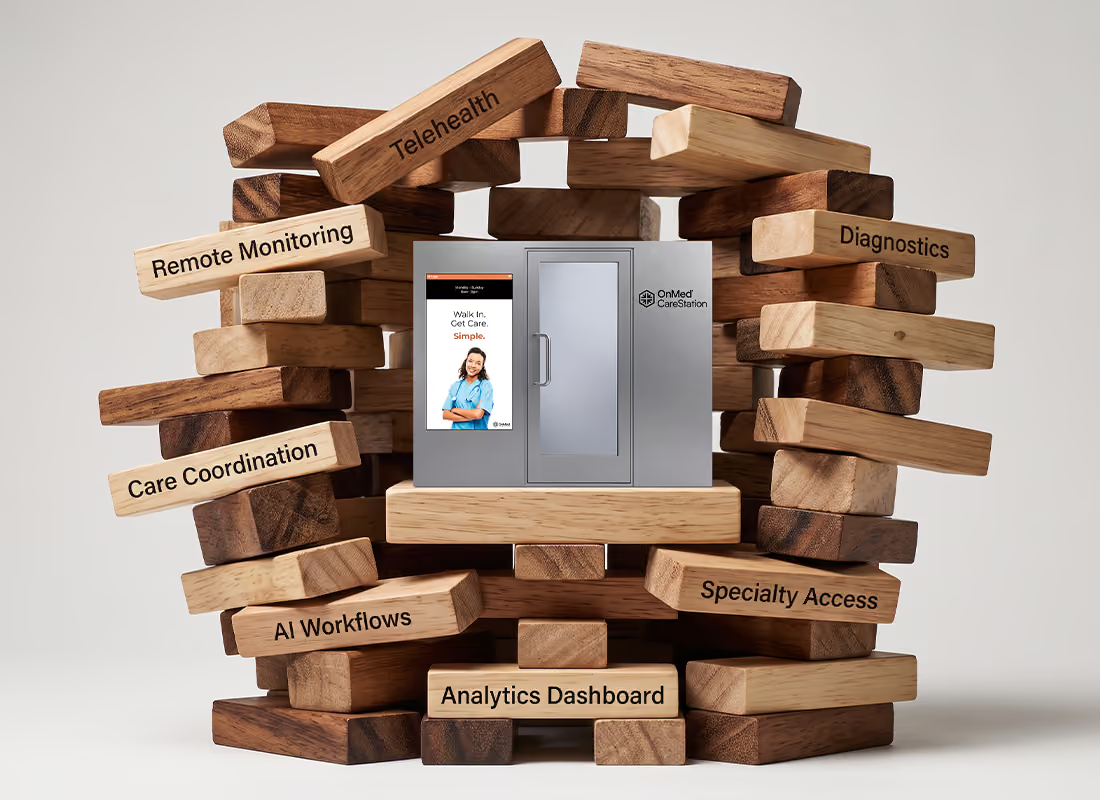
For healthcare organizations, RHTP represents the largest single federal investment in rural health infrastructure in recent memory. CMS explicitly cited the OnMed CareStation™ in the RHTP Notice of Funding Opportunity as a "Rural Health Regional Excellence Initiative" example, and Virginia and Nebraska have both named OnMed directly in their RHTP applications—this is not a theoretical fit, it's a model states are already building around. OnMed has tracked the program closely as states begin deploying their awards—see "OnMed CareStation™ Gains Momentum Across the U.S." for early implementation examples, and "How to Turn RHTP Funding Into Rural Healthcare Access—Fast" for a practical breakdown of moving from award to deployment. Two structural risks are worth flagging as states plan: RHTP's flexibility means many will default to funding several disconnected vendors rather than one integrated system, and mobile-clinic models struggle to meet RHTP's "sustainable access" goal precisely because they're built to rotate rather than stay. The National Rural Health Association's RHTP tracker gives a real-time, state-by-state view of where funding opportunities and RFPs currently stand.
The Rural Health Transformation Program is a federal initiative directing $50 billion over five years into rural healthcare systems, administered by CMS. It's structured around five priorities: preventive care and chronic disease management, sustainable access infrastructure, workforce development, innovative care models, and technology-enabled diagnostics.
First-year (FY2026) RHTP awards averaged approximately $200 million per state, ranging from roughly $147 million to $281 million, with CMS distributing $10 billion nationally in FY2026 alone as part of the program's $50 billion, five-year total, per CMS's December 2025 award announcement.
No. RHTP funds explicitly cannot be used to pay for services already reimbursable through Medicare or Medicaid—the program is intended to fund infrastructure, technology, and workforce investments beyond standard reimbursement.
Yes. CMS explicitly cited the OnMed CareStation™ in the RHTP Notice of Funding Opportunity as a "Rural Health Regional Excellence Initiative" example, and Virginia and Nebraska have both named OnMed in their state RHTP applications.
The CareStation is operational in as little as 45 days from contract signing, requiring only a power outlet and broadband or satellite connectivity—no construction or permits.
Every term here points to the same gap in healthcare access. See how the CareStation closes it.
Talk to Our Team