

Most employers are paying more for healthcare every year, yet getting less in return. Costs are up roughly 50% over the last decade: catastrophic claims of $1 million or more have climbed 29% in the past year and 61% over the last four, $168 billion is spent annually treating avoidable, non-emergent ER visits, and over $575 billion is lost to health-related absenteeism. None of this is random, it's a structural inefficiency that compounds year after year until the real cost is far larger than most organizations realize.
The instinct is to cut coverage, but that's counterproductive: it shifts cost onto employees, drives delayed care, and increases the very claims costs employers were trying to reduce. The real driver sits one layer down.
Benefits are typically an employer's second-highest cost after payroll, and healthcare is consuming a growing share of that budget without a matching improvement in outcomes, because the one variable tying claims and wellness spend together—access—rarely shows up on a spreadsheet next to premium costs and renewal rates. When everyday care is out of reach, every health issue becomes more expensive to resolve, for the employee and for the organization.
The more durable path is fixing access. Here are seven strategies employers can act on now.
Close to 60-70% of emergency department visits are considered non-emergent. The average ER visit costs five to ten times more than primary or on-site care, and $168 billion is wasted annually treating non-emergencies in the ER, costs that flow directly into employer claims and renewal rates.
Giving employees a trusted, convenient alternative for exactly those non-emergent needs, infections, minor injuries, and the everyday conditions that never needed that setting, is one of the highest-leverage cost levers available to an employer.
Employers who give employees a walk-in visit with a live clinician right at the worksite, for precisely the needs that never belonged in an ER to begin with, capture that savings immediately.
Shift-based, safety-sensitive work doesn't pause for a 31 to 90 day wait for a doctor. Employees push through minor issues rather than lose a shift, and plants in industrial or rural corridors often sit far from urgent care. For self-funded manufacturers carrying direct claims exposure under ERISA, that delay compounds into workers' compensation claims and downtime that earlier intervention could have prevented.
Roughly 44% of employees using on-site care present with a chronic condition. Consistent monitoring and easy access to follow-up care are what keep a manageable condition from becoming an expensive one, instead of an emergency.
Making that care access the default instead of the exception, no appointment to book, no shift to give up, is what gets the same employee who couldn't get in last time to actually show up for the follow-up.

Many employers invest heavily in wellness programs, screenings, health risk assessments, coaching, only to see participation stall. Many employer-sponsored wellness programs see engagement rates below 25%, meaning three out of four employees never receive the preventive touchpoints that keep claims low. Nationally, $45 billion is wasted annually on non-participation in wellness programs. The barrier is rarely willingness. It's access and convenience.
Employers who bring care on-site see wellness engagement run 2 to 3 times higher, because the touchpoint is built into a visit employees are already making, not one more program competing for their attention.
73% of Gen Z employees say they'd prioritize mental health and well-being over maximizing their salary, which means healthcare access isn't a nice-to-have for this workforce, it's close to a deciding factor when selecting a company to work for.
The pattern holds more broadly, too: employees who don't feel supported leave, and replacing them costs anywhere from 50% to 200% of their salary once recruiting, onboarding, and the productivity dip during ramp-up are factored in. SHRM has reported that 92% of employees say their benefits directly affect whether they stay, which makes healthcare access a retention lever as much as a cost line.
Health-related absenteeism costs U.S. employers $575 billion annually, and presenteeism, employees who show up but operate at a fraction of capacity while managing an untreated condition, consistently costs more than absenteeism and disability combined. Every hour an employee spends traveling to and waiting for routine care is an hour of lost productivity that never shows up on a claims report.
The average doctor's visit costs an employee two or more hours of productive time once travel, waiting, and return are factored in. Bringing that visit on-site returns those two-plus hours directly to the workday instead of costing them. Multiply that across a workforce and the drag adds up quickly. Employers who reduce the time and friction it takes to get care see employees seek treatment earlier, before a condition escalates into a multi-day absence, and get back to work faster when they do need it.
Some employers offer telehealth as an option for convenient care access. Most worksites have reliable connectivity, but that advantage disappears the moment an employee logs in from home instead, where roughly 1 in 5 Americans still lack broadband reliable enough for a clinical-quality video visit. Virtual visits capture no vitals or diagnostics, and telehealth accounts for only 4 to 6% of all outpatient visits nationally. Without the ability to examine, scan, or diagnose, telehealth alone cannot resolve the majority of everyday conditions employees bring to it.
The fix is pairing telehealth with real diagnostic tools instead of a screen and a phone camera. A digital stethoscope, HD and thermal imaging, pulse oximetry, and blood pressure monitoring built into an on-site care solution allows a clinician examine the patient instead of just talking to them.
A fully staffed on-site clinic build runs $2 million to $5 million to construct, plus roughly $65,000 a month to operate once it's open, and between design, construction, credentialing, and ongoing OSHA and HIPAA compliance, it takes two or more years to get there. That's not an ideal timeline.
Where should employers start?
The thread connecting all seven strategies is access. When employees can reach timely, trusted care, every other strategy works better: prevention gets used, chronic conditions get managed, and the emergency department stops functioning as the default front door.
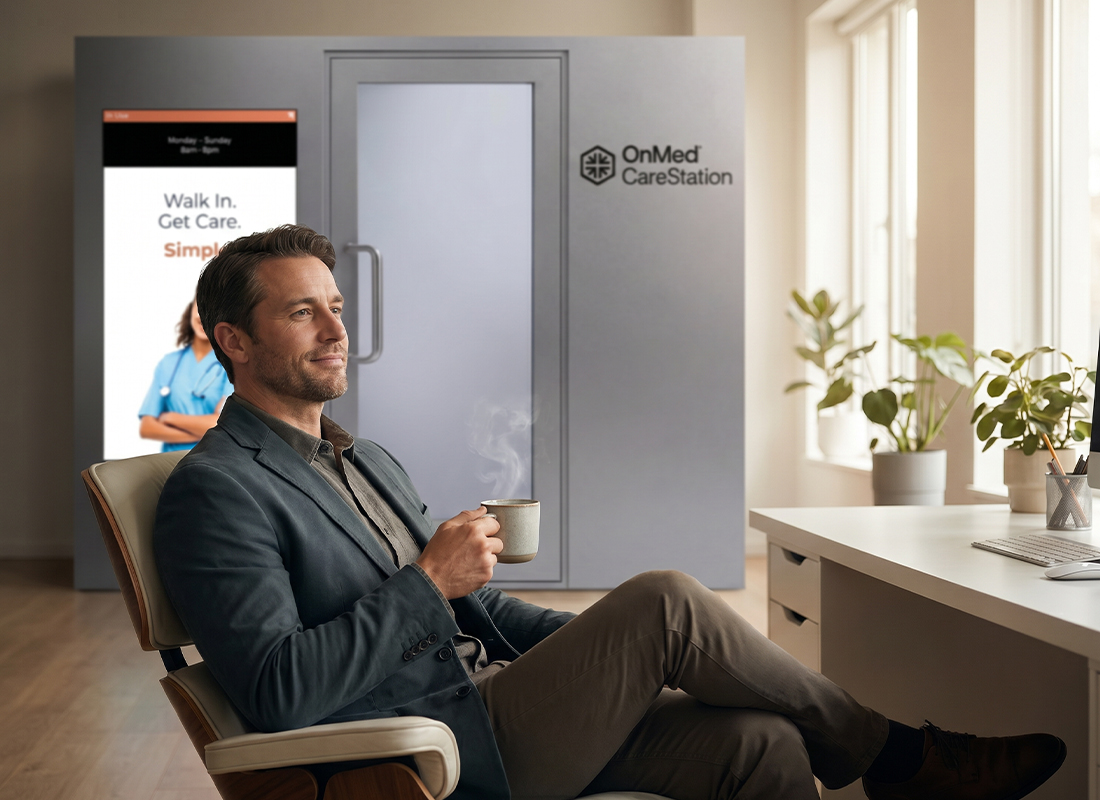
The OnMed CareStation® solves for all of these challenges.
It's a patented, 8x10 ft "Clinic-in-a-Box" that deploys in as little as 45 days, requiring only an electrical outlet, no construction, no new real estate, and no clinical staff to hire, so employers bring care to employees faster and more efficiently.
Employees connect with a clinician in seconds and walk away 17 to 20 minutes later with a diagnosis, a treatment plan, and an e-prescription. Employers who deploy this model see 86% of visits resolve on-site without a referral, and 58% of users say they would otherwise have ended up in the ER or urgent care.
The CareStation is AI-amplified, always human-delivered, and accessible anywhere. Use these ideas as a practical checklist:
For employers ready to close that gap, contact OnMed to learn how on-site, clinician-led care can reduce claims costs and absenteeism, while improving productivity and delivering measurable ROI.
Follow along as we continue to redefine the healthcare landscape and bring the OnMed CareStation to communities across the U.S.

.png)