
A Plug-and-Play solution for healthcare access at scale. No gaps, no construction, and no zip code left behind.
80%
OF US COUNTIES QUALIFY AS HEALTHCARE DESERTS
3 of 4
AMERICAN ADULTS HAVE AT LEAST ONE CHRONIC CONDITION
$168B
TREATING UNNECESSARY ANDAVOIDABLE CASES IN THE EMERGENCY ROOM
MARKET CHALLENGE
61%
CLOSURE OF PROVIDER GAPS IN COUNTIES WITH CARESTATIONS
$500
RESTORED IN LOCAL ECONOMIC VITALITY PER VISIT
80%
HAVE NO PCP, CARESTATION IS THEIR MEDICAL HOME
In the carestation
The perfect blend of traditional "brick and mortar" and virtual care.


Easy Installation

Private

Secure

Device Ecosystem

Real-time Clinician

Self-cleaning
Tech-enabled. AI-powered. Human-delivered. Think of it as a Clinic-in-a-Box.







Read about how we’re transforming access to care by bringing the OnMed CareStation® to more communities across the U.S.
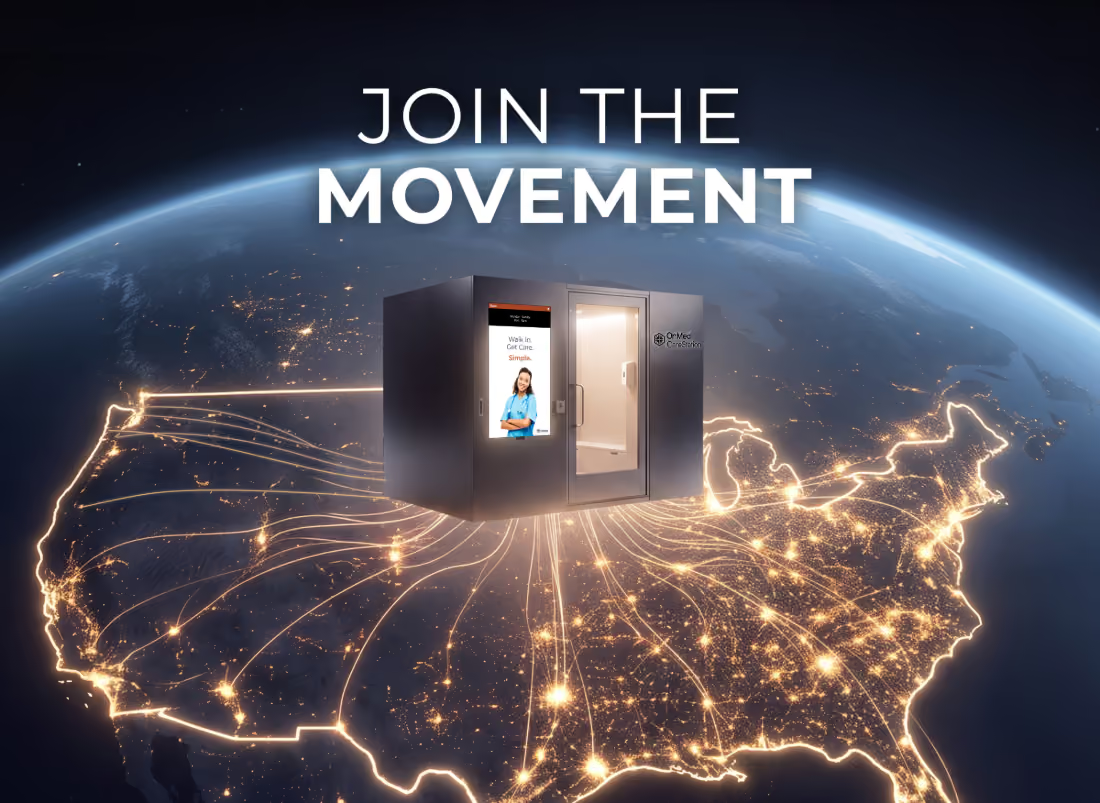
OnMed, the leader in tech-enabled hybrid-healthcare, is expanding access to care through the patented OnMed CareStation®, an 8x10 foot "Clinic-in-a-Box" that brings licensed clinicians and diagnostic tools through a fully integrated device and human platform. Remote clinicians can examine a patient, assess symptoms and provide treatment and prescriptions, blending the comprehensiveness and comfort of a traditional doctor's visit with the rapid scalability of virtual care. OnMed's tech ecosystem, and scalable infrastructure are designed to be deployed in communities where people live, work and gather, bringing access to healthcare without requiring the time, staffing and physical footprint of a traditional clinic. Learn more about OnMed and what we’re building.
The OnMed CareStation® is an 8-by-10-foot "Clinic-in-a-Box" that connects patients in real time with licensed clinicians and integrated diagnostic tools through a fully integrated device and human platform. Patients can walk in and receive a diagnosis, treatment plan, and e-prescription, often without an appointment or waiting room. Unlike traditional telehealth, the CareStation combines virtual care with diagnostic tools, real-time scans, and vital sign monitoring to support comprehensive clinical evaluations where care is needed most. See how a CareStation visit works.
The OnMed CareStation® addresses two limitations of traditional telehealth: diagnostic capability and access. Traditional telehealth often lacks the clinical data needed to support diagnosis, and 1 in 5 Americans lack access to viable broadband. The CareStation combines live licensed clinicians with integrated diagnostic tools, including a digital stethoscope and HD exam camera, and broadband or satellite connectivity to help close both gaps. 86% of patients are treated in the CareStation without escalation to a specialist, ER, or urgent care. Read why diagnostic tools make the difference.
The Rural Health Transformation Program (RHTP) is a CMS initiative investing $50 billion over five years to expand healthcare access, strengthen healthcare infrastructure, address workforce shortages, and improve health outcomes in rural communities. It is one of the most significant federal investments in rural healthcare in a generation. The program is structured around five priorities: preventive care and chronic disease management, sustainable access infrastructure, workforce development, innovative care models, and technology-enabled diagnostics. CMS cited the OnMed CareStation® in the RHTP Notice of Funding Opportunity (NOFO) as a Rural Health Regional Excellence Initiative example demonstrating how innovation can expand access to care. Read how to turn RHTP funding into rural healthcare access.
Healthcare deserts are growing as communities face a combination of provider shortages, rural hospital closures, workforce challenges, rising healthcare costs, and increasing demand for care. Many areas struggle to recruit and retain healthcare professionals while existing facilities face growing financial and operational pressures. As local access points disappear, residents are often forced to travel farther, wait longer for appointments, or go without the preventive, primary, urgent, and chronic care services they need. Learn more about healthcare deserts and how the CareStation is reviving previous healthcare deserts.
Rural health organizations cannot apply directly for Rural Health Transformation Program (RHTP) funding. CMS awards RHTP funds to states, and organizations typically access those funds through state subawards, contracts, grants, and requests for proposals. The first step is identifying the state's lead RHTP agency and monitoring funding opportunities. RHTP investments are focused on healthcare access, workforce development, sustainable healthcare infrastructure, innovative care models, and technology-enabled diagnostics. Get your pre-filled RHTP application.
CMS cited the OnMed CareStation® in the RHTP Notice of Funding Opportunity (NOFO) as a Rural Health Regional Excellence Initiative example demonstrating how innovation can expand access to healthcare. Read how states are deploying RHTP funding with the CareStation.
Both mobile clinics and fixed care sites can expand healthcare access, but they serve different purposes. Mobile clinics are effective for outreach, screenings, and periodic services, while fixed, always-on care sites provide a permanent point of care that supports continuity, chronic condition management, follow-up care, and ongoing patient engagement. Because RHTP is focused on sustainable healthcare access and long-term transformation, many communities are evaluating solutions that remain available year-round rather than only when a mobile unit is scheduled to visit. Read the full comparison of mobile clinics and always-on care.
Yes. CMS cited OnMed’s Alabama deployment through the Auburn Rural Health Initiative as a model in the RHTP NOFO, under the “Rural health regional excellence initiative” example within the “Sustainable access” goal. Read how states are deploying RHTP funding with the CareStation.