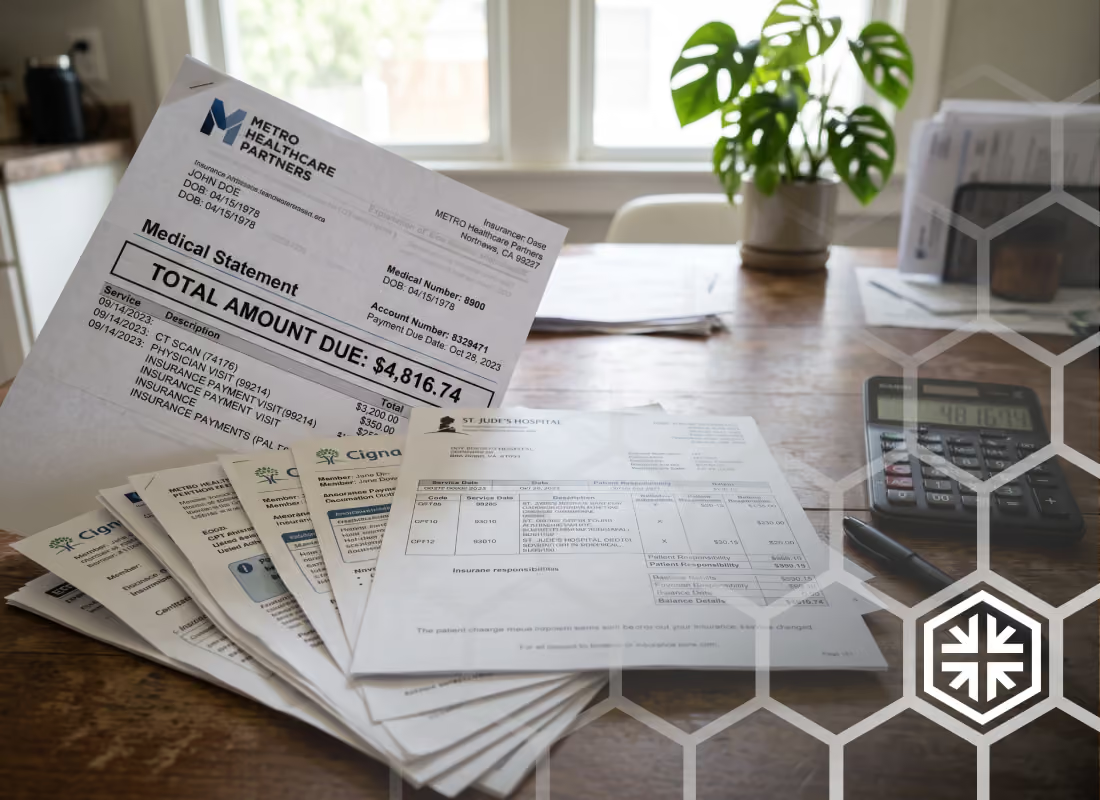
Explore how on-site healthcare can help employers improve workforce health while supporting business performance.


Employers track per-employee premiums, renewal rates, plan tiers, and year-over-year increases closely. Those figures do not show the full cost of employee healthcare: productivity lost to untreated conditions, claims that grow when care comes too late, wellness programs employees do not use, or turnover linked to a disappointing benefits experience. As costs rise, employers need to understand not only what they are spending, but what prevents that spending from delivering more value.
That variable is access.
Coverage and benefits investment cannot deliver their full value if employees cannot get timely, convenient care. When routine needs go untreated, the effects can reach beyond medical claims to time away from work, benefits engagement, and the employee experience. Improving access gives employers a way to address those connected problems alongside plan design and other cost strategies.
Employer-sponsored healthcare costs have risen more than 50% over the last decade, and premiums are projected to climb roughly 9.2% in 2027—among the sharpest increases in fifteen years. That trend line isn't random. It's the compounding effect of a system where everyday care is hard to reach, so conditions escalate into the most expensive settings available.
For employers, the impact falls into three connected areas: medical spending when care is delayed or delivered in a more expensive setting; work time lost to untreated conditions or time away for appointments; and benefits value when employees cannot use the support already available to them. These costs require different measures, but the starting question is the same: what prevents employees from getting appropriate care early?
Employers are the largest single purchaser of healthcare in the country. When access breaks down, employers are the ones who absorb the bill—whether or not it's labeled that way on the renewal invoice.
Some healthcare costs show up in claims. Others show up in the workday—and difficulty getting timely care connects the two. Start with presenteeism: employees are at work, but an untreated condition keeps them from working at their usual capacity. A lingering sinus infection, persistent backache, or unmanaged anxiety may never register as an absence, yet the disruption can add up across a workforce. Claims alone do not reveal that lost productivity.
Getting treatment can create a different kind of disruption. Travel, waiting, and the appointment itself can take employees away from work for half a day or longer, especially when care is far from home or work. That creates a difficult trade-off: take time away to get help, or put off the visit and keep working through the problem. The time required to reach care is therefore more than a scheduling inconvenience—it can become a reason employees delay treatment.
When care is delayed, the cost can move from the workday into the claims file. An unresolved problem may eventually require urgent care, an ER visit, or more time away from work. Missed routine visits can also mean missed opportunities to identify and manage conditions such as hypertension or prediabetes before they become more serious. That progression is not inevitable, but it explains why employers need to look beyond claims: reduced productivity, time spent getting care, and missed opportunities for early treatment are connected costs, not separate problems.
→ Read more: The Hidden Cost Centers Employers Aren't Measuring—But Should Be
If difficulty getting care contributes to higher costs, cutting benefits can make that problem worse. Reducing coverage may lower what an employer pays upfront, but it can also leave employees paying more to get treatment. Some may put off a visit as a result. That shifts the immediate expense rather than addressing the underlying need—and when an untreated condition becomes more serious, the cost can return as a larger claim.
A different approach is to make appropriate care easier to reach before a problem escalates. Emergency room use illustrates the opportunity: when employees have a trusted, convenient option for non-emergent needs, they have an alternative to seeking routine treatment in a higher-cost setting. The goal is not simply to pay for fewer services. It is to help employees get the care they need earlier and in the right setting, without reducing the coverage that makes treatment affordable.
→ Read more: 7 Ways Employers Can Reduce Healthcare Costs Without Cutting Benefits

Shift-based and safety-sensitive work doesn't pause for a 31-to-90-day wait for a doctor's appointment. Employees push through minor issues rather than lose a shift, and for self-funded employers carrying direct claims exposure under ERISA, that delay compounds into workers' compensation claims and downtime that earlier intervention could have prevented. The average U.S. workers' compensation claim now runs more than $50,000.
Roughly 42% of employees using on-site care present with a chronic condition. Consistent monitoring and easy follow-up access are what keep a manageable condition from becoming an expensive one. And 58% of CareStation users say they would otherwise have gone to the ER or urgent care for a condition that didn't need that setting—meaning the claims trend is not fixed, it's redirectable, if the access point actually exists.
→ Read more: Preventing Tomorrow's Claims Today | The Missing Link in Chronic Disease Management
Many employers invest heavily in wellness programs—screenings, health risk assessments, coaching—only to watch participation stall. Many employer-sponsored wellness programs see engagement rates below 25%, meaning three out of four employees never receive the preventive touchpoints that keep claims low. The barrier is rarely willingness. It's access and convenience: when a screening requires a separate trip, a scheduled gap in the workday, or navigating an off-site clinic, participation drops. When that same touchpoint is built into a visit employees are already making, engagement runs two to three times higher.
A wellness program cannot deliver its intended value if employees do not use it. Before investing in another program, employers can examine whether the services they already fund are easy to reach and fit into the workday. Low participation may reveal a barrier to care, not simply a lack of employee interest.
→ Read more: 7 Ways Employers Can Reduce Healthcare Costs Without Cutting Benefits | The Hidden Cost Centers Employers Aren't Measuring
Healthcare access has become a retention lever, not just a line item. WTW’s 2024 Global Benefits Attitudes Survey found that 54% of employees stayed with their employer because of its benefits package, and Gallup estimates replacing an employee costs one-half to two times their annual salary once recruiting, onboarding, and ramp-up productivity loss are factored in.
Gen Z is sharpening that equation further. 73% say they'd prioritize mental health and wellbeing over maximizing salary, and 75% say they'd leave a job that doesn't meet their expectations around it. This generation grew up with on-demand everything and holds healthcare to the same bar: more than half expect an immediate response from a provider, and the vast majority expect same-day contact at minimum. A benefits package that requires booking weeks out isn't meeting that bar, and employers who treat healthcare access as a checkbox rather than a retention lever are losing people over it without ever connecting the two in an exit interview.
→ Read more: The Gen Z Effect: Why Career Growth and Healthcare Access Drive Retention | How Gen Z Is Redefining Workplace Health and Retention

Most benefits stacks today are full of genuinely good individual programs: MSK platforms, fertility benefits, mental health apps, chronic disease coaching. Each one can report on its own play—fewer physical therapy visits, better glucose trends. None of them can report the score: what happened to that same employee's ER visits, absenteeism, or overall health six months later. A benefits stack full of good players without anyone coordinating across them is a team with no one calling the plays—every point solution becomes a bet placed without a scoreboard.
The coordination gap is not simply a reporting problem. As the primary-care relationship that once connected specialists and programs has eroded, employers have added point solutions for individual conditions without necessarily restoring that connection. This is the next requirement beyond convenient access: employees need a consistent point of care that helps connect the services already available to them.
→ Read more: The Missing Quarterback Behind Every Digital Health ROI Problem
Employers who recognize the value of on-site access are often deterred by what they assume it costs. A fully staffed traditional on-site clinic runs $2–5 million to build, plus tens of thousands of dollars a month to operate once it's open, and between design, construction, credentialing, and ongoing compliance, it takes two or more years to open. Telehealth looks like the cheaper alternative, but it has real limits: virtual-only visits can't capture vitals or support hands-on diagnostics, and roughly 42 million Americans still lack broadband reliable enough for a clinical-quality video visit. Telehealth accounts for only 4–6% of all outpatient visits nationally for exactly this reason.
On-site access does not have to mean building a traditional clinic or relying on a video-only visit. A diagnostic-capable access point offers another approach: in-person diagnostic support within a managed, all-in model, without construction, permits, or clinical staff to hire. Employers can compare a model that deploys in 45 days with the two-plus years required to open a traditional clinic, while also accounting for operating costs, lost productivity, and claims associated with delayed care.
→ Read more: The Greatest Untapped Source of ROI—Employee Health | The Healthcare Access Gap Driving Up Claims Cost
Before choosing an approach, ask whether employees can use it during their actual working hours, which routine needs it can address, what diagnostic support is available, and how follow-up connects with existing benefits. Then compare the full operating requirements and cost—not just the price of a visit. A convenient access point only adds value if it fits the workforce and helps employees reach the right next step in care.
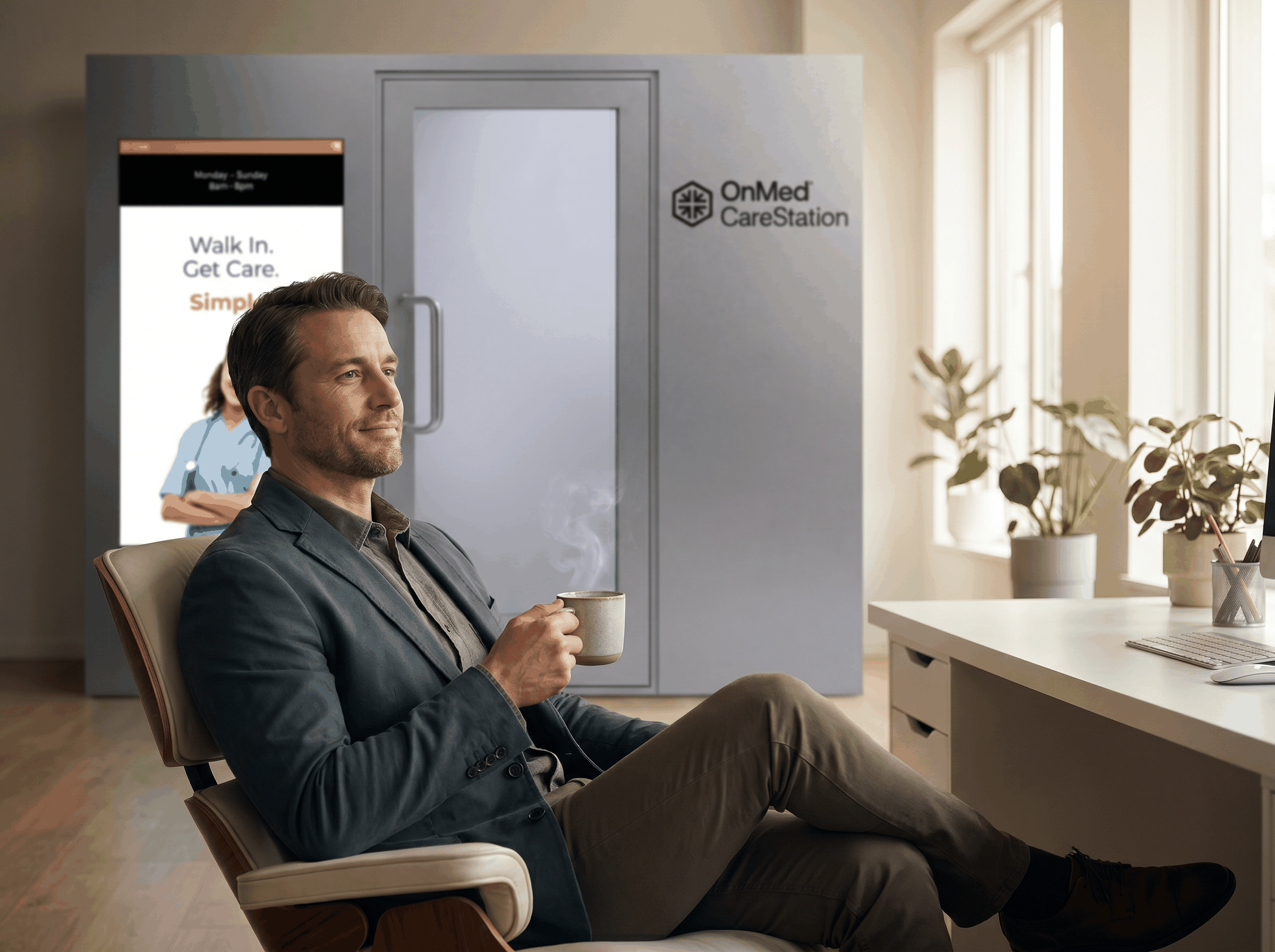
This is the problem the OnMed CareStation® was built to solve: a patented, 8×10 foot "Clinic-in-a-Box" that brings comprehensive, immediate care directly to the worksite. It's a tech-enabled, AI-powered, and always human-delivered platform that blends the depth of in-person care with the deployment speed and scalability of telemedicine.
It requires only an electrical outlet—no construction, no new real estate, no clinical staff to hire—and is operational within 45 days of signing. Employees connect with a licensed clinician in real time, supported by integrated diagnostic tools: a digital stethoscope, HD and thermal imaging, pulse oximetry, and blood pressure monitoring. A visit takes about 20 minutes, start to finish.
The question is not just how much employers spend on healthcare. It is what that investment delivers when employees need care. Coverage, wellness programs, and specialized benefits lose value when getting help means missing a shift, waiting weeks, or navigating disconnected services. Addressing those barriers puts the focus where it belongs: helping employees get timely care and making the benefits employers already fund work better together.
Start with the friction employees face today. Find out where they go for routine care, how much time it takes, and what causes them to put off a visit. Then target those barriers and measure what changes: time away from work, use of existing benefits, avoidable visits to higher-cost settings, and claims trends. More visits alone are not the goal. Better access needs to translate into better use of care and demonstrable value for the workforce.
A lower healthcare budget is not a win if the cost returns as delayed treatment, lost productivity, or larger claims. The stronger strategy is to remove the barriers that make care harder to get—and everyday health needs more expensive to address.
Ready to see what closing the access gap could mean for your renewal? Contact OnMed to see how the CareStation can reduce claims, restore productivity, and improve the employee experience, or explore the Employer Guide to On-Site Healthcare for the full breakdown.
The CareStation is an 8x10 foot "Clinic-in-a-Box" that brings everyday primary and urgent care to your workforce. Employees walk in and a live, licensed clinician uses clinic-grade diagnostic tools to provide a diagnosis, treatment plan, or e-prescription. No need for any staffing or new construction is needed.
Limited access to healthcare can increase employer healthcare costs by delaying care until conditions become more serious and expensive to treat. Employer healthcare spending has increased more than 50% over the last decade, while poor employee health costs U.S. employers an estimated $575 billion annually in lost productivity. The OnMed CareStation® helps expand access to primary and urgent care, enabling earlier intervention, chronic condition management, reduced absenteeism, and fewer avoidable emergency room visits. Learn more: Download The Complete Employer Guide to On-Site Healthcare.
No. Cost containment targets the upstream drivers of spend, like delayed care and avoidable ED use, rather than reducing plan coverage or shifting more cost to employees.
Yes. The OnMed CareStation® provides workplace access to primary and urgent care without the need for on-site clinical staffing or new construction. Unlike traditional on-site clinics, the CareStation is an 8x10-foot "Clinic-in-a-Box" that can be deployed in as little as 45 days and brings licensed clinicians and integrated diagnostic tools directly to the workplace. Download The Complete Employer Guide to On-Site Healthcare to compare your options.
Across OnMed employer deployments, 86% of conditions are resolved on-site, 58% of patients would have otherwise sought care in an emergency room or urgent care setting, and more than two hours of productivity are returned per visit. Employer deployments have also demonstrated 2-3x higher wellness engagement and more than $1,300 saved per employee patient. Patient satisfaction averages 4.96 out of 5, and 99% of patients would recommend the CareStation.
The Georgia State Health Benefit Plan (SHBP) case study reports separate program-specific outcomes. Download the Georgia SHBP case study.
Follow along as we continue to redefine the healthcare landscape and bring the OnMed CareStation to communities across the U.S.